
Current News
Archived Posts from this Category
March 24, 2009
Abi Turns Twelve (months, of course!)
Posted by Steve and Pam Wise under Current NewsLeave a Comment
March 20, 2009

This is a road sign just a few miles down the road on the way to Lincoln. It is the name of a town, not directions for use of local amenities, although the ‘please drive carefully’ works in either case, don’t you think? A little further along the road you get to Ownby by Spital, and then Normanby by Spital.
If that tickles you funny bone, as it does mine every time I pass by, beyond Lincoln on the road to London is the town of Lower Bottom. I understand that there is also a Middle Bottom and a Little Bottom close by. Cheek by jowl, as it were.
Last night on the ‘telly’ there was a news item of a local fair featuring a four mile horse race that has been run every year since 1519. At the same festival there was a cheese rolling contest, where teams take one metre diameter rounds of cheese and roll them down a hill. In order to keep them going the teams roll down the hill beside the cheese, and here was the newscaster doing a straight up account of the contest as all these cheeses and all the contestants tumbled over one another in a chaotic fall down a very steep hill. It was hilarious!
It is this combination of the very historic and the very silly – the sublime and the ridiculous, if you will – that gives England its charm: the pomp and circumstance of the longest monarchial dynasty on the planet, as well as the home of Peter Sellers, Monty Python and Mr. Bean.
March 19, 2009

Mom doesn’t get out much anymore. Travel is a problem when you are ninety, even in a country that takes care of its elderly the way Britain does. So Mom had never seen the latest edition to her growing family, Jack Chappell, the first-born son of my nephew Colin and Verity Chappell, until yesterday.
Verity was kind enough to bring both Jack and my sister Rosey into Lincoln and we arranged to meet at an inn on the outskirts of town, not far from the cathedral area where Mom and Dad used to live. It was a happy occasion for all, but especially for Mom, who was charmed by Jack’s sunny disposition. Afterwards I took Mom out for her favourite meal: pancakes with Canadian maple syrup and ice cream!
March 17, 2009
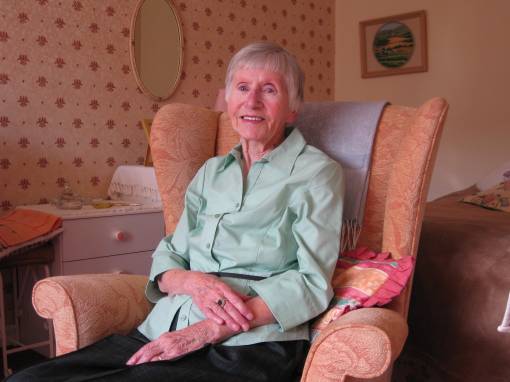
I am in England while Pam is still back in Malaysia. The reason for my visit is my mother’s birthday. She is turning 90! Doesn’t look it, does she?
Mom is part of what has come to be called “the heroic generation”: those who fought Hitler in the last great war; many of whom died in places they had scarcely heard of before the war started. My father fought in Africa and India, running the motor pool at Cheringa in what is now Bangladesh, which was the airbase closest to the front line against the Japanese in Burma. While we were in Bangladesh ourselves I visited the cemetary where over half his regiment were buried in that conflict.
Needless to say Mom and Dad survived that war, Mom going through the Blitz in London and manning radar stations in the south. Married during the war, they were reunited after a separation of five years and began a family. I am the youngest of their three surviving children that emigrated to Canada in the mid-fifties to escape the privations of post-war England. With nothing more than courage and hope they began anew in Canada and built a life that saw all three of their children to a post secondary education that a devastating war had stolen from them. They retired back to England, and Dad passed away while we were in Germany in the mid-nineties.
All three of their children married and had children, giving them seven grandchildren. Three of those grandchildren are now married, giving them five great grandchildren. That’s fifteen people on this planet that owe their life and their heritage to this truly heroic couple. Only one of them remains, and at ninety Great Grandma Wise is still as sharp as she ever was, with all her faculties and memories intact. It has been a real delight to visit with her again.
March 10, 2009
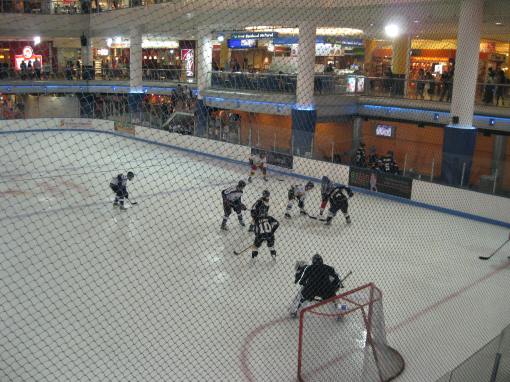
Going to the mall is very definitely a national pastime here and the malls are amazing. Malls are open 365 days a year and are air conditioned, what’s not to like? Our local mall includes a Lagoon Waterpark and two other theme parks as well as an ice rink. There is even a local hockey league and several of the staff are key players. As you can see by the picture, there is even a Wendy’s close at hand but sadly, no Tim Horton’s.
My birthday happened to coincide with a play-off game between two teams, each of which has one of our colleagues on the roster. The group went out for supper at Tony Roma’s and then cheered for our favourite team. Being teachers, of course we were assigned a team to cheer for and given banners to wave and there was much singing and cheering. I am sure no one in that mall had ever heard the theme from Hockey Night in Canada before and I am reasonably sure that they just thought we were all out of our minds.
Farshad and Les even treated the crowd to a post game, jersey removing “fight”. It was good fun, with a great group of staff and hopefully Steve’s throat will heal before he goes to England this weekend.
March 8, 2009
Beware of Public Opinion in Science – Two
Posted by Steve and Pam Wise under Current NewsLeave a Comment

Our sun is a typical star, right? Nope, you couldn’t be more wrong, but your opinion is entirely understandable, since that is how it is often portrayed. In fact our sun is more massive than 95% of all stars. Stars without our sun’s mass are incapable of holding habitable planets in orbit, immediately eliminating them from contention for the possibility of sentient life.
So what about the 5% of stars that have our sun’s mass, or greater? Surely they could hold planets? True, and in fact a number of planets have been detected around stars more massive than our own. But their size is their nemesis. More massive stars are hotter and radiate substantially more ultraviolet light than our sun. Ultraviolet light breaks the bonds of biological molecules and UV light is itself disastrous for the formation of an atmosphere. Our sun emits less than 10% of its energy as UV light, making our sun very rare indeed.
But it is not only our sun’s mass and the nature of the radiation that it emits rare, but so too is its stability. Unlike many stars, our sun has singularity. Many stars are binary, and the nearest ‘one’ to us, Alpha Centauri, is in fact three stars in close proximity, making life impossible. Nor is our sun variable, as most stars are, emitting a change in the amount of radiation produced over time. Our sun is remarkably dull in this department, with almost a negligible variation in radiation emitted. Apparently this radiation is not only stable, it has been consistently so for a remarkably long period of time, perhaps as much as 5 billion years and will remain so long into the future, as much as another 5 billion by some estimates. These factors: distance from the cataclysmic center of the galaxy, high mass, consistent radiation, low incidence of UV radiation, singularity and longevity make our sun almost unique in the galaxy.
Speculating about life around other suns is fun, and I love a good science fiction story as much (and probably more) than most. I will see the new Star Trek movie as soon as it hits the screens in KL. Aside from driving movies and science fiction novels, keeping the notion of extra-terrestial life alive is also a good funding strategy for NASA and other science agencies that depend on public acceptance for their financing. But beware of public opinion on this subject. It can be manipulated for purposes that serve the needs of the few, at the expense of the understanding of many. The Earth is rare, and perhaps unique.
March 6, 2009
“March 6, 2007
Heading to Malaysia
Posted by Steve and Pam Wise under Current News
[20] Comments
Okay. Pam and I are new at this, and hosting a blog is going to take some getting used to. But we do want to stay in touch, and we are not too old to learn. So bear with us and forgive our mistakes as we attempt to navigate our way around this new domain.”
________________________________________________________________________________
It has now been two years since we started this adventure in blogging and it has been great. We have often been frustrated with our total lack of knowledge of computers and the terminology involved in this world but we have learned many things. We are very grateful to our son, Jon who has been a huge source of information and encouragement and has bailed us out more than once.
Thanks to our blog stats we know we have 213 posts on our site and we have had close to 23,000 hits: 378 on our busiest day. Sadly, we have had only 388 comments so please, if you drop by, say Hi. Don’t worry, your comments will not go directly to the site as all comments must be approved, and can be edited, by us before they are posted.
At this point it is a real joy to have this web journal to keep as a record of all we have experienced in these past two years. I must admit though that we still do not fully trust computers yet, so now want to figure out how to print it in hard copy.
March 5, 2009
Beware of Public Opinion in Science – One
Posted by Steve and Pam Wise under Current NewsLeave a Comment

I have always held that the view that anything slavishly followed by too many people must, of necessity, be wrong. When I was younger I had my hair long. But when long hair become a badge of social acceptance among my peers, I cut it off, then cheerfully confronted the reverse discrimination that followed. When Time magazine famously declared ‘God is Dead’ and millions lined up in rows behind that banner, I figured it was high time I began investigating the truths of the Bible for myself.
Global warming has been much in the news the last twenty years or so. My understanding of that phenomenon has been much enlightened by Rare Earth, a book written in 2000 by Peter Ward and Donald Brownlee. Rare Earth disputes the notion of Coperinican Mediocrity that was the darling of the late Carl Sagan, among others. According to this notion, the earth is an insignificant peice of dirt among the vastness of the universe, with nothing unusual to its credit.
According to Sagan, and his associate Frank Drake, there are as many as a million civilizations out there in our Milky Way Galaxy alone, and many hundereds of millions more on far distant stars. Considering the recent revision of the number of stars in our galaxy, and the number of galaxies in the universe, the number of civilizations out there must be truly mind-boggling. Certainly plenty of species to populate an infinite number of Star Trek reruns.
Since this is now the popularly held view of space, I naturally think it is bunk, and I cheerfully encourage you to do the same. You could no better than to begin your study with Rare Earth, a highly readable book on the orgins of the earth, whose countervailing conclusion is that the earth is so unique, so rare, that perhaps we really are alone in the universe. Their study and its stunning conclusions are part of the growing awareness of what is called the Anthromoporphic Principle: that so many things in the universe – from the mass of protons, to the position of the earth – are so carefully calibrated that even the most minute deviation would have made existence impossible.
Ward and Brownlee discuss about ten of these in good detail, and allude more briefly to a dozen others. Along the way they deal with some naive notions of eath’s importance, such as the fact that if we were really important we would be at the center of the galaxy, not two-thirds of the way out in some ‘remote’ region of the Milky Way. We are in fact in the optimal position: any closer and life would have been sterilized by the DNA destroying gamma rays emanating from the center of our galaxy; any further out from the center and the abundance of elements heavier than helium – elements necessary for planetary formation – rapidly declines.
In a similar way we are in the exact center of the CMZ, the continuously habitable zone, that is present around our (see the next post) remarkable stable sun, a position not enjoyed by our closest, and lifeless neighbours, Mars and Venus.
But clearly location isn’t everything (even in real estate) since the moon shares our exact location from the sun on average, and is itself lifeless. That is also explored by Ward and Brownlee, who point to the creation of atmosphere by the restless mantle of our earth, a mantle that is itself unique. To say that the earth itself is a living organism is not too much of a stretch once you properly understand its relationship with the organisms it supports. I’ll have more on these thoughts later, including the much ballyhoo’d global warming. Stay tuned.
March 3, 2009

We are incredibly grateful for the technology that keeps us connected to our family and friends!
Our web visits with Jon and Nic and the kids allow us to hear their little voices, watch them try to interact with us and see how happy they are to have each other in their little lives. Ben seems to know who we are as he gets very excited as soon as he sees us and immediately begins blowing kisses. Abi, of course doesn’t know yet what is going on but it is such a joy just to watch her grow up.
We are starting to long for June and the chance to hold them again.
February 20, 2009
 “Trans World Radio (TWR) is the most far-reaching Christian radio network in the world. Programs in over 225 languages and dialects are aired from more than 2,000 outlets, including 14 international broadcasting locations, as well as local AM, shortwave, long wave and FM radio stations, direct-to-listener satellite broadcasts, cable audio systems and the Internet. Every day, TWR’s broadcasts reach millions in over 160 countries.” see www.twr.org
It was fifty five years ago this month that Dr Paul Freed began broadcasting Christian radio from Morroco using an army surplus transmitter. In 1960, TWR Monte Carlo began shortwave transmssions into Europe, the Middle East and Russia from a facility that was originally built by Hitler to broadcast Nazi propaganda. Just four years later, from the island of Bonaire the message went out ot South America, Central America and the Caribbean. By 1974, the Middle East and North Africa was being reached from sites in Central Asia and Swaziland.
With the beginning of shortwave transmissions, in 1977, from the island of Guam which could reach China, Southeast Asia and the eastern Soviet Union, TWR had the potential to reach half of the world’s population. Growth continued with new transmissions reaching approximately 11 million people in South America and via shortwave programs from Siberia in 13 languages spoken in North India, Bhutan, Nepal and Tibet. In 1996 broadcasts began from Central Asia to 60 of the world’s least evangelized groups in Central Asiaand the Middle East. The goal of 200 languages and dialects into 160 countries was reached in 2005 but growth continues with the latest being broadcasts form Benin into West Africa.
We have prayerfully followed and supported the ministry of TWR since our Pastor, mentor and friend Dr Carl Seyffert, became the Canadian Director of TWR and invited us to join him as lay representatives in 1983. It is a real joy and privilege to be here in Asia and to have even a small part in this work.

