trans_world_radio“Trans World Radio (TWR) is the most far-reaching Christian radio network in the world. Programs in over 225 languages and dialects are aired from more than 2,000 outlets, including 14 international broadcasting locations, as well as local AM, shortwave, long wave and FM radio stations, direct-to-listener satellite broadcasts, cable audio systems and the Internet. Every day, TWR’s broadcasts reach millions in over 160 countries.”  see www.twr.org

It was fifty five years ago this month that Dr Paul Freed began broadcasting Christian radio from Morroco using an army surplus transmitter.  In 1960, TWR Monte Carlo began shortwave transmssions into Europe, the Middle East and Russia from a facility that was originally built by Hitler to broadcast Nazi propaganda.  Just four years later, from the island of Bonaire the message went out ot South America, Central America and the Caribbean.  By 1974, the Middle East and North Africa was being reached from sites in Central Asia and Swaziland. 

With the beginning of shortwave transmissions, in 1977, from the island of Guam which could reach China, Southeast Asia and the eastern Soviet Union, TWR had the potential to reach half of the world’s population. Growth continued with new transmissions reaching  approximately 11 million people in South America and via  shortwave programs from Siberia in 13 languages spoken in North India, Bhutan, Nepal and Tibet.  In 1996 broadcasts began from Central Asia to 60 of the world’s least evangelized groups in Central Asiaand the Middle East.  The goal  of 200 languages and dialects into 160 countries was reached in 2005 but growth continues with the latest being broadcasts form Benin into West Africa.

We have prayerfully followed and supported the ministry of TWR since our Pastor, mentor and friend Dr Carl Seyffert, became the Canadian Director of TWR and invited us to join him as lay representatives in 1983.  It is a real joy and privilege to be here in Asia and to have even a small part in this work.

During my trips to various countries I am seeking to learn the reality for women so that broadcasts can be written in a manner that is relevant to their spiritual, cultural and social reality, and be presented in a way that they can understand and apply to their lives.

086

One of the real joys, for me is to meet people who have a burden for the women and are willing to pay the price to help them. About a year ago, I was in Thailand and met a lady who has become a friend that I greatly admire.

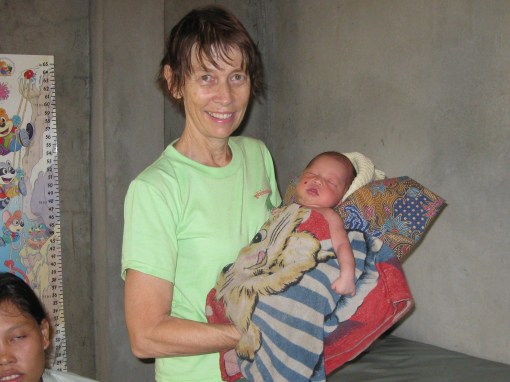
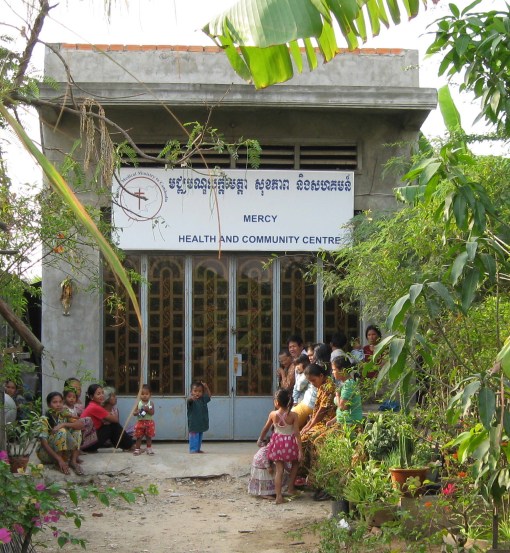
Five years ago, Sandy “retired” from her position as a Nurse Practitioner/Midwife in Australia and was commissioned by her home church to work in Cambodia. The Lord led her to a group of people who live in a garbage dump on the edge of the city and make a living by picking through the garbage. This is now a village community, with a very strong church and she has a three room, clinic building. As we did on this recent trip, I try to arrange my time  in Cambodia, so that I am able to work in her clinic and I love it.


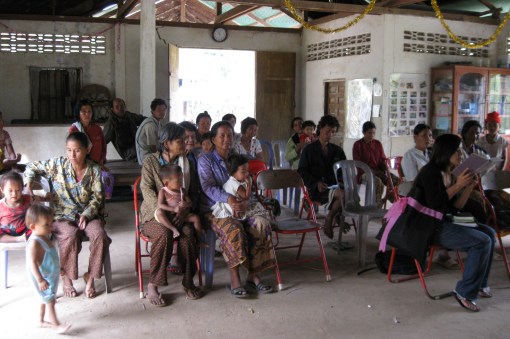
 When we arrived at the clinic people were already waiting and the morning moved very quickly. There are three full time Khmer workers and a Pastor who teach health care or spiritual lessons while individuals wait to be seen. They are also available throughout the week to provide in home follow-up and training. We took a quick look to see if there is anyone who needed to be seen urgently and then handed out numbers to the rest, in an effort to maintain some sort of order.

0792 0841

We had only one interpreter, but with Sandy’s “medical” Khmer, we could keep two clients active at a time. We saw around 48 patients in rapid succession and then sat back to regroup. Suddenly it dawned on me that what we had just seen was pretty much what you would see in a walk-in clinic in Ontario. Sniffles, joint pains, complaints of upset tummies and tiredness, mom’s with newborns, young women needing birth control injections, urinary tract and yeast infections, older folks with high blood pressure and some ongoing follow-up on injuries sustained accidently.

Through the vision of one women, backed by her home church, these people are healthy, clean, and know the joy that only God can give. Everyone there has a water filter and understands the need to use it, they know how to care for their children and their  families and are learning to advocate for their own rights. I did a dressing change on a man’s foot that had been run over by a truck and was kind of dreading what I might find when the bandage can off. It was certainly still open, right down to the muscle, but was totally clean with no sign of infection. 

I found it oddly reassuring that the chief concern of  several young moms was why  their babies sweat when they sleep.  I used to wonder about that myself and my son had recently done a blog commenting on how Ben sweats when he sleeps.

Somehow, in the worst of circumstances they were so happy and proud of the changes in their lives. Moms everywhere  want to do the best for their babies.

steve-marking

I love teaching. There is absolutely nothing in the world I would rather do. I love to learn and dig up new and interesting facts I can use to enrich my lessons. I love to learn new technologies and incorporate them into my lessons. I love the interchange of ideas among my colleagues from different disciplines. I love the interaction with the kids I teach and joy I get from seeing them grasp new concepts that will help them in their futures. I even love the rhythm of my job, the pressure of exams, the pleasure of the holidays. I love everything about my job. Except the marking.

I hate marking. It is boring and repetitive. I find it really hard to keep my mind on task, and I need the constant stimulus of caffeine and music to keep my mind awake. I think, “I have already taught this concept a dozen times, and they still don’t get it.” I think of all the other things I would rather be doing. I think of all the jobs that don’t require marking, or wasting entire weekends on essentially unpaid labour. There isn’t a single thing about marking that I like. Except that it is an essential part of teaching (see paragraph one).

What really galls, however, is the inequality between my marking load, and that of other disciplines. I was chatting to a business teacher who showed me a test generating program for business. He clicks a few categories – chapters and concepts covered, number of questions desired – and hits a button. The multiple choice test instantly appears on his screen. He hits print, and his test is written. He will photocopy it and give it to his students along with a form that the students use to select their choice of answer. He will turn in those forms to an exam office that will scan the form and give him a print out of student marks. His time on task? About two minutes.

I on the other hand will take two hours to write a test that is tailored to what I taught in English, and then spend about twenty to thirty hours marking it. (Oh, did I mention that he gets a four thousand dollar bonus for teaching an “essential” subject?) However, I still love teaching. I just hate marking. In fact I am writing this post just to avoid getting back to it. Guess my time is up.

Christmas was tough. Miles from home, family and friends, Christmas Day can be a lonely time. But that is the exception, rather than the rule. More and more we think of our little apartment in Subang Jaya as home, and we are happy here.

For Pam it is the first time in her life that she has been able to do what she has long wanted to do: to serve the Lord in a missionary capacity. Much of her life has been spent in working to support our family and make a living. It great to see her joy in living this new kind of life.

For me, I get to do what I have long wanted to do: teach high school English. It was what I set out to do at the start of my career, and again got sidetracked. To be doing this in Asia is just the icing on the cake.

Neither of us have ever shirked our duty to provide for our children with enough left over the meet the needs of the less fortunate, and this is a sweet reward for our patience and perseverence. It is a very satisfying place to be in our lives and in our relationship, and we are hoping that it may last for a few more years. We still have something that we want to do for Him, and we want it to count.

Please forgive me if you are already tired of this subject. But I just received a comment from a friend of mine from an old post that does not deserve to be buried in the comment archives of last November. Gary is a well read and articulate thinker and his response deserves a post on this site. I do not agree with every thing he says, but as Voltaire famously said: “I will defend to the death his right to say it.” I consider myself fortunate to work in such an intellectually stimulating environment, I learn something new everyday. Here is Gary’s (unedited) comment:

I have just been made aware of this site and as I am a colleague of Steve’s on the other side of the debate I would like to enter in.

First, let me state that I have no firm conviction on the existence of a Creator, although I lean to atheism. There are questions which cannot be currently answered by science. Some cannot be answered because we have not had the time, or the resources or the theoretical understanding to deal with them or even to formulate them. Most of these will with time and effort yield, but the existence of a Creator is unlikely to, so we should be each free to come to our own conclusions: but certainly you cannot use science at this time to justify an answer either way.

Behe’s ideas fall into the realm of the miraculous (and I did read the book, Steve, when you lent it to me) although he is knowledgable enough in the science. His ideas are miraculous simply because they indicate that there are complex entities which cannot be explained in terms of simpler ones. The philosophy of science is that all problems are in principle explicable with time and effort, including biochemical ones. Thus a scientist is not likely to like Behe’s approach for philosophical reasons: it would close off so many avenues of research. That, of course, would not matter if Behe were right and some processes are irreducibly complex. But it is actually fairly simple to find explanations on the internet for the processes he sites. I give you here the website of Kenneth Miller (I am sure you will recognize the name, but you shouldn’t be deterred by him being a strong opponent of ID – he is after all a strong Catholic Christian as well). His explanation for a possible evolutionary development of the Clotting Cascade (which you like to cite) is clear and comprehensible: http://www.millerandlevine.com/km/evol/DI/clot/Clotting.html

Keep in mind that to refute the idea irreducible complexity all that is logically needed is a feasible pathway based in current knowledge of biochemistry and genetics: the exact pathway will never be known.

As to probabilities, the calculations as presented are not correct or applicable. The most unlikely event in the whole process is the original synthesis of a self-replicating molecule from precursors. However, in a large “soup” of small molecules, given the chemical bonding rules as we know them and chemical energetics sooner or later a molecule would be built – it wouldn’t require all the small molecules coming together simultaneously which would be improbable to the point of impossibility: rather, if the first “living” molecule required 26 precursors, call them A to Z for convenience, they might first link chemically in pairs, AB, CD, EF and so on and then in pairs again. None of these steps would be prohibitively improbable especially given the times involved. From there variation and differential reproduction take hold: this process never requires multiple elements to come together simultaneously – an existing gene, for that is what the living molecules are, is modified and acts as a template for some new protein. Evolution does not build each new protein or enzyme from the beginning, from 0, but adapts existing models, which is why the probability calculation often quoted is wrong (I know you like Hoyle who it seems introduced this calculation: a brilliant physicist but not so hot in biology). The only point in this process which is random or at least unpredictable is variation in an existing gene or chromosome, by reshuffling of component parts, or duplication of a gene, or mutation and these occur so frequently that cells have evolved sophisticated repair mechanisms

Jon Wise brings makes a point that scientists are desperate. I don’t think so, although science is under attack particularly in America, by more literalist Christians who would censor science where it disagrees with their beliefs. But scientists are interested in the question of origins, naturally, and would like naturalistic explanations. At this point there are several possible explanations for the nature of our universe, that is the setting of certain constants at values that are necessary for life, often referred to as the Anthropic Principle. Possibly these were set this way be God, possibly it is mere chance – the values could have been anything, but at the time of the Big Bang, they settled at just the right values, perhaps the universe is a multiverse, with possibly an infinite number of universes each subtly different, perhaps the universe will go through a potentially infinite number of cycles of Bang and Crunch, with each new cycle having a new, random set of values and we are of course living in one of the cycles in which it is possible for us to live, perhaps, as Lee Smolen of the Perimeter Institute, suggests, black holes within our universe act as progenitors for new universes each with subtly different characteristics. All scientists know that these ideas are not science, they are interesting speculation: no serious scientist would ever say “This is how it was or is” because there is no data. There is no real evidence for any of these hypotheses and likely never will be. Thus origins, the nature of God lie beyond us, and reason and science cannot help us without fact to work on.

My own feeling is somewhat like Jon’s. Science is a means of exploring the nature of God, however one conceives it. If there is a God, then all of Creation is a book for us to read; if not, we should continue to learn in any case.

Personally, I find evolution and quantum mechanics (especially) far more elegant than a set-piece creation. If God made it all in a particular way, and knows all, how boring that must be and pointless, since all the outcomes would already be known. On the other hand, in QM, uncertainty rules, the outcome of any interaction is fundamentally unpredicable, based on current knowledge, let alone all of them. How much more interesting it would be for God to look with curiousity and amazement at the handiwork as it developed.

langkawi-0151

Situated just 30 kms off the coast of northwest Malaysia, between the Andaman Sea and the Strait of Malacca, Langkawi consists of 104 islands most of which are uninhabited. The main island is peaceful and relaxed and nowhere near as crowded as similar places in Thailand.

The shores of the islands are fringed by wide beaches of white, fine grained sand and are perfect for strolling, swimming or lapping up the sun.  Although this is the high season for tourism, the island was very quiet and the beaches almost deserted.

langkawi-0051langkawi-009

Although we had just a three day weekend, it was beautiful and wonderfully refreshing.  We would however, caution you that if you every get to Langkawi, you do not want to stay at the Langkasuka Beach Resort.  It is definitely not as advertised on the internet! A lovely resort at one time, it has badly suffered from the all too common malaise: a lack of maintenance. But we rented a car and scoped out some great looking places for a return visit to this beautiful island.

Lmahendi-and-sangeet-024 

Last night I had a neat opportunity to attend the Mehendi and Sangeet Party for my friend Evangeline’s son and his fiancee, Dr Niruben and Dr Monica.  The Indian people love family, colour, music, dance and food so it was a warm, happy event with wonderful food.  Apparently it is usually only for women but this included the men as well and was held at the home of the bride’s parents.

According to wikipedia: “A Sangeet or Ladies Sangeet is an event in a Hindu or Sikh wedding. This event takes place 2 or 3 days before a wedding in a Banquet Hall or if a small affair, then at home. Ladies are the only people to take part in the event. Some men are there if they are close to the bride or groom. During this event ladies will sing traditional Indian songs, and joke around with guests. This event is also like a dinner and dance, because there is a lot of dancing and lots of food!

mahendi-and-sangeet-043

Courtesy of the InternetMehndi is the art of applying Henna on the body. It is a beautiful form of temporary body decoration. Mehndi is a traditional form of decoration for both men and women in countries such as India, Morocco, and Pakistan. It is generally used for special occasions, particularly weddings.”

 mahendi-and-sangeet-0811

The ladies wore beautiful, brightly coloured outfits and everybody loves to dance.  Even the little tiny girls already knew the moves.

Two of our three ‘children’ are in Calgary, and the picture out there is not pretty. The Economist reports:

Extracting oil from the sands took off in the late 1990s, boosted by technological advances that greatly reduced costs. Sitting on the equivalent of 173 billion barrels of crude, the provincial government dreamed of making Alberta a new Saudi Arabia (with moose instead of camels). Although some, such as Peter Lougheed, a former premier, called for “orderly” development, a wild rush ensued, causing provincewide labour shortages. Even servers at fast-food restaurants had to be lured with an iPod or other inducements. Now, though, employment is slumping: Steve Vetter, a manager at a firm that services the gas industry, says it recently had 50 applicants for one job; two years ago it would have been lucky to get any.

Extracting oil from tar sands causes more carbon emissions than traditional drilling. At some projects, leaks of toxic material have polluted waterways. So even if the credit crunch eases and the oil price steadies, Canada’s tar sands may face tougher scrutiny from their main customer. The United States has hitherto been an enthusiastic buyer but the incoming Obama administration, packed with environmentalist hawks, may prove much less so, especially as the Democrats also control Congress. Henry Waxman, a Californian green crusader, has become chairman of the House energy committee. He wrote part of an energy bill passed in 2007 that seemed to ban American government agencies from buying oil produced from the tar sands.

It will be a further damper on investment in Alberta if the Obama administration enforces the ban. Canada’s prime minister, Stephen Harper, who will meet Mr Obama soon after his inauguration, said this week that the tar sands would be one of the stickier subjects on their agenda.

On top of the oil bust, Canada’s other commodity exports, such as lumber, are also suffering collapsing demand. After years of good growth, the economy will shrink this year. Mr Harper says it will take up to five years of “big, comprehensive” government stimulus to dig it out of the deep, black hole it is in.

We recognize that all things are in the Lord’s hands. But the Lord doesn’t promise that we will escape unscathed from the problems that beset our world. Our prayer is that Dave and Liz will be able to hold on the jobs that they have – as difficult a task as that might be – through the hard times that we all see coming.

For the complete article on Calgary’s bust see:

http://www.economist.com/displayStory.cfm?story_id=12932252

I will never grow tired of the opportunity to visit in villages and meet the women who are regular listeners of  “Women Of Hope”.  Their faces radiate the joy of their hearts.

In the west, our contentment is so often dependent on having what makes us comfortable, our courage is dependent on our perception of our own strength and ability and our confidence lies in our own plans.  We are so blessed and have been given so much that few of us really understand what it is to be in want and to struggle amid unending pain and poverty to just survive.

049

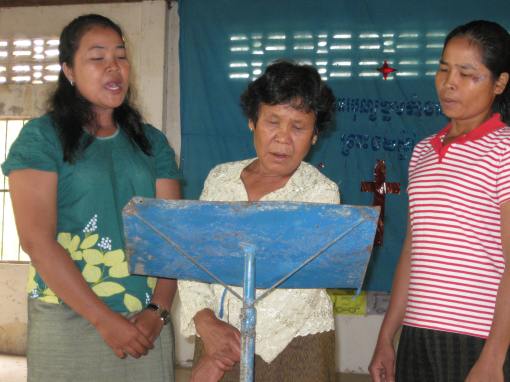
When I listen to the stories of women who have nothing and yet are filled with hope and peace, I am constantly amazed.  In a very poor village, 30 ladies have formed a listener group around the broadcast. Led by a very vibrant young lady along with her mother and sister, they love to sing and learn together.  As it was a work day morning, many were out in the fields so I didn’t get to meet all of them, mainly the older ladies and the mothers of young children.  It was very evident that the best way to improve the life of a child is to reach the mothers.

0501

We have this hope as an anchor for the soul, firm and secure.

Heb 6:19

Here in Asia, Chinese New Year is a  very important event for the Chinese. And since the Chinese either own or operate every business in the East, it is an important holiday for everyone. Everything shuts down for three days, so we get a week off and most of the staff go traveling.

We went traveling too, to Phnom Penh, but not to see the sights. We went for a week of ministry in the midst of our ministry, and it was a surprisingly nice way to spend the week. Pam had a series of meetings to attempt to patch together a co-ordinated strategy for health care evangelism, including a morning at a health clinic in the town’s garbage dump. Pam will blog about her work tomorrow, but let me just take a minute to talk about mine.

ctc-students1

I was asked to give a series of ten lessons on Eastern religions. So I did my research and came prepared with documents. What I was not prepared for was the audience. These are kids, and at 18 to 20 years of age barely more that that, who are hungry to learn. I taught through a translator, as their English is pretty limited, and they hung on every word, wrote down every reference, absorbed every concept. It was an awesome and humbling teaching experience.

seang-heak-translator ctc-classroom1

It was more than that for them, as they have all come out of the slavery of Buddhism and their new faith is the first time they have tasted hope and freedom. They are desperate to understand how they can help their families to grapple with the chains that have bound them for a thousand years. They are the first fruits of a new life, and it was sweet to be in their presence.

I know many of you will not think it is very politically correct to speak of another religion in such terms. A shallow look leads one to the conclusion that all religions are the same, just a shallow look at the solar system leads one to think that all planets may hold intelligent life. A deeper look leads to the understanding that life on earth is unique. A deeper look at the world’s religions will lead to a similar understanding of the uniqueness of eternal life.

We have absolutely no idea of how fortunate we are in North America, of the emotional and intellectual freedom that we take for granted. We think it is the product of good fortune or rugged individualism. That is just our vanity talking. Our culture is the gracious gift of one Man. It was a privilege watching Him at work in the lives of these young people, and to be a part of giving them an understanding of how to share that hope with others.

For those who would like to take a deeper look at how the central doctrines of religion – the nature of God, the problem of evil, salvation, and so on – are understood by all religions, have a look at Ernest Valea’s excellent site www.comparativereligion.com