Live Long and Prosper

There are a lot of you out there who like to think that you are original trekkers. Not so. You had to have been a Palladin fan first. You had to have grown up with a lot of corny westerns like The Lone Ranger and Gunsmoke so that when Have Gun, Will Travel came along you recognized it for what it was: a morality tale wrapped in the guise of a western that featured tight dialogue and well-crafted scripts. You had to have been disappointed when Palladin’s lead actor Richard Boone’s next project – a repetoire company doing a series of television plays – was rejected in favour of Hawaii Five-O.  You would have to have recognized the divine providence involved in Boone’s best writer, Gene Roddenberry, leaving to do a morality tale wrapped in a space epic instead. That is how Star Trek was born, and I have been a fan from the beginning; watching every show, and delighting in the interplay of personalities and the subtleties of social criticism that it offered.

But here’s news: I never liked Kirk. He was a self-important pompous ass, as was (and is) William Shatner. I liked Spock: his cool reserve, his ascerbic wit. I liked his insight into the human condition. I liked the fact that Leonard Nimoy didn’t like Spock, and tried to distance himself from his alter ego (famously declaring “I am not Spock!”). I liked it that Nimoy refused to get involved in the excesses that Star Trek later indulged in, such as Star Trek: Generations, which managed in one show to make a travesty out of all the iconic material that Star Trek fans had spent a generation (there’s an irony worthy of a Vulcan) investing in the show.

Of this new show Nimoy says “These people, the makers of this film, awakened in me the passion I had when me made the original film and series. [Star Trek] went off in a direction that I didn’t relate to very well, that’s the simplest way to put it. I was put back in touch with what I cared about, what I liked about Star Trek.”  Me too. What  all the spin offs of this series failed to realize, and what Abrams recaptures, is the chemistry in the original characters. They are in fact living out Richard Boone’s original concept: a repetoire company of well-loved characters playing out a series of original scripts, comfortably the same, and endlessly new.

The show is great, and if you haven’t seen it I highly recommend it. It is the best in the series since The Undiscovered Country, and I don’t mind that Abrams has allowed the characters to morph slightly and develop elements that were not there in the original series, any more than I mind different interpretations of Lear or Willy Loman. However, I must admit I blanched a little when the elder Spock – who  incidentally brings the same unspoken gravitas to the film as he did throughout the series – wishes his younger incarnation “Good Luck.” Ouch! Is it too late to reshoot that scene?


Scan10077

008

You have come a long way in those 60 years and it has been such a joy and privilege to spend more than half of them with you. 

Thank you for the joy that we shared on our wedding day as we began this journey together.  Raising our three amazing children was absolutely delightful, and at times totally frightening, but we did it together and always had God to lead us. We rebuilt cars and renovated old houses and ventured to far away places and I have loved our life together. 

In so many ways, it feels like now is the opportunity to reap the benefit of many years of hard work and commitment to each other even through some difficult times.  I am so happy to be here in Malaysia with you, seeing the impact that you continue to have on the lives of the students that you teach.  Never one to take the easy way out, you are still using the gifts that God has blessed you with, to the fullest and I honour you for that.  I love you and look forward to seeing where God will take us in the adolescence of our old age.

Marli Spieker

I was reading Marli Spieker’s testimony this past week and was captured by these words:


“ God is able to bring Beauty out of ashes and hope out of despair. If He can use a simple mother and grandmother from South Brazil to go around the world in His name and for His sake, he certainly has a plan for you today. He wants to open your horizons and take you out of your comfort zone so that you will stand in the gap.”

http://www.godswordtowomen.org/spieker.htm


Marli Spieker grew up in Brazil where as a teenager she began working in slums, brothels and bars offering hope, feeding, bathing, loving and telling about the love of Jesus.
It was there that she and her husband Edmund, began what is now more than thirty years of service with Trans World Radio. They moved to the States to join the international team and Edmund served for more than ten years as TWR’s International Director. Since 1983, Marli has been leading women’s ministries in The United States and Canada.
With their three children grown and independent, Marli was finally able to join her husband for the extended periods of time he spent in the Asia Pacific region.  Although she went without any clear picture of what ministry opportunity she would have there, God soon began to lead her in a very different direction than she had imagined. It was while she was in Singapore that she was challenged by the needs of the suffering women in Asia, Africa and Latin America and really saw the power of radio to reach, even in to the privacy of their own homes, these women so isolated by poverty, despair and fear.
From this passion and years of prayer and hard work, Project Hannah has grown into the ministry that it is today.

I am very much looking forward to attending a three day Project Hannah Consultation in Chiang Mai, next week where I will finally get to meet with Marli and explore the details of my new role as Project Hannah Facilitator for Southeast Asia.

025We have seen a lot of countries in our lives. Somewhere up around forty by now, we think. And in all those countries we have seen many more cities. Some, like Paris and London are justifiably famous. Others like Orvieto and Colmar are underappreciated jewels. But we go to Singapore every chance we get for its cleanliness, modern architectural beauty and comfortable colonial charm, which it wisely preserves and enhances.

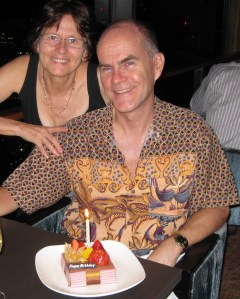
Pam had a conference, which she will blog about later, and Steve has a birthday coming up, which he undoubtedly – in his typically humble way – will crow about later. Both had a wish to enjoy a meal atop Swiss Hotel’s Stamford Towers on the 72nd floor overlooking Singapore Harbour. The meal was wonderful, the view even better, but each other’s company on a road that has taken us to so many of the world’s most beautiful places, was the most enjoyable thing of all for both of us. Surely God is good to those who have learned to let Him lead them along this road called life.

Star and Garter

My parents went back to England when I was 18. My sister had already decided to move back herself and her new boyfriend, shortly to be her husband, solidified that decision. Wyn left with my parents and stayed with them for a while before moving on to a Kibbutz in Israel, leaving me with a difficult decision. Should I leave Canada, a country I had grown to love, to be closer to my family, or stick it out in Toronto alone?

Never one to close doors, I tried making my living in London, England for six months, slogging ale in a trendy pub in Soho called the Star and Garter. I didn’t mind the work, despite being up to my ankles in beer every lunch hour (the pub was a frenzy of activity, and with six of us in a tiny square of space, a fair amount of spillage was just one of the work conditions). What I objected to was the pay, barely enough to cover food, bus fare and rent and nothing put aside. In my tiny flat there were rats in the loo in the hallway, and not enough heat to keep the frost off the inside of the windows. It was a miserable way to live, and pretty standard in England in those days. Borrowing airfare from my brother, I high-tailed it back to Canada, and have been happy to be Canadian ever since. We have our problems as a country, to be sure, but of all the places I have travelled, it is by far the nicest, most decent place to live.

So it came with some true reluctance to file for non-resident status on our income tax form this year. No, we haven’t given up our citizenship, nowhere near. But we have declared ourselves to be non-residents of Canada. It is a step we never intended to take, but circumstances dictate otherwise. To remain residents will cost us too much in that we are forced to pay not only tax in both countries, but to also pay tax on our Malaysian income in Canada for the privilege of remaining residents of Canada. At the same time our residence in Malaysia ensures that we receive no benefit in Canada for the tax that we pay there.

We are, in some small sense, lowering the flag, and by doing so following the advice that we received two years ago when we came here. It has been only our stubborn national pride that kept us from acknowledging the obvious: now we bow to the inevitable leveler, the tax law.

dad and frank As we packed up our home to head to Asia we were faced with the question of  a suitable home for our cat Frank, who with his near human personality, had firmly enthroned himself in our living room, and just as firmly established a place in our hearts.

When Jon married Nicole our family welcomed not only a dear daughter-in-law but also her cat, Frank. We took “temporary custody” of Frank when Jon and Nic moved down to the States and no longer had room for both Frank and Jon’s lumpy cat Daisy. If you’ve met Daisy, you know we got the better end of that deal. Unfortunately, a couple of years later we also had plans to move, and we agonized over what to do with Frank.

I was reminded of  a cat that we had for a number of years during my childhood.  His name was Pussyfoot John (Don’t ask; I have no idea what that name was about).  Although he was a family cat, everybody knew of the special bond that existed between Dad and Pussyfoot John.  Dad was always an early riser and every morning would fry himself eggs for breakfast.  Dad ate the yolk and the cat ate the whites.  If Dad were ever tempted to sleep in even an extra few minutes, that cat was on his bed batting him around the face to get up and make him breakfast.

From this came the devious plan to ask dad to “babysit” Frank for awhile.  They have become fast friends and, even though I think that Frank actually runs the place, I know that he is great companion for Dad.  And, after all, if you are going to take a walk around the property, it is nice to have company. We owe this picture to my niece, Jenelle, who had this lovely picture posted on Facebook. I thank her for this touching photograph which has brought back some very fond memories.

This has felt like a long slog of trying to figure out exactly how we will be spending the semester end school break, but it is finally all coming together and as usual- in God’s good time.  Issues with passports and visas seemed endless but are falling into place.  All this simply served to ensure that Pam would be around for several meetings that we didn’t even know existed when we formulated the initial plan.

As part of Steve’s contract, the school pays for one trip home a year for both of us.  It sounds pretty straight forward but in fact that is not necessarily the case once you get the HR department involved.  We were dreading the battle, only to find that the tour company, which works for the school, has new staff that are wonderful  and have a bit of an understanding of geography.  It is really difficult to argue with someone who insists they will not pay for you to fly to Ontario when the contract states specifically that they will only fly you to Toronto.  Just try to add Calgary into that mix!

Jace gets it and was able to book us exactly what we want and at $5 under the price that the school will cover.  Consequently, we will leave KL on June 11 and spend the night in Hong Kong.  On the 12th we will fly out at noon to Vancouver, arriving there at 9:20 am on the 12th, thanks to the International Date Line.  We will then arrive in Calgary at around 3:0o pm for a four day visit with Dave and Liz.

On the 16th, following a meeting regarding ministry, we will head on to London, arriving around midnight.  We will be in the London area until Steve flies back to KL, arriving there on July 4th to recover from jetlag so he can begin teaching on the 6th. Pam will stay on until July 28th to get a little extra family time and to pursue some potential new developments in ministry.

We are looking forward to visiting with so many people but our calendar is filling up very quickly.  Let us know if you want to get together and we will happily work you in to our schedule!

Which brings me to The Shack, by William Young. What Young has written falls into the third category I mentioned: stories (and barely so) of people coming face to face with the Almighty. There has been a lot written about this book, both pro and con. As you can see from my previous post, I am not naturally inclined toward this kind of writing: the storyline is weak and the characters poorly developed. In addition there are any number of ways to get derailed from the author’s purpose along the way.

God Almighty, as presented in this book, is a happy, slightly scatological African woman, the Holy Spirit is an Asian nymph, and Jesus is a Middle Eastern Jew (true to type, at least once). They confront our protagonist in a woodsy shack where his daughter was brutally assaulted and murdered. Their response to our hero’s grief and dismay is dishearteningly facile, at least initially.

If that is as far as you got before throwing the book aside in disgust and righteous indignation (as I almost did) then you will have missed an interesting book. Putting aside the author’s obvious deficiencies as a writer – “blazing campire”,  “veritable feast of hamburgers”, and so on – there is a thoughtful man who has something to say on the nature of suffering. No, it is not Job, and clearly this is not the majestic view of God that we get in that venerable exploration of human pain. It is not even C.S. Lewis’ insightful The Problem of Pain. But there are some worthwhile thoughts, nonetheless, and it is worth seeing past the book’s peculiarities to find them.

Consider these little nuggets. “Paradigms power perceptions, and perceptions power emotions;” or, “Grace doesn’t depend on suffering to exist, but where you find suffering you will see grace in many facets;” or, “There are many people who end up locking themselves into a very small space with a monster that will ultimately betray them.”  Here is a man who has done some serious thinking on the problem of human suffering. If he has chosen to share his insights through the metaphor of an incarnate Trinity of questionable theological sanctity, then I can live with that. As for God being offended by this portrayal, let’s not go too far down that road, shall we? There is already a religion out there that specializes in being offended by distorted representations of its view of God. I don’t want my faith in that camp!

Christian allegory has a long and venerable history from Piers Plowman and Pilgrim’s Progress to the Narnia books by C.S. Lewis. I like allegory because of its narrative structure. The writer has a story to tell, and as with Lewis’ books, the story can stand by itself on its own merits. (Lewis was, incidentally, adamant that his most famous works were not allegorical but suppositional. I think he protests too much). Because the writer is Christian, allegories can be read at a deeper, spiritual level. Puddleglum, one of Lewis’ most interesting characters,  has a lot to say about our own struggles as Christians in dealing with a world of powerful inducements to doubt on the one hand, and equally powerful penalties for stubbornly adhering to faith on the other.

A second kind of Christian fiction is that exemplified by Ben Hur, which in its original publication was subtitled A Story of the Christ. There are plenty of these kinds of books on the market: David and Bathsheba, When Joseph Met Mary, and so on. They are an attempt to fill in the Biblical narrative by providing additional information gleaned either from historical sources, or the writer’s own imagination. The purpose seems to be to provide some wholesome Christian reading and give readers more evidence for their faith. I don’t find either of these reasons sufficient. The Biblical stories are briefly told and sparse because that was the Holy Spirit’s intention. He didn’t want us living these lives; He wants us to live our own lives, to write our own narrative of faith. Dwelling on the minutiae of Esther’s life won’t help us to be like her. Living our own life with similar courage will.

A third kind of Christian literature is an account of one man’s journey to heaven to meet God face to face. Again, this has a long lineage, dating back to Moses’ prayer to see God, and refered to again in the New Testament in Paul’s vision of heaven. However, these were actual events, not fiction, and they are blessedly uninformative about the personhood of God and His paradise. Even John’s account of heaven in his Revelation is clearly heavily symbolic and not meant to be taken literally. Which is how it should be. God gives us the hope of dwelling in His perfect presence, where ‘all tears will be wiped away.’ He had no intention of telling us what was for breakfast when we got there. Nor do we need to know.

Because such works have the intention of showing us a view of God and of heaven and this is the central purpose in the book, the narrative line is usually weak. It was just a way of getting the reader to the main point, which is ‘what is God actually like.’ The story has a tendency to be sentimental and superficial, which is where I struggle. I like a good story, and narrative is important to me. Books (and movies) that don’t have a strong narrative are just not that appealing to me.

Certainly there is plenty of room for spiritual imagination about the nature of heaven. But that is precisely the point. It is my imagination, not yours, that is engaged, and it is only valid because it is imbued with my hopes for the conclusion of the narrative that I have been living for the past sixty years. It is not valid for you. Sure we share some things in common, but this is uniquely my story, just as your story is uniquely yours. For me to take my view of heaven and declare in a work of fiction that it is THE view of heaven, would be wrong. God has deliberately left some things in the Bible in sketchy detail, because it is not the details that are important, it is the spiritual truths that can be drawn from what He does provide. When we try to fill in the blanks for Him, we often go astray.

Paul Auster: “We construct a narrative for ourselves, and that’s the thread we follow from one day to the next. People who disintegrate as personalities are the ones who lose that thread.”

Erik Erikson: “To be adult means to see one’s own life in continuous perspective, both in retrospect and in future prospect.”

Clifford Geertz: “A human being is an organism that cannot live in a world that it cannot understand.”