Ministry


Two years ago I went to Chiang Mai, Thailand and attended the Community Health Education Training of Trainers 1.  The CHE approach to community development was a concept that I had first heard of  in Cambodia and it fascinated me.  At that point, I took the training specifically to learn more about the strategy and the extensive library of educational materials that have been developed with the needs of the oral learner in mind.

Although several individuals in Malaysia have completed TOT1 and a number of organizations have begun using the CHE priniciples, that approach is fairly new here.

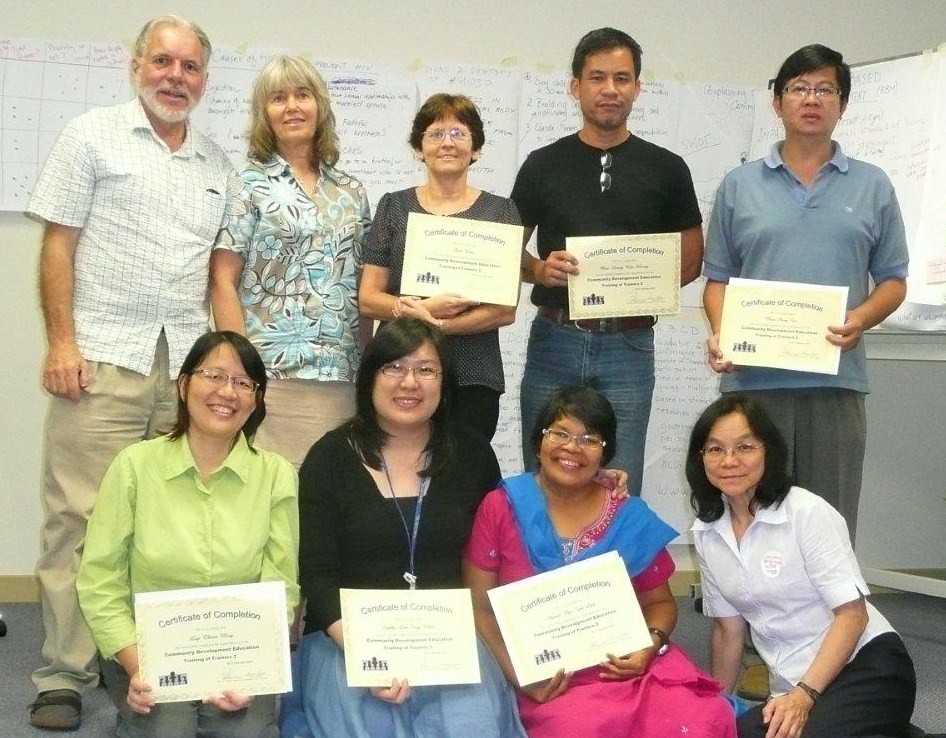
This past weekend I and five others were able to complete  TOT2.  It is normally done over five days but we did twelve hours each on Friday and Saturday and finished up with four hours on Sunday afternoon.  I thoroughly enjoyed the training and the opportunity to meet some very fine, committed Malaysians and hear about the projects they are involved with.  Programs represented are reaching out to street people, addicts, single parents, immigrants, youth and the aboriginal people of Malaysia with some very unique strategies.

With six of us now trained in Malaysia, we are hoping to be able to begin doing TOT1 sessions for local organizations and I  look forward to the opportunity to develop some new relationships in Malaysia.  This coming weekend I will go back to Thailand to attend the CHE SE Asia Consultation where each country will present on their own CHE projects, a great opportunity to meet some new people and to build some relationships for Project Hannah.

Forty-two pages, 12,490 words. That’s how long Pam’s proposal was when it went ‘out the door’ at 7 pm last night. During the time it took to write those 42 pages, three months have gone by, along with three trips to Cambodia, a dozen conference calls to major stake holders, a hundred hours of research, and countless discussions and revisions. The document calls for the creation of an entire new team within the TWR office in Cambodia to deal with HIV/AIDs and the associated health and social issues. If approved it will provide funding for this team for three years.

My small role in all this work has been to edit the grammar and syntax and do some fact checking in some of the various UN documents that had to be referenced. Along the way Pam and I have both had to learn some new skills and extend others. I always tell my students that if what they hand in is the best they can do, then it isn’t good enough. The best you can do implies that you haven’t learned anything in the process of what you were doing. Instead you should aim to do more than you thought you were capable of. The doing of it should produce not just a new project, but new understanding, new skills. That is what this project has done for both of us.

To say that I am proud of Pam would be to belittle her. Being proud of her would imply that I already had the skills that she has just attained. That is not the case. She is doing things that I simply cannot do. She has a skillset that I will never have. It would be more honest to say that I am proud of myself for being part of the person she is becoming, for not getting in her way, for seeking to be what support I can. This proposal is something that I could never have written, and I am pleased to have had even a small part in its creation. I trust the Lord will bless its way through the many stages it must now go through before it can be funded.

I am also pleased with how this first part of the term has gone for me. I am teaching ENG 4U this term. This will be the fourth new English curriculum I have had to master since I got here. Each new curriculum has its own challenges, and of course there are no lessons in my computer to call up; they all have to be written from scratch. I have over two thousand documents – lesson, articles, slide shows – that I have written since I got here, and the number grows every day. I tell myself that there is going to come a point when everything I have to teach will all be written down and I will just have to call it up from some file. But I know that this is just a little white lie I comfort myself with from time to time. When that day comes, I will truly be ready to retire; for when there is nothing new to learn, there is nothing new to teach.

This week is the Chinese New Year break, an appropriate time for both of us to take a few days rest from what has been a very busy stretch for both of us. We plan on spending our days reading and watching the Olympics and maybe getting caught up on our sleep. We wish you all a Gong Xi Fa Cai and a prosperous and happy year of the tiger.

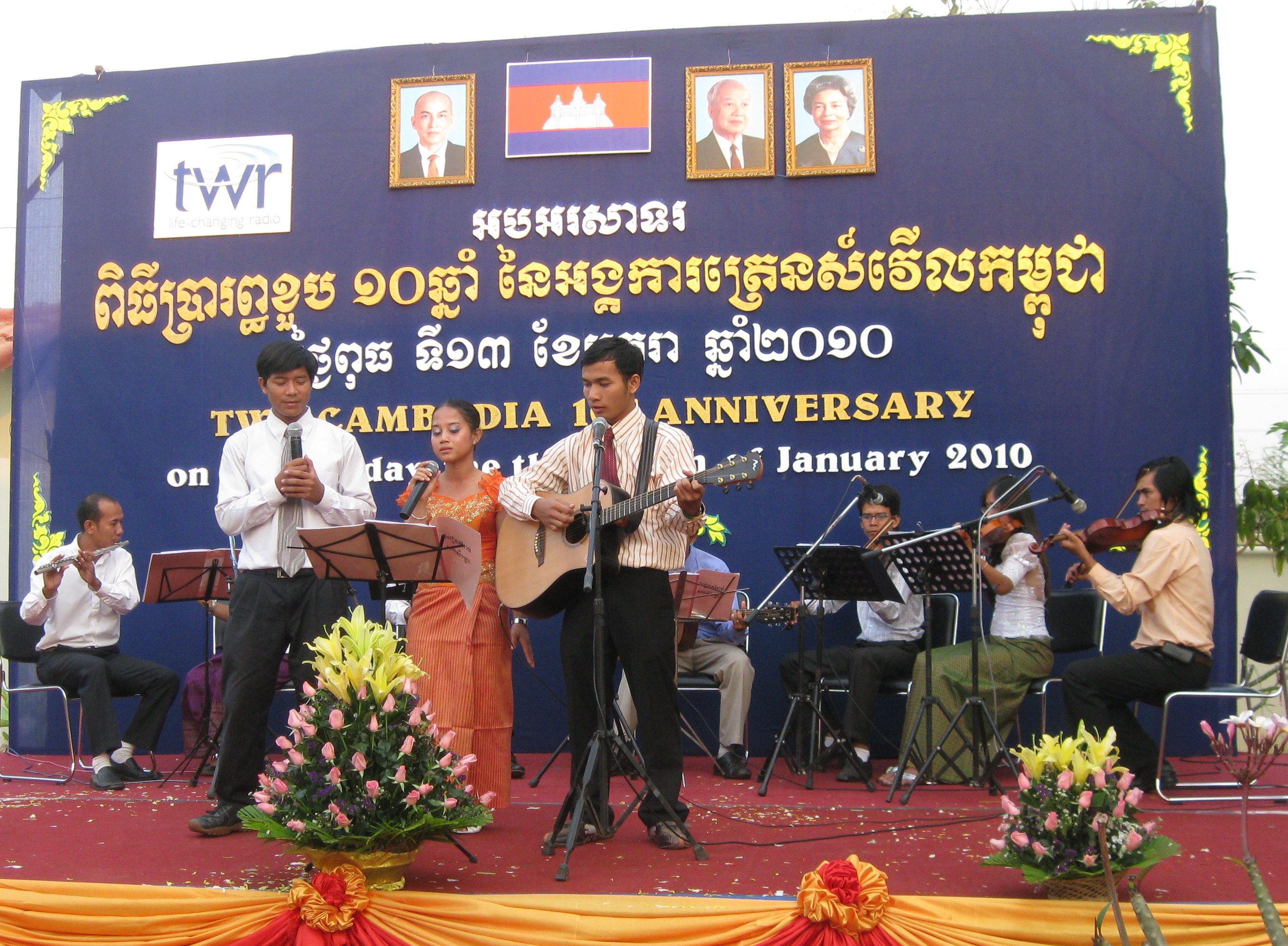
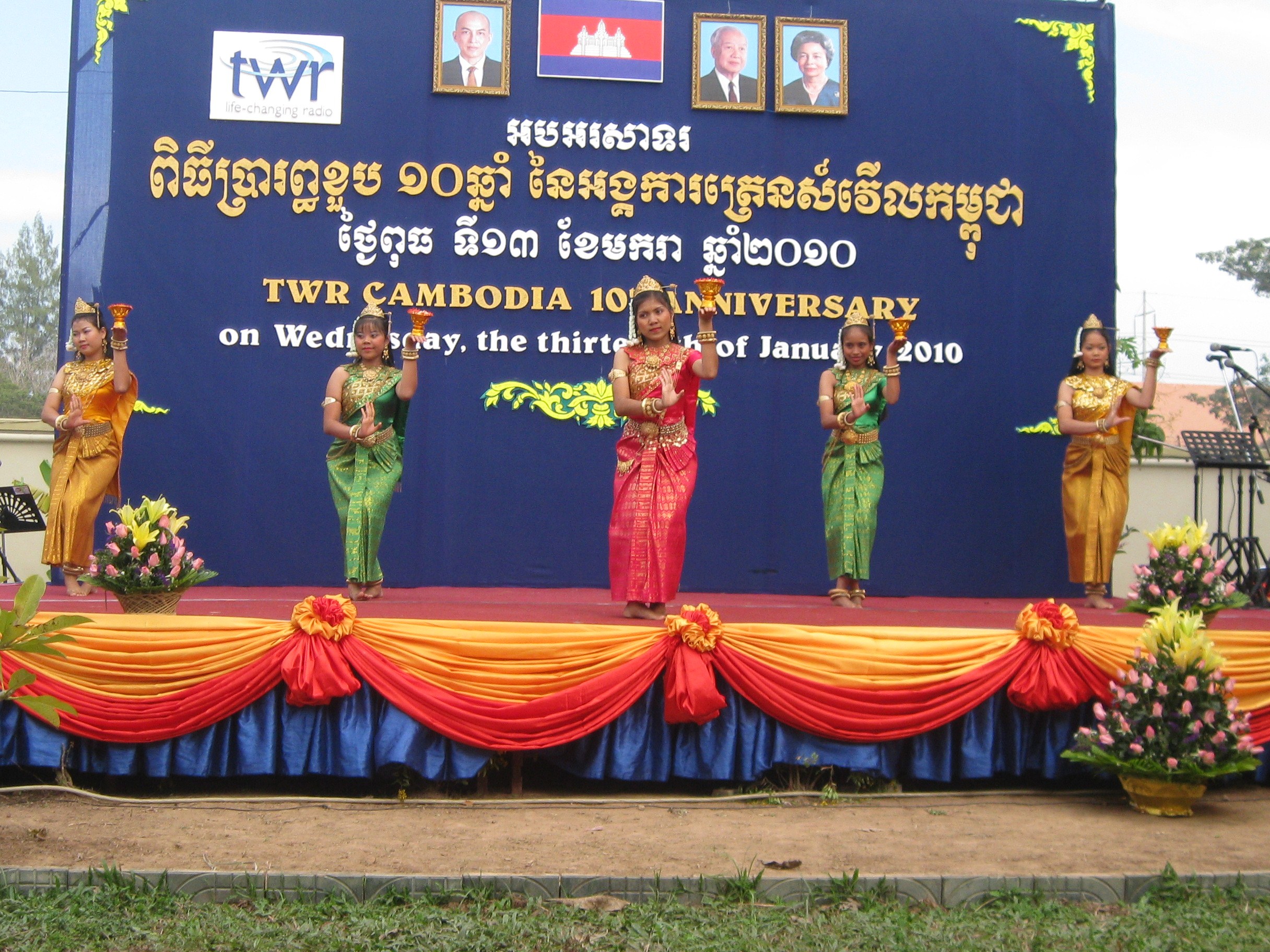
It is such a privilege to be able to be in Phnom Penh to celebrate ten amazing years of ministry with this team that has been so mightily used of God. The staff did a great job of organizing the program, entertainment and meal, all decorated in bright, colourful, Cambodian style.

Guests were welcomed by a talented group of young musicians and a troupe of dancers doing a traditional dance of blessing and a dance of harvest.

Dan Blosser, a TWR missionary who has been in Phnom Penh since the beginning of the work, reviewed the history and talked about the current response to just a few of the programs that exist today.


We heard testimonies from a number of listeners and partners of what TWR has meant to them over the years. Certificates and letters of appreciation were presented to individuals who had been regular listeners of Women of Hope for more than five years and those who had completed the Through the Bible series.

The day ended with a time of fellowship around a great meal prepared by the catering company which had set up their temporary “kitchen” in the vacant field beside the office.

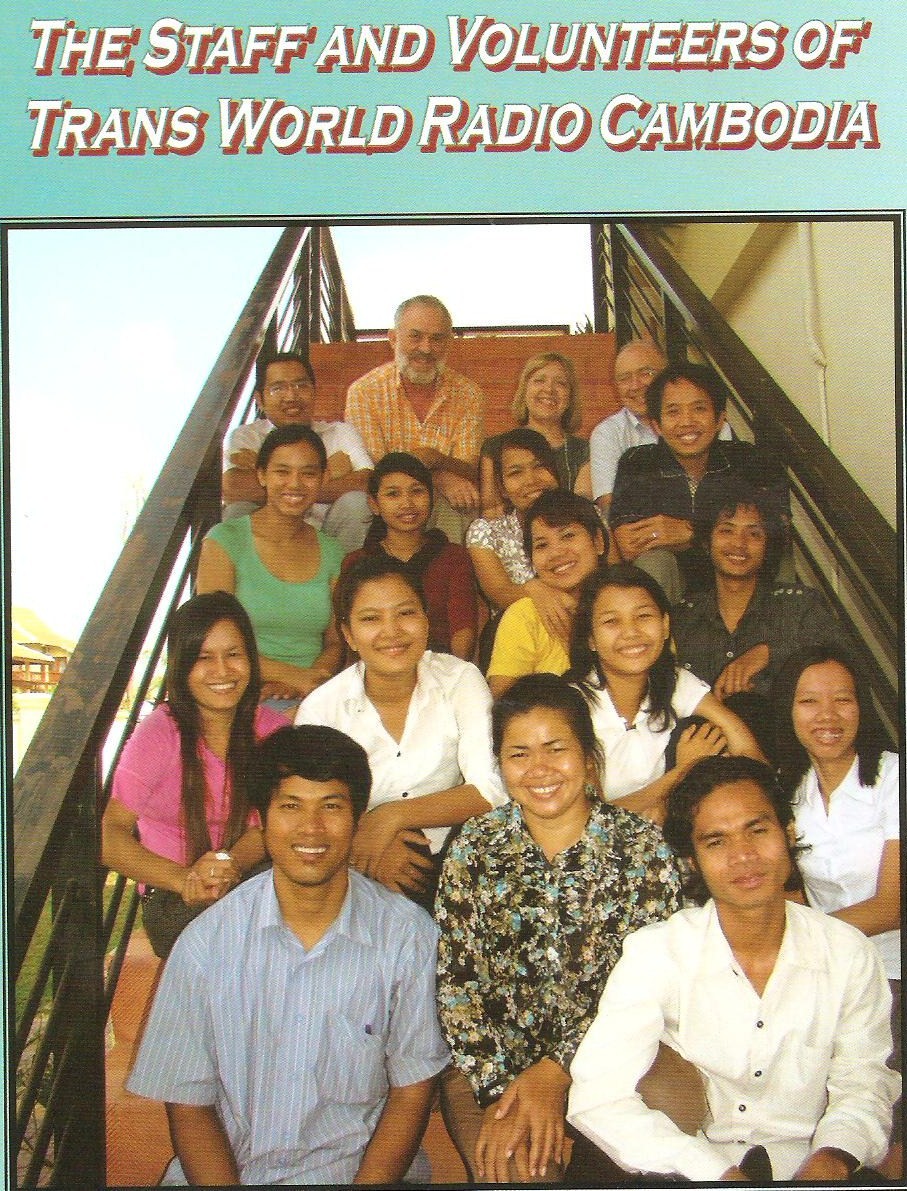
This ministry began through the efforts of one woman to translate and broadcast the Woman of Hope program and has now grown to a very competent team that reaches all ages, throughout the country. The Children’s team alone receives an average of 1200 listener letters a month, a fact that is much more significant when you consider that this is a country that is essentially without a postal service. TWR has created their own system of drop-off and pick-up points, using taxis, buses and motorcycles so that they can maintain and build relationships with their listeners.

Congratulations to Veasna and all of the TWR Cambodia staff.  I look forward to what God has in store for you over the next ten years.


Steve and I were happy to get away to Australia for a couple of weeks, but our vacation came at a bit of an awkward time for me in that I am in the midst of writing a proposal for funding for a new program for TWR Cambodia

Once again I have reached the point in my work that I can go no further without the input of the Cambodian team. So for the third time in this project, I will spend a week at the TWR office in Phnom Penh. During the first visit we just really launched the idea for an HIV/AIDS program and had some general discussions about the challenges the Cambodian teams face as they regularly confront the questions of their listeners. Following that visit and for the next two weeks, I did some background research on the situation in Cambodia and began to write up my research in rough form while the individual teams there looked at the needs of their particular target audiences.

On my second visit in early December, we went through the proposal guidelines step by step and I took notes of the discussions. We were also able to meet with several organizations that we hoped would be interested in partnering with us and received very positive responses from each of them. Since then I have been compiling all of the information and combining it with my previous research into a proposal, using the format required by the funding agency. I have a first draft prepared, minus some very specific information that the team will need to provide. I am grateful for a very gifted and knowledgeable English teacher as a husband who has helped immensely with editing and formatting the document.

I have chosen this week to go to Phnom Penh as it will allow me not only to meet the funding deadline, but also give me the privilege of being with the Cambodian staff to celebrate their 10th Anniversary. What a joy it will be to celebrate with this dedicated team who constantly amaze me by how such a small team can deal with the extent of the work they have accomplished.

I would appreciate your prayers for my safety, for a successful conclusion to the nearly two months of work I and others have put into this proposal, and to a joyous celebration of what God has been able to accomplish through TWR in Cambodia through the lives of ordinary people touched by His extraordinary grace.

We have just returned from a wonderful vacation in Australia, so naturally thoughts of travel are on my mind. Travel is for Pam and I a precious privilege, and one that we do not take lightly. We are fortunate to be able to see so many new places, and meet so many new people.

But no matter where in the world we go, there is always one person that we are bound meet: ourselves. I read a story a long time ago that has stuck with me for many years. A simple story that illustrates this simple truth. It goes like this:

In a place far away there lived a wise old man at the edge of a city. Early one morning a traveler approached who asked him what the people who lived in his city were like. The old man responded with a question: “What are the people like where you come from?”

“The people where I come from are greedy and mean, boring and arrogant. Whenever two of us get together it usually ends in a quarrel. That is why I left.” The man shook his head and sighed: “What bad luck you are having, for I’m afraid you will find people here much the same way.”

Later in the day the old man greeted another traveler who asked the same question: “What are the people like in your city?” The old man replied as before, “What are the people like where you come from?”

“Oh, the people where I come from are wonderful. They are generous and energetic, kind and understanding. Whenever two or three of us get together, the joy we feel at being in each other’s presence is multiplied and overflows into laughter and sometimes music and dance.” The old man replied, “What good fortune awaits you, for here you will find that people are much the same way.”

May your travels this year take you to places filled with people who are ‘generous and energetic, kind and understanding,’ for then you will be where you should be.

For the past month, I have been buried in work for a country that I love, Cambodia, trying to assist the team of dedicated men and women working to change lives in that needy country. They are just a great group of young men and women, with a passion for rebuilding their war-torn country, who write, produce, and distribute for broadcast very specialized programs to meet the needs of their target audience. 

“Happy Children’s Garden” is a weekly radio program aimed at the 32% of the population who are under 15, mostly living in poor rural villages with little hope of a quality education or health care or even a nutritious diet.

“It’s Yours” seeks to bring a new way of thinking to youth, roughly half of the population,  who have  grown up in poverty, exposed to drugs, pornography, per-marital intimacy, gangs and violence in ways most adults have never experienced.  These young people are the hope for the future of Cambodia.

“Women of Hope,” the radio broadcast of Project Hannah, meets the needs of women who face constant problems related to poverty, poor health care, poor nutrition, high maternal mortality, HIV/AIDS, illiteracy, domestic violence and sexual abuse. I am currently working with the TWR team there on the writing of a proposal for external government funding of a new HIV/AIDS program. My goal is to have a draft proposal in their hands by the end of this week.

The Church and Leadership Development team seeks to equip pastors and lay leaders who have no formal Bible education to enable them to mature in Biblical understanding.  “The Word Today” and “Through the Bible” have been translated and are offered both on radio and through CD Listener Centers throughout the country.  Pastors are also provided with Bibles, hymnbooks  and other teaching resources as the funds are available.

Cambodia is a nation of oral learners with many people who either cannot read at all, read poorly or read well but do not have access to decent reading material.   The goal of the Orality Team is to meet the needs of those who need to “hear” the Word.  They are currently researching a weekly radio program in magazine format using story telling, songs, testimonies, discussions and poems which the Cambodians love so much.  They distribute radios and other media devices like MegaVoice and Saber Units for areas where radio is not an option, as funds allow.

Each of these programs has a complete follow-up strategy that involves phone calls, letters, text messages, village visits, listener groups, prayer calendars, seminars and outreach programs in orphanages and rescue centers.  They work in partnership with many other organizations to provide referrals for help and protection for listeners when they come across needs that are beyond their scope.

Everytime I look at this group of young people, and understand the enormity of the work that they are doing, I stand in awe of what God can do through a small group of passionate and committed individuals. It is my great privilege to stand with them in that work, and I ask for your continued prayers that God’s work would be done through me as well.

If you want to read a brief and challenging summary of the last thirty years of Cambodian history, read our son’s latest post at http://www.jonandnic.com/topics/news/hadda-be-played-on-a-jukebox
Cambodia is one of the countries worst affected by HIV in south-east Asia. Despite a decline in prevalence from 3.3% in 1998 to an estimated 0.9% currently, over 250,000 people have been infected with HIV since the beginning of the epidemic in 1991, and over 16,000 people have died of AIDS.

The decline in prevalence is attributed to a combination of high mortality rates among those infected with HIV and successful HIV prevention programs among some populations. These programs were the result of committed efforts on the part of government, non-governmental organizations and civil society. The new challenge is to avoid becoming complacent.

While the highest levels of HIV infection are still to be found among sex workers, men who have sex with men, men in uniform, and drug users, national statistics show that the epidemic is also shifting from these traditionally high-risk populations into the general population. The highest number of new infections now occur among housewives as men switch to having casual sex with ‘sweethearts’.

Partly as a consequence of high levels of HIV prevalence, it is estimated that 7.8% of children below 15 in Cambodia have lost one or both parents – approximately 335,000 children. Care of orphans is a major concern in a country still recovering from decades of civil unrest and facing extreme poverty. Many of TWR Cambodia’s existing programs for children, youth and women already do address some of the issues around HIV/AIDS but staff are concerned that this is inadequate.

I have spent his week with the team here presenting to them the potential for accessing funding for a dedicated HIV/AIDS program. They are an excellent team and excited about the possibility. Next week will be spent doing some background research in a number of areas and I will return the first week in December to work with them developing an in depth proposal and meeting with some potential partners in this venture.

Unlike my husband and son, I am not usually given to writing posts about the things that are burdening my heart. However, this is a thought that I have struggled with almost daily since our trips into the Philippines and Vietnam.

I feel compassion deeply for people and came here to put that into action in some small way. Many times my compassion for the women can feel overwhelming and emotionally draining, especially when the needs I see are so basic and so desperate. I know that I need to find a balance because I can’t help everyone, in fact there is little I can do even for the immediate needs of food and shelter for most of the people I meet.

Laotian Lady


When I look past the poverty and dirt and hunger, I see in the faces of the women their beauty and dignity and their hopes for their lives. I realize that except for the place they were born and the circumstances of their lives, they could have all the opportunities that I have.

I don’t want to only meet their physical needs, as important as they are, I want to meet the needs of their heart, for them to know that they have great value and are loved and are entitled to be treated with respect and dignity.


Compassion literally means to feel with, to suffer with. Everyone is capable of compassion, and yet everyone tends to avoid it because it’s uncomfortable. And the avoidance produces psychic numbing — resistance to experiencing our pain for the world and other beings” Joanna Macy

I never want to lose the blessing that my heart hurts for the women. I never want to just live here and do good things. I want to long to help more and I want to love these women in a greater depth than ever before. So what I am learning about, and praying about and hopefully growing in, is how to move beyond wanting to help the women and even feeling pity to genuine compassion and love that leads to action.

Vietnam 011While Steve spent a few days exploring the city and the Mekong Delta area, I took the opportunity to travel with friends up into the central area of Vietnam. Starting our visit with a lovely lunch at a hawker stall on the beach, we were absolutely amazed by the beauty of sea and the the rice paddies. By evening as we drove into the city, we saw first hand the effects of a “normal” rainfall and waded through almost knee deep water to get to a friend’s home.
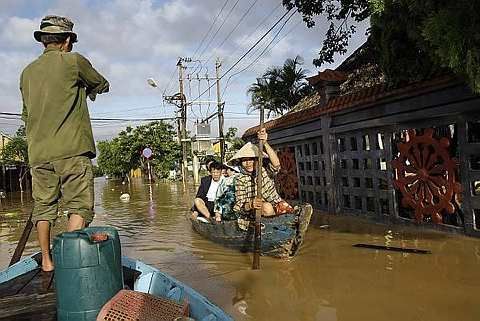
Many of the friends that I had hoped to meet the following day, were unable to come due to their need to try and rescue their crops from the damage of the winds and rain. Those ladies we did meet told of their daily struggles just to meet the daily needs of their families. They all seemed so thin and frail, that I found it hard to fathom the joy and peace that they expressed when they described the impact of the radio broadcasts and their gratitude for what they have learned.

This week Typhoon Ketsana hit this very area, leaving cities and surrounding countryside devastated by floods and wind damage.  We know that many of our listeners in the Philippines and Indonesia have also suffered huge loses as a result of  not only the typhoon but also earthquakes and tidal waves that have devastated these countries.  Please pray for safety and provision for our staff and listeners in South East Asia.
vietnam1_0110
http://gallery.thestar.com.my/default.asp?id=1251

Philippines PH Team
There are some TWR fields that have clearly established project teams, such as the one that I work with, Project Hannah. The reality in the Philippines is that if you are in the office and you are a woman, you are a part of the Project Hannah team. The “Women of Hope” program begins with an English script which is then translated and broadcast in three languages, Tagalog, Ilocano and Cebuano. As it is designed to be a “chat over tea”, a number of voices are needed for each program and they must be the voices of native language speakers to make it more acceptable to the listeners. Therefore, if you work in the office and you speak the language you will be called upon to translate, voice the scripts or to do listener follow-up.

Each program that is aired invites listeners to send their questions or comments via text message to one of three phones – one for each language – that are manned twenty four hours a day by these women. It is not unusual for them to be up during the night providing counselling and support over cell phone lines to women who often have no one else to turn to. Fortunately, in this part of the world text messaging costs pennies a month, and cell phones are very cheap.

Philippines SoupRuthanna, the Project Hannah co-ordinator graciously invited all of the women to her home out in the hills surrounding Baguio, for a time of fellowship and an opportunity for me to get to know them. We chatted over a snack of boiled bananas while Ruthanna prepared a large bowl of a traditional Philippines soup, served over rice, and guava leaf tea.

It was a wonderful opportunity to hear of the joys and challenges of family life for these women as well as to get an understanding of the depth of their love for the women of their own country and their commitment to the ministry of Project Hannah.

Jeepney Ride

As the afternoon rains started, we all piled into a Jeepney, the common means of transport for most Filipinos, for the crowded journey back into the city. My heart has been touched by these women and their devotion to the cause of Christ. There is so much that I want to do for them, and they have so many needs to more effectively carry out their ministry.

« Previous PageNext Page »