Family


If you live long enough, every good thing comes around again. When we were young and having kids all our friends were having kids. It was kid city at our church, at work, in our neighbourhood; kids popping out everywhere! Okay, I understand it only seems easy to our gender. But regardless of who did the work, they were fun days. But now we are old enough that our kids are having kids and it is even more fun (more joy, fewer sleepless nights).

verity-and-jack.jpg baby-joe.jpg

Case in point: my nephew Jack. Isn’t he a charmer! He is my older sister Rosey’s older son Colin’s child. His wife Verity had a bit of a rough time with his birth and the little gaffer had to stay an extra week in hospital recovering. But he’s home now and growing well; a happy, healthy little boy.

Then there is Joe, or Joseph, if you please, my sister Rosey’s daughter Claire’s second child, born just this last week. Notice that already he’s got more hair than I do! He was kind of in a hurry to be born and Mom Claire and Dad Phil barely made it to the hospital in time. Grandma Chappell stayed home to look after Megan, who is a very active one and half year old.

Of course then there is Abigail, our son Jon and his wife Nicole’s second child, due in March, a sister for their first-born, Benjamin. I tell you, babies just a-popping out everywhere! Our only trick now is how we are going to arrange our travel plans so that we can see all these babies while they are still willing to be cuddled!
green-canoe-1-large_1.jpg

A good teacher lets his students know something about himself. Not excessively, and certainly not to fulfill a need, but because there is pedagogical value in doing so: people learn better if they understand the person who is teaching them. So you have to let your students know who you are. (The reverse is obviously also true: you have to be interested in who they are!)

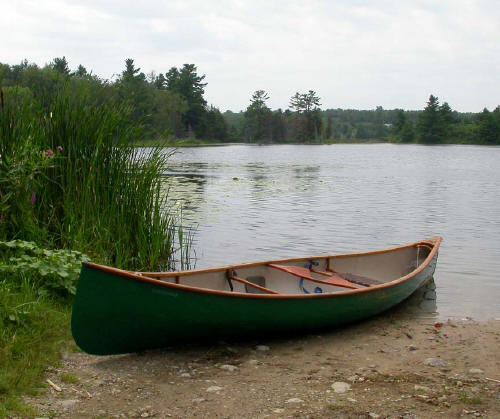
This week in my introduction to things Canadian – hockey, the Maple Leaf, snow – the canoe came up. So I told my students about the canoe I built in St. Thomas some thirty years ago. And how my love for the canoe stretched back to when I was a kid and had learned to paddle in Algonquin Park. I told them of the waterfall where the mighty Magnetewan enters a chute only five meters wide where three fellow teachers and I nearly lost our boats and our lives.

I told them about taking my kids out for camping trips when they were small and how they had come to understand and share my love for Canada’s natural beauty. Then I told them that I had given my boat away when we had come to Malaysia, and how I missed it. They gave a collective “aww.”

But I think the lesson had more of an effect on me than them, and I left class mulling over what I had said. Unlike the guitar, my canoe is irreplaceable. I don’t have the knowledge, tools or space to ever build another one. Nor will any canoe I ever buy replace the memories of that particular craft. But there’s the consolation, isn’t it? For I have the memories of all those wonderful trips with family and friends, and they too are irreplaceable.

b4592.jpg 

Christmas in Malaysia is, well … different. There are lights, it is true. But they don’t seem the same when hung from palm trees. Although if you want to get right down to it, there were more likely palm trees in Bethlehem than pine trees. It is just what you associate with the season when you live in Canada.

But it is not the trees or the lights we miss, or even the gifts. We are going to miss our family and friends, and there is just no getting around that, is there? So to all of you who have watched and prayed over our wanderings for the Lord this last year, a Merry Christmas. Sorry that we can’t be there with you, but the Lord is with us both, and that is a great comfort.

Christmas is a day of joy and charity. May God make you rich in both on this special day, and throughout the coming year.

img_2430.jpg

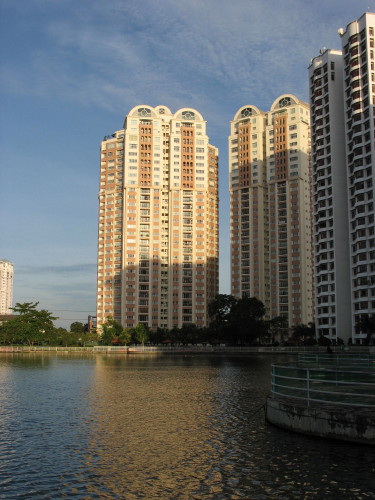
Pam told me that Cambodia would be amazing. She was right. She told me that I would fall in love with the place, and she was right about that as well.  But for now we live in Malaysia, and KL is home, and it was actually nice to get back here to our little condo by the lake and be able to unpack.

Last night we went to a Christmas party hosted by our friends Bill and Kim. There is a new couple starting at the school in January, Gary and Kveta, and we spent some time getting to know them a bit. They have been on the International School circuit for a while and have taught in England, Germany and most recently Papua New Guinea. Garry is an avid chess player, so it looks as if I will finally have some one around here to play against. I also had a interesting conversation with an English professor about the evolution of our language and the part played by the Germans and Nordic peoples in its development.

Now we are eager to get caught up on our email and news from Canada. Give us a “hi” if you haven’t recently. Thanks to those who been in touch. Christmas is going to seem a little weird this year and your notes, cards and gifts are very much appreciated. We are going to post our pictures soon, as we promised.

img_4413_1.jpg

We’ve been back in Phnom Penh for a couple of days of ministry before heading back to Malaysia. This has been an incredible trip, one that I will never forget. We promise to upload some pictures as soon as we get back to KL and fill you in on some of the stories that we have to tell.

We are sitting in the airport – a lovely modern facility – sipping cappucinos and thinking that we are two of the most fortunate people on earth to be seeing what we are seeing and doing what we are doing at our stage of life. Thank you to all who prayed for our safety and our spiritual refreshment. The Lord has been good to us and we feel truly blessed.

img_4439_1.jpg

Kep, pronounced kep, keep, or kipe depending on who you are talking to, is on the Gulf of Thailand on Cambodia’s south coast. It was favourite of Cambodia’s colonial masters, the French, and the site of King Sihanouk’s beach cottage pictured above. That was before the Vietnam War. Now it is a mostly deserted town visited by tourists who are looking for a Asian beach without the glitz of a Western resort.

We stayed at a reasonable little hotel for $15 a night and rented a motorbike for $5 for the day. Without the tourists Kep has reverted to what it must have been throughout most of its history, a small fishing village supporting an indigenous population in small thatch cottages dotting the coast. A little further inland are the rice paddys stretching back into the Cardamon Hills where spice has been harvested for centuries. Closer to the coast are the salt flats where salt farmers eke out a living. It is a peaceful and pleasant place.

We travelled into Kampot, a provincial town with a fair sized wet market consisting mostly of fish and locally grown vegetables. There is the beginnings of a tourist strip along the river, and some quite nice little cafes and guest houses line the eastern shore where we stopped for lunch. Traffic was light along the coast road and the ox carts and bicycles that fill the road ensure that no one travels very fast, for which Pam was very grateful.

Our evening were spent at the Riel, owned by Marcel and ex-pat Dutchman and his Cambodian wife. The clientele were an odd bunch: young Australian tourists on a cheap holiday, world trekkers making their way from China to India, and do-gooders like ourselves involved in a number of projects to help turn this country around after 150 years of colonial abuse by both the French and the Americans. More on this later.

img_4369_1.jpg

We got to Phnom Penh on Wednesday, travelling by bus through the Cambodian countryside in a very pleasant five hours. Rice paddies and water buffalo were everywhere, much like in Bangladesh. What was missing were the people. Cambodia has been decimated by war going back to the Japanese invasion in 1942 and continuing more or less continuously until the Vietnamese drove out Pol Pot in 1979.

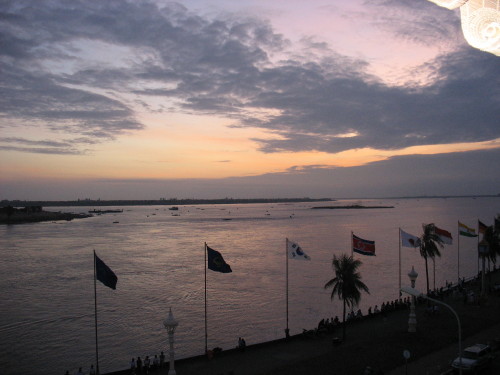
Phnom Pehn is on the Mekong River, the ninth largest river in the world and navigable by cargo ship right up to the city. Before Pol Pot took power in 1975 it had a population of two million, but under the Khmer Rouge it was emptied to 50,000 loyal cadres, most of whom were employed in the torture and extermination of everyone who could read. Slowly it is becoming a city again, although without an entire generation of doctors, nurses, teachers, engineers, clerks and administrators, it has been a long slow road.

We took in the temples and monuments, including the infamous S21, and strolled along the quay. We bought a few things in the Russian and Central markets and relaxed in the numerous little cafes that line the streets. Tomorrow we are headed down to the south coast for a few days on the beach before coming back to Phnom Pehn to meet Pam’s colleagues in the city. We are working on getting some pictures up, but it is not so easy when the internet cafes have no photo programs. Believe me, we have lots to show you!

picture-003_1.jpg

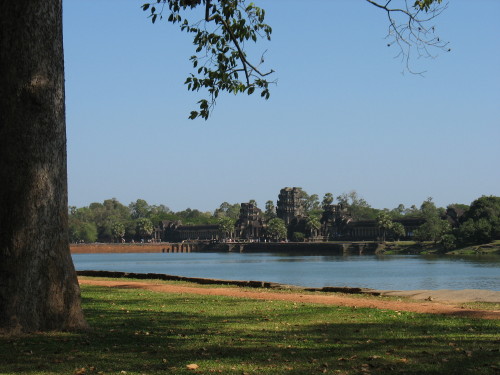
What are the new seven wonders of the world? 100 million people in 200 countries voted on the new list and although Angkor Wat was a finalist, it did not make the top seven. But I’m thinking that this had a lot more to do with the voting populations of Italy, Brazil and Mexico than anything else. I have seen the Colliseum in Rome and the ruins of Chichen Itza and let me tell you neither of them can hold a candle to Angkor Wat.

First there is the size of these things. There isn’t just one temple, there are dozens that cover miles of territory, about the size of metropolitan Toronto. There there is the scale of each temple. You could drop the Collesium inside the moat of Angkor Wat with lots of room to spare.

As for Chichen Itza. It was impressive, but again it just one site. Imagine a walled city large enough to hold a population over over a million, dotted with temples and ruled from the center by the brooding face of Jayavarmen VII staring at you on all four sides of 54 massive pillars. Or a palace that covers five acres with a fronting wall a long as the Houses of Parliament in England decorated with bas relief sculptures of parading elephants. This leads to a promenade down to a ten acre man-made lake and you begin to get an idea of the scope of the ancient Angkor whose civilization extended from Vietnam to Burma.

The dozen temple sites that we were able to see were remarkable for their originality and scope. From the regal Angkor Wat, to the enigmatic Bayon to the eerie Ta Prohm, backdrop for Tomb Raider, where the jungle has reclaimed its own, each site had its own splendor and story in the history of this remarkable empire.

picture-053.jpg

I have always been a little in awe of Pam’s organizational skills. Yes, her varied career in administration has given her plenty of practice, but there is a gift there that I just don’t have. She moved the five of us to Bangladesh in six suitcases when our oldest was just five and I don’t think we went without anything we needed for an entire year. She organized our trips through Europe when we were in Germany with ease, booking ferries, flights, hotels and campsites on a day’s notice. She got us to Malaysia barely three months after we sold our house and moved into a condo. Who else would even tackle that? She is amazing.

So why should I be surprised at our accommodation in Siem Reap? It had to be the nicest place in the entire town. It certainly was the closest to the temples and the closest to the airport. It was also the loveliest and quietest little spot you can imagine; more like a spa than a hotel. We had a lovely room with a veranda by the pool, an intimate little restaurant and bar just steps away and sweetest staff imaginable. And this cost us twenty five dollars a night? Incredible!

I won’t disguise the fact that I have had a tough first term. I knew it would be. I have worked my little tail off to make the transition to a new culture, a new school, a new curriculum, and a whole host of new software. But three days at the Pavillion Indochine in Siem Reap has been a wonderful tonic to my weary soul and I am very grateful to have been there. Thank you, dear!

img_3957_1.jpg

When I was younger I wanted to be a folk singer, like Bob Dylan. Not an unreasonable goal for a sixteen year old growing up in the sixties. I taught myself some chords and some basic finger picking and with a bit of talent and a lot of gall I was on my way. But life is what happens while you are doing other things, and I ended up a teacher instead, which is probably just as well. Aging folk singers make pretty thin wages these days.

I never gave up the guitar though, serenading our children until they wouldn’t take it anymore and leading in music in a number of churches until I got too old for that as well. I made a tough decision not bringing my guitar with me to Asia knowing that the demands of high school preparation, not to mention luggage restrictions, ruled it out. I have missed it.

Last week I broke down and blew RM300 on a reasonbly decent Chinese made guitar (That would be $75 Can, spendthrift that I am). It was like finding an old friend. I’ve never been a very good guitarist, relying more on my voice than my hands to get by. But that doesn’t matter to me anymore. What matters is that I can sing a tune that is meaningful to me in a way that soothes my heart and encourages my spirit. Isn’t that what good friends are for?

« Previous PageNext Page »