Current News


Parasailing

When we were kids Mom and Dad would take us to Wasaga Beach for a day. Pam’s family used to go to Ipperwash. When we had kids we would go to Little Beach at Port Stanley for the day, or up to the Bruce Penisula to hang out at the beach for a week. There’s just something about the gentle splash of the water and the sun dancing on the waves that settles into your spirit and just relaxes you.

We have had our share of vacations this term and I wasn’t eager to get away for Deepavali, the Hindu Festival of Light. But Air Asia had a special on for Langkawi at a price we couldn’t resist, so we went for the long weekend, and just got back. We are very glad we went.

Langkawi is a much overlooked little island in the Andaman Sea between the more famous Phuket to the north and Penang to the south. It has been designated by UNESCO as a GeoPark, like the Cotswolds and the Shetlands, so that development is limited and controlled. As a result you don’t get hordes of tourists or overpriced tacky souvenirs. We stayed at a modest little resort with near access to the beach at Cenang, easily the equal of Patong Beach in Phuket, or Batu Ferengi in Penang but much more laid back and undeveloped. We stayed for the entire day at one little spot, drinking club soda and ice tea and knoshing on some very nice green curry for lunch for around 10 bucks for the entire day.

The sea was clean, the beach very shallowly sloped for splashing in and the view was restful and pleasant. We watched the tide recede for the day and watched it come back in again in the evening. We sat and drank our tea and soda and read and chatted away, then came back the next day and did the same thing again. It was such a nice holiday, and a very nice way to spend Deepavali. Unfortunately all that swimming and fresh air wore us out and we had to retire before the fireworks, but I assure you we had a very Happy Deepavali, and we hope all our Hindu friends did as well. May good always triumph over evil, and light over darkness.

Oh yes, there was a little bit of excitement. That’s me in the air above the beach on a really lovely parasail ride over the bay. Great view from up there and a real feeling of serenity. I loved it.
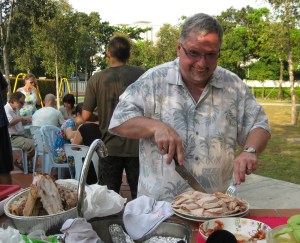
Jim LeonardWe both love the Fall season and Thanksgiving has always been one of our favourite weekends of the year.  We do miss family and friends and, of course, the fall colours of Ontario but at least this year we didn’t have to miss out on the turkey dinner.  Jim and Karen, the Director and his wife actually have a gas oven and very graciously cooked a turkey for the whole gang.
When we originally talked about a Thanksgiving get together a good number of people indicated that they were not too concerned about having turkey so we planned a BBQ with each one bringing their own meat.  I think that pretty much everyone was pretty delighted when they arrived to find a turkey dinner with all the trimmings.  Thanks so much, Jim and Karen.

It was also one of the teacher’s birthday (Happy Birthday John!) and we always use these events to get some cake and try to encourage one another. It is great when family members come to visit (hint, hint), but for the most part we are each other’s family. We are so thankful for the many rich blessings in our lives and for the opportunity to be working int his beautiful part of the world with a great set of friends and colleagues.

Staff 09

This is a shout out for a former student of mine Marline Yan, who has a lead role in a new TV series in Canada called How to be Indie. It is the kind of show that Canada does well, youthful and multi-cultural, and it is backed by the folks who did the long-running and successful Degrassi shows. Marline plays the faithful friend Abi who is wise and sympathetic, and she does a really great job in the role.

One of the hats I used to wear in my last teaching position at Locke’s was to co-ordinate the annual school talent show. Of all the things I did at Locke’s that was certainly one of the most enjoyable. Marline was taking singing lessons at the time, and had already won a couple of local competitions. Her singing was one of the highlights of our show, and I enjoyed the opportunity to work with her and Jessica Goodall, another good singer.

Here is a video clip from the show. All four segments are uploaded to YouTube, so if you like the clip just enter the show’s title into their search engine for the rest. The show aired on Channel 25 on October 2, so if you are in Canada you can check your local listings for when it will be on next. Way to go, Marline. All of St. Thomas is watching, and hopefully soon all of Canada will be as well!

Saigon
Pam got back from the north about midday on Thursday. I will let her blog about her experiences when she gets a minute. I am looking forward to reading about them as much as you are. Although I have heard bits and pieces, I have yet to hear the full story, Pam not being as given to verbal fluency as one who continues to make his comfortable living from such activities.

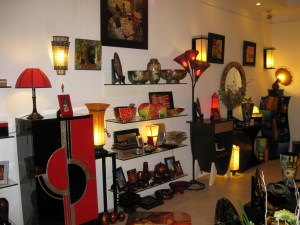
Our last afternoon and evening we spent hunting for souvenirs to bring to Canada in June. Vietnam is home to some remarkable craftsmanship, much more so that any South-East Asian country we have yet seen. Carvings, paintings, woodwork, lacquer work and ceramics are all done at any exceptionally fine level of craftsmanship, and we were hard pressed to choose from such a rich assortment.
Vietnam Laquer Crafts
Choices finally made we settled on some tasty noodles for supper, cuisine being another well developed aspect of Vietnamese culture and then went for a stroll along Nguyen Hue in the cool evening air. Saigon, with its blend of American hustle, French cuisine and civic planning and Asian culture and resilience, is a captivating city.

But Saigon is not Vietnam, and we both got out of the city enough to see that. With a coastline of 3,500 kilometres – longer than the distance from Key West to Bangor, Maine – there is clearly a lot of the country that we didn’t get to see. Fortunately for us Vietnam is less than two hours and only about $70 US away from us in KL. It may have taken us more than two years to get here, but we are both thinking that it will not take that long to get back.

Pam and I do not often take tours, prefering to go our own way and explore at our own pace. But sometimes the tour is the best way to go: the cheapest, the safest, and the most effective way to see difficult to reach places. Yesterday I took the tour to the Mekong Delta. In order to get a good price you have to be prepared to do a little shopping around, which can take some time. I checked out the prices at a few places ranging from 90 to 150 dollars American before I found the same package for $15. That included a motorcycle pickup at my hotel. We boarded a small airconditioned bus for the two hour drive to the start of the delta at a place called My Tho. Those who opted for the cheaper package got off here to tour the fruit orchards and honey farms that dot the delta.
Vietnam2009441

I stayed on the bus for another hour to the northern main branch of the Mekong where we boarded a comfortable and stable boat for a tour of the floating market, an area where fresh produce is brought down the river and sold wholesale to the many vegetable sellers in this region. We had the obligatory tour of the coconut candy and the puffed rice stores, but the rustic and hand intensive production of both operations was quite interesting, and the Vietnamese tea that they served, kept piping hot inside tea cosy that was a hollowed out coconut shell, had a delicate flavour and aroma.

Then it was back on the river to go across to the village for lunch. The Mekong is probably close to two kilometers wide at this point, at least this one branch of it is, and I was grateful for a steady craft and a powerful engine. Across the river we entered a narrow channel, that branched many times before we docked at a little village for lunch consisting of rice, chicken vegetables and a local delicacy called ‘elephant fish.’ It was delicious.

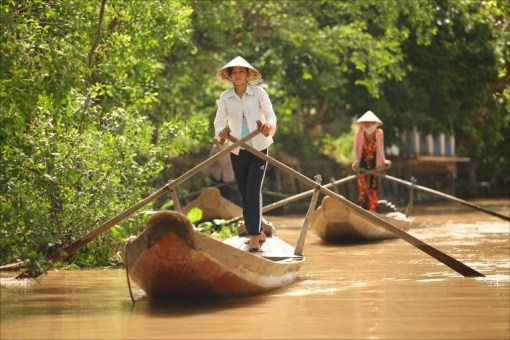
I managed to cop a wee nap in a hammock before we headed out again. The Mekong Delta is tidal, and now that it was low tide we had to be paddled out on small skiffs rowed by a wiry Vietnamese who stand at the back of the boat and row forward, crossing and levering two long oars against each other along the narrow channel. A variety of ducks frolicked and fed in our wake until we reached the next branch of the Mekong where our larger boat lay anchored. Once again we manoevered downriver, the Mekong’s flow now battled by the incoming tidal waters from the sea making for some turbulent water. Safely ashore at Vinh Long we walked through a long market crowded with produce to a small outdoor cafe overlooking the river. We sat sipping iced tea and staring at the river while we waited for our bus to arrive to take us back to Saigon.
mekong-delta-women

The bus trip back was uneventful, but I was happy not to be driving. The roads in this densely populated country are crowded with trucks, and lane discipline is a new concept, most prefering their half of the road right down the middle, thank you. We stopped once at a lovely roadside restaurant, complete with gardens, before hitting the road again. We got into Saigon around 7:30 pm, almost exactly 12 hours after we had started. The tour guide, the bus, the boat, the lunch; all that cost me $15 for one of those ‘once in a lifetime’ experiences. I think I got a bargain.

Vietnam_MekongDeltaI don’t think any river has captured my imagination like the Mekong. It is not merely that it travels through Nepal, Burma, Thailand, Laos, Cambodia and Vietnam, but it is the lifeblood of those countries; providing the only reliable highway in Laos, feeding fish to the Cambodians who eat virtually nothing else and providing Vietnam with enough rice for its 90 million people while giving it a valuable export commodity.

 

But that is not what captures me. It was the war, what the Americans call the Vietnam War, and what they call here The American War. It was the thousands of soldiers who travelled from North Vietnam across Loas to the Mekong, and spent months travelling down that mighty river to the delta from where they mounted the southern front in terrain that was impossible to penetrate, let alone defend. The scale of that offensive, the tactical daring of it captured my imagination, and made me long to see the river that had made such heroic tactics possible.

Last year we travelled from Luang Prabang in Laos to the Thai border along the Mekong. It was an idyllic trip through lush teak forest, and a magical journey I will never forget. We have seen the Tonle Sap at Siem Reap, and sipped tea where it joins the Mekong at Phnom Penh. At that point it is now a mighty torrent that last year drowned the entire crew of one dragon boat in their annual international race. And now today I have seen the Mekong Delta.

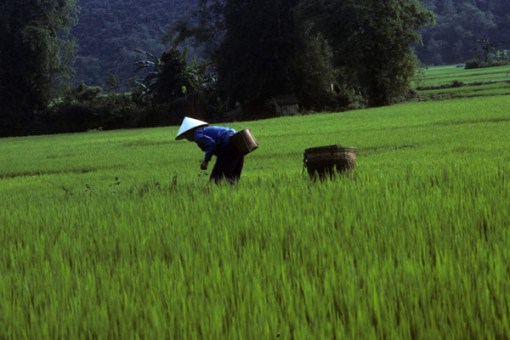
It is massive. One arm of it alone completely dwarfs the Mississippi, and there are nine arms, known as the nine dragons. Twenty million people live here, twice the population of Ontario, and yet there are no structures higher than two stories. Millions live either on the rivers or along their shores, boat and jetties line every bank, and behind every house are the fields of rice stretching to the flat horizon. There is a timelessness to the river and its patient stoic inhabitants that alters your perception of the planet and its people. I have finally seen the Mekong, and it was worth the wait.

We flew into Vietnam on Sunday. The airport is new and efficient and we paid the stated rate, $15 to get to our hotel. Having missed the place the first time and going around the block, the cab driver remarked “O my **, that IS it!” Not the most auspicious introduction, but we’ve been around the block a few times ourselves, Pam and I, and we are not easily put off. Our hotel may be modest, but it is clean and moderately priced and in a safe neighbourhood. Anything beyond that we consider conspicuous consumption.

Ho Chi Minh City

We got in early enough for an evening stroll through the upscale part of town, and I have to say we were pretty impressed. The streets and sidewalks are wide, as they are in Phnom Penh, similarly influenced by the French genius for civil planning, and the sidewalk cafes and rooftop terraces were gracious and friendly. We must have walked 20 kilometers on Monday. We started with a tour through Ben Thanh Market, much more organized than Central Market in Phnom Penh, but not nearly as much fun. Prices are pretty well as stated, and the Vietnamese are not easily moved.

Bycycle Rickshaw

We made the mistake of catching bicycle rickshaws outside of the market whose drivers took us two kilometers the wrong way and into a deserted courtyard for a shakedown. We don’t often make that kind of mistake when we are travelling, but we got off relatively lightly and more than a little chagrinned at our naivete. We hoofed it the rest of the day and found Saigon to be full of the romance of French influence and the legacy of protracted war.

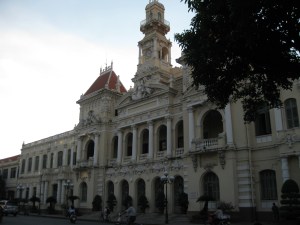
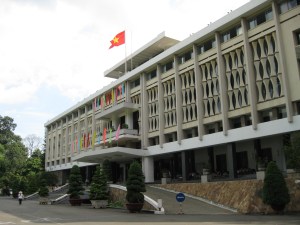
It is an odd combination. The Reunification Palace was everything you remember the archectecture of the sixties to be: angular and airy. The Hotel de Ville and the post office pure French colonial gingerbread.

Reunification Palace

Hotel de Ville

The War Museum was suitably horrific, as befits a horrible war. The artefacts of the American genius for crafting weapons of death were eye-opening even for one as cynical as I, and the pictures of the human costs of torture, mines, napalm and Agent Orange won’t be easily forgotten. Salad Nicoise and a sweet crepe at a French cafe went some way to restoring a sense of perspective on a troubling day.

The Vietnamese are a hard and hardened people. Their drive for prosperity is being noted even among their neighbours in South-East Asia who are used to seeing such rampant capitalist ambition. A square foot of land in Saigon is now more expensive than Hong Kong or New York. Everywhere you look buildings are going up; expensive buildings. Our shakedown at the market is just the tip of the iceberg: these people are tenacious and determined. Whatever is takes, they are going to succeed, and they are going to be a force to be reckoned with in this part of the world.

vietnam

Hindsight is a curious thing. As you age there comes a need to make sense of where you have been in life, and to put things in perspective. Quite often this becomes an exercise is self-deception and flattery, a kind of personal revision of history, hence the wide disdain for such reflections. While making every allowance for this tendency, and seeking as best as I am able to avoid it, I recognize that some will see this post in that light regardless.

But we are going to Vietnam, Pam to minister, I to visit, and some reflection is unavoidable. After all, for my generation there are few countries that more resonate with our personal histories than this one. So many deaths, including four innocent students on the campus of Kent State, so many horrific images – the naked girl fleeing in terror from her napalmed village, the Buddhist monk in saffron flames – so much deception and corruption, finally ending in the resignation of America’s most hated president, Richard Milhous Nixon. To finally visit the country that generated much of this angst is cause enough for reflection.

My part in the protest movement of the 60s was minimal: some marches, some arrests for public disorder, some police surveillance. Nothing out of the ordinary for an average Canadian growing up in those days. Canada was a haven for those who protested the war, and we were relatively safe in our mild protestations. America was the real battlefield, and although I spent some time there and took part in the social activism of the day, my passport ensured that I paid a moderate price for my view on events in South-East Asia.

But Vietnam was never far from my thoughts, and there was no question that what America did to that country and the neighbouring countries of Cambodia and Laos was seen by many of us as criminal. While fifty thousand American soldiers lost their lives in that war, ten times that number of Vietnamese died, the overwhelming majority of those being innocent civilians caught in the crossfire. Cambodia and Laos still haven’t recovered, Vietnam, with its far greater population and national resiliance, has.

I am looking forward to seeing a country that has been in my thoughts since I began to think about my global responsibility. I think it is going to be a worthwhile experience, and one that for me is long overdue.

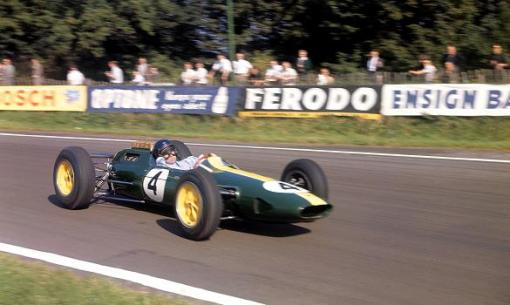
1963 Lotus
The name was as hip as the Beatles and as charismatic as Carnaby Street and now Lotus is back on the grid. The company says it will compete in Formula One next year, a team revived after 15 years away from the glitz and glamour of grand prix racing it once dominated to become one of the iconic names in motor racing history.

In spite of the indomitable history of the familiar green and yellow badge, it is a sign of the times that the new Lotus team will be British-based but backed entirely by money from Malaysia. Tony Fernandes, the entrepreneurial founder of Air Asia, will be the team principal with Mike Gascoyne, the former technical head at the now defunct Jordan and Toyota teams, running the construction operation.

The team was founded by Colin Chapman, a brilliant engineer, whose ability to innovate soon powered his cars to the front of grand prix racing. With drivers like Jim Clark and Graham Hill at the wheel, the Sixties became a period when British cars started to dominate Formula One after years of rule by the Italians.

The Lotus name was also turning into an icon on the roads, Chapman building a series of sports cars, including the little, white Elan driven glamorously by Diana Rigg as Emma Peel in the television series, The Avengers, which even today is a cult classic.

The team started a sad decline from 1982 after Chapman died of a heart attack, aged just 54, amid allegations of fraud after he became involved in the ill-fated DeLorean scandal. The team left Formula One in 1994 and the brand was sold in 1996 to Proton, the Malaysian state-owned carmaker now behind the new venture. Tony Fernandes, former shortstop for the World Series Champion Toronto Blue Jays, and now the fifteenth richest man in Malaysia and other Malaysian investors are backing the venture with considerable financial capital.

“It will be a big challenge to get on the grid but certainly by mid-season I think we’d clearly like to be the best of the new teams and by the end of the year I would hope we have broken into the top 10 overall,” Gascoyne told reporters.

Excerpted from: The Times Online and The Malaysian Star

Philippine Restaurant
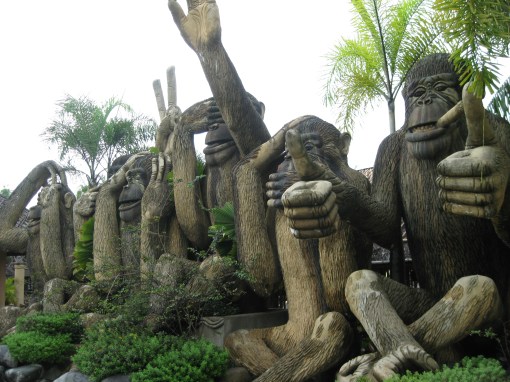
Travelling in Asia has some surreal moments. Like driving down the highway from Baguio City to Clark Field and encountering a “floating restaurant.” As we were miles from the ocean at that point, we stopped to investigate. Here was this restaurant on the edge of the highway, miles from anywhere that was built on a marsh. Taking advantage of what anyone else would have deemed a liability, the owner had constructed a series of platforms and private gazebos connected by bamboo bridges, and made that the site of a restaurant.

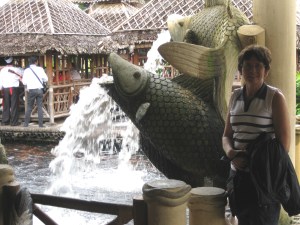
Philippine RestaurantBut not content with that incongruity, the owner stretched the point by populating the place with the oddest sculptures, like the monkees pictured above and huge concrete fish in various poses. There were pools of goldfish to feed and a narrow concrete bridge over which the daring were invited to walk to win their lunch, or get thoroughly soaked trying.
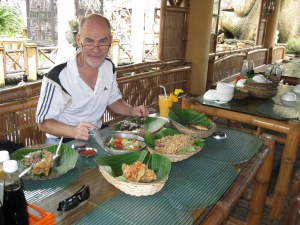
Philippines 101We settled on paying for a feast of fried chicken, grilled tilapia, chow mein and shanghai fried rice, washed down with mango and papaya smoothies for a very reasonable price. We paid a little more for Steve to seranade Pam along with a troop of wandering minstrels singing Elvis and Ritchie Valens. Just another surprising and delightful chance stop along the route of our Asian journey together.

« Previous PageNext Page »