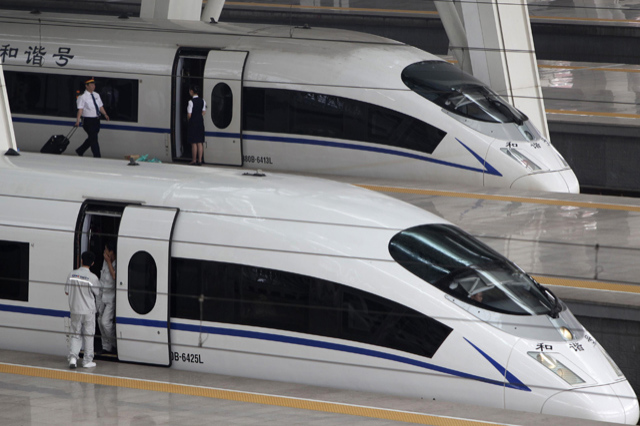
I had been looking forward to the train ride from Beijing to Shanghai ever since construction began in 2008. The line opened for service in June 2011, but an accident due to a brake malfunction caused the authorities to recall 54 trains in August of that year. All the recalled trains went back into service in December 2011. Designed to travel at 380 kilometers an hour, speed is restricted to 305 clicks to save energy. It took just under five hours to travel the 1300 kilometers to Shanghai and on the rubberized wheels smoother than travelling at 100 clicks back home. The ladies spent a good deal of the time in the comfortable restaurant car, but I was happy to sit and do a little blogging while we travelled.

We passed through a number of cities on our way south, any one of them as large or larger than Toronto, and over the Yellow River in the north and the Yangtze closer to Shanghai. The countryside was largely flat and agricultural, and although there were a few hills in the distance, they were mostly obscured by the ever present smog. The train station, like the ones in Tianjin and Beijing, was clean, spacious and modern and we had no trouble finding a cab for the forty minute run to our hotel, which cost 80 Yuan (around $12). Pam had chosen another Holiday Inn Express for its location right beside the train station to Hangzhou where we were to catch our flight back to Malaysia. Once again we had booked through Agoda, and once again our reservations were secure and fully paid for, making check-in and check-out a breeze.
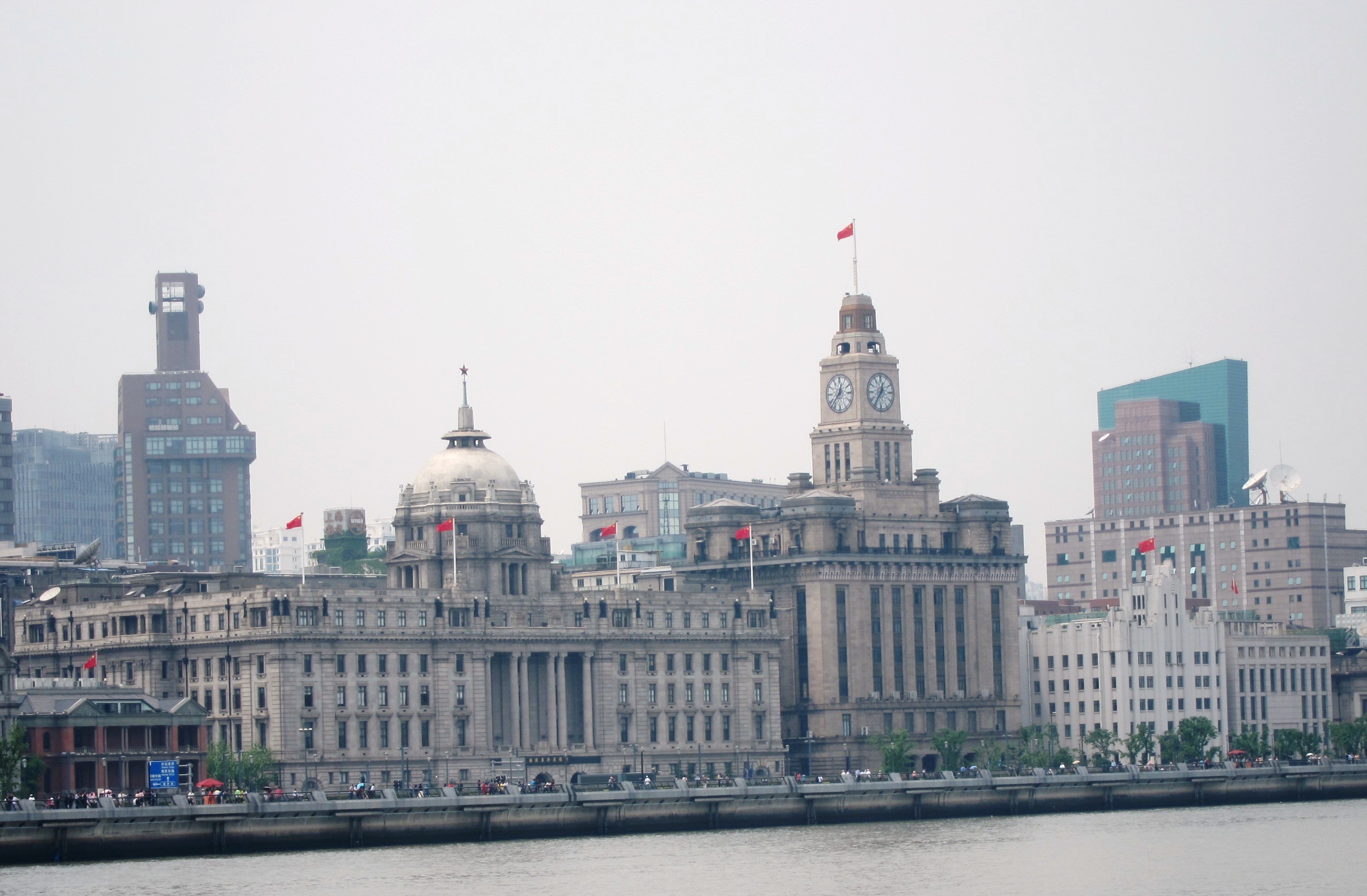
Once settled we walked to the train station where we caught a subway to People’s Square, figuring from the map that it would make a good starting point for our exploration of Shanghai. As soon as we got there we found a Hop On-Hop Off bus tour. Our good friends Bill and Kim McNamara always used these things to get oriented to a new city, and it sounded like a good deal, 300 Yuan ($50) for 48 hours and entry to a number of sites. The red line took us down to the Bund, the impressive street of buildings overlooking the Huangpo River that flows through Shanghai. One of those buildings, home of the Hong Kong and Shanghai Bank, figures prominently in my family’s history.

At the end of the Bund we turned back into the city, past the Yu Gardens and the French Concession, and back to Rompin Park and People’s Square. This arm of the tour lasts 30 minutes, and connects to the blue and green lines which cover other parts of the city. We walked up the street to find a local noodle shop and found one offering a huge bowl of noodles, bean sprouts and sliced beef for 20Yuan ($3). Then we walked down Nanjing Street which is closed to vehicles from the park most of the way down to the Bund. Hawkers selling every imaginable gizmo lined the street. A simple bu yao was enough to get them to back off.

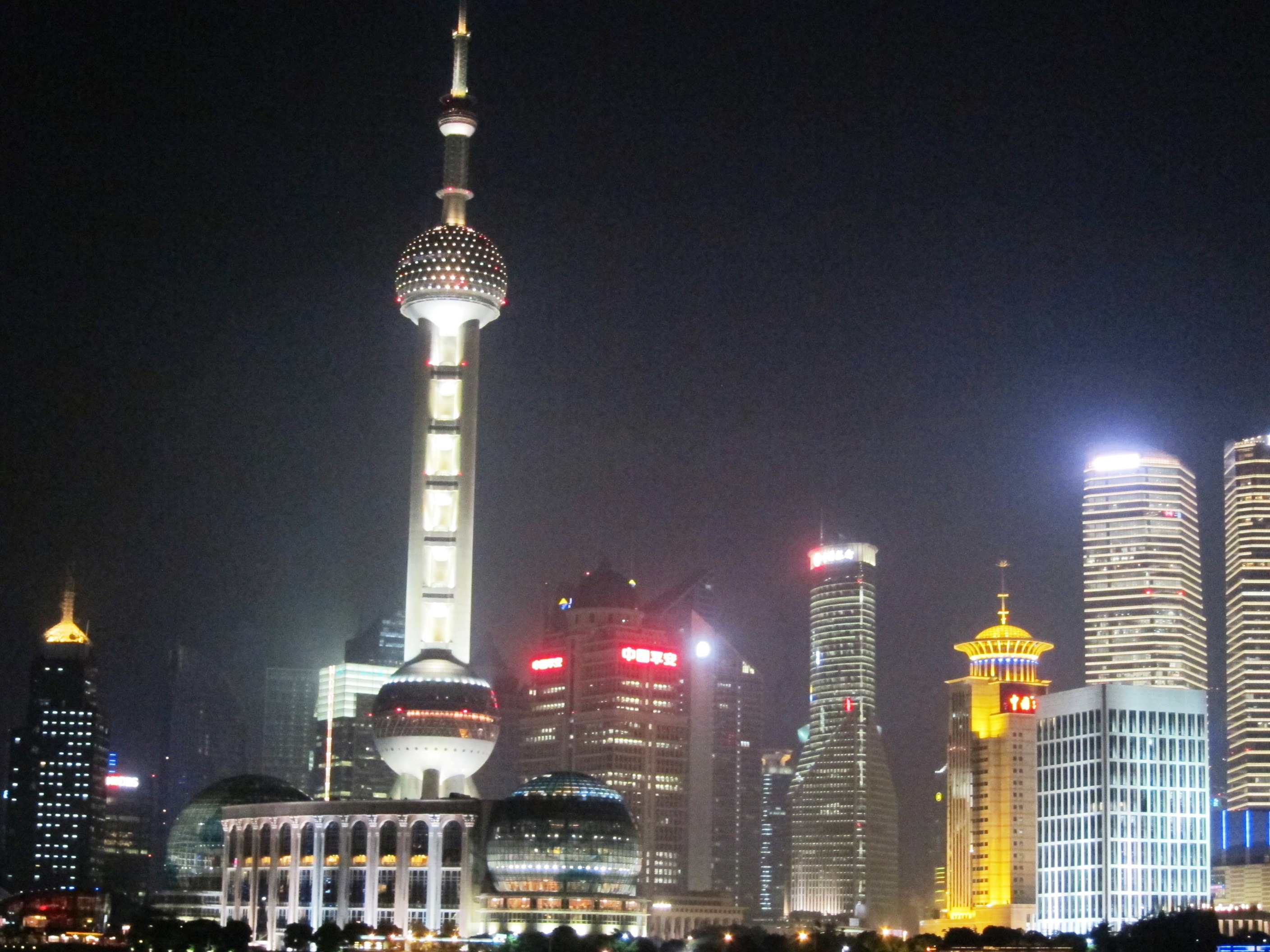
By the time we got back to the waterfront the lights were on, and the buildings across the river in Pudong District were all aglow. Some, like the Citi Bank tower had artistic light displays of butterflies and flower petals, but others, like the distinctly Asian Pearl Tower were simply stunning by virtue of their design.
It would have been easy enough to catch a subway back to our hotel, but we were all tired and opted for a cab instead. It was a mere 30 Yuan ($5) for the four of us, and well worth it. Once again the beds were comfortable, and with air in Shanghai a mild 20 degrees, sleeping was a delight. Shanghai looks wonderful, filled with colour and light, and with an almost holiday mood among the people compared to the austere and severe atmosphere of Beijing. We slept well in anticipation of a full day.

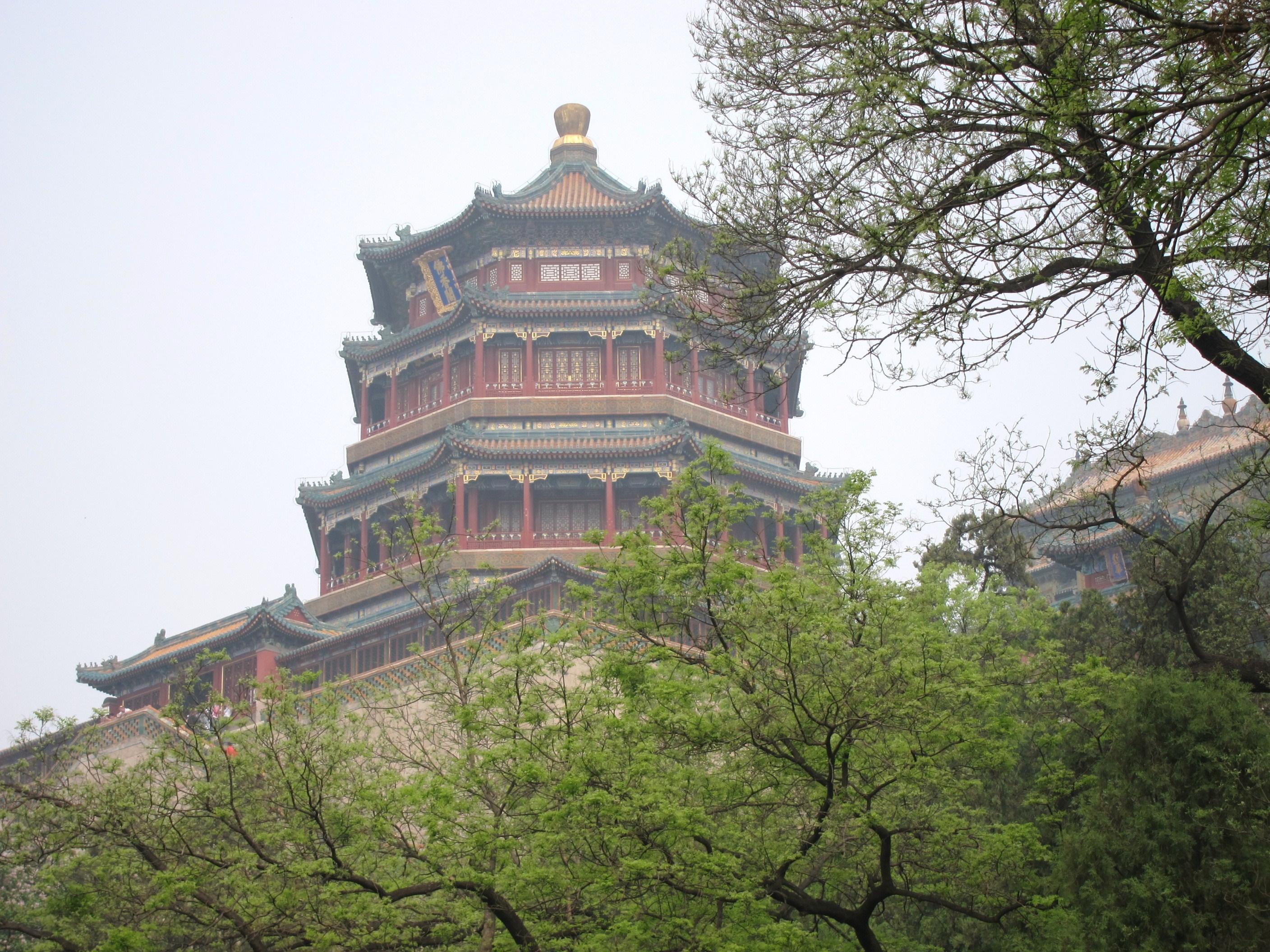
We woke up as stiff as before, but still game for what lay ahead. Sandy and her driver were right on time and we headed out to the northeast of the city to see the place where the emperor moved his court during the summer months. Although only a few kilometers from the Forbidden City, the Summer Place was as green and pleasant as the Forbidden City had been barren and dirty. Trees and flowers lined the walkways, and the grounds were boarded by a pleasant lake on which there were scattered hundred of little paddle boats. We strolled through a colonnade whose beams were painted with scenes of pastoral China, and climbed to the top of the Buddhist temple, twice razed by colonial powers in their attempt to humiliate the emperor and gain trade access to China’s vast market. Rebuilt in 1902, the temple affords a lovely view of the lake, its vista tempered by the ever present smog which hangs over this country like a veil.

 
Along the way we stopped to watch some traditional Asian dance and listen to some local residents serenade the morning air with songs filled with patriotic fervor and pride; unaccountably accompanied, by a band consisting of trumpet, saxophone and tuba!

After buying a couple of small souvenirs, we came out on to the street only to find the police in the process of hauling away the carts of some local vendors who clearly did not have the proper permits. I was impressed not by the efficient taciturnity of the authorities, but the enthusiastic protest of the vendors, who at one point took to throwing their wares – sweet potatoes, in this case – at the backs of the officers. These are a passionate people!

Sandy insisted on taking us to a silk factory, which is always part of the deal of renting a driver in Asia. We reluctantly agreed, and Shelley and Moochi did in fact end up buying some stuff. We pulled over to look at the Bird’s Nest Stadium, again obscured by smog and took a couple of pictures. Then it was on to the tea factory (Dr. Tea) for their song and dance. Once again the experience was lovely, but the whole ‘drag the dumb tourist around to buy things’ was beginning to get to us, and we bought nothing. Then Sandy wanted to do lunch. We knew what that meant: a pedestrian meal at an exorbitant price where the driver and guide would eat at our expense. We declined; they were ticked. They picked up some food at McDonald’s and drove us to the Olympic site, as agreed, but only to get a foot message. Again we declined, and went for a walk around the grounds instead.

On our return we asked to be taken to Prospect Hill and were told it was “out of our way” and they wanted an extra 100 Yuan to go there. It was time to play the heavy. I had kept the agent’s card and with my trusted Malaysia SIM card called the agent and told her that I expected her to keep the terms of our arrangement and direct her guide to do the same. I then handed the phone over to Sandy for what I hoped would be a firm rebuke. This was not to be; after a few minutes Sandy handed the phone back and the agent then said that the site was out of the way and they wanted another 100 Yuan. It was time to play my trump. In a militaristic culture everyone is afraid of the authorities. I threatened the agent with reporting her if she did not comply, hung up, and waited. A few minutes later Sandy’s phone rang. I didn’t need a translator to hear her compliant tone. After the call she turned around to say we were going to Prospect Hill. She also added, most unconvincingly to my ear, that she still wanted 100 Yuan. I simply said ‘no,’ but to help her save face, I offered to make this the last stop, as it would be 3 o’clock by the time they picked us up at the East Gate and it was still a half-hour back to the hotel.

Disdaining our complaining muscles, we once again set about to climb to another temple. But this one has the distinction of having the best view of Beijing in general, and of the Forbidden City in particular. That may be, but short of closing down the city for three months as China did prior to the Olympics, no one may ever know. The smog was so thick you could not see much beyond the temple gardens on the north side of the imperial grounds. The flowers on the other side of the hill looked much more inviting, and we made our way down into the gardens of tulips and peonies that line that side of the hill. It looked so much like Ottawa in the spring it made Shelley’s heart ache.

Linking up with our guide and driver at the East Gate we drove back through the impressively wide boulevards of Beijing. Politely declining the offer to ‘tip the driver,’ we had a quick stop to refresh before we headed out for an early evening meal.

A couple of blocks brought us to the Honglian Roast Duck Restaurant where we intended to try the local specialty. The duck, to be honest, was nothing special. But the rest of what we ordered was fantastic. Salad, roasted cauliflower, lotus root, ocean perch, kale, sweet and sour pork, roast duck and drinks all combined came to about ten dollars Canadian each. It was a memorable meal and we happily waddled home like ducks ourselves after it!

A year ago today we had the joy of welcoming our lovely little Elisa Grace into the family even as we prayed for quick healing of Jon’s leg and dealt with the anxiety of wondering about the long term impact of one old ladies decision to drive without her glasses.  We rejoice in the beautiful little girl Eli is and the extent of the healing that Jon has experienced.

Once again I am packed and ready to return to Canada this afternoon for the annual visit home.  Steve will, of necessity, stay behind to finish out the school year before joining me in Ontario on June 22 for a ten day visit there and then on to Calgary for another ten days.  The school break is very short this year so it will be a challenge for Steve to get in all the desired visits and necessary tasks in less than three weeks.

No weddings or new babies to look forward to this year but can’t wait to get my hands on Ben, Abi and Eli and to see family and friends- and get to see Greg and Liz’z new home.


China’s imperial past displays an affinity for dragons, both mythological and human. Their present control by the totalitarian Communist Party is not a new phenomenon: China has been ruled by dictators throughout most of its long history. Some of these despots have worn the green uniforms of the current ruling party; some have worn the red dragons of symbolic heavenly approval. Both types of rule have written a narrative of misery on the backs of China’s suffering millions.

China’s present rulers show an unwavering appreciation for utilitarian architecture. Beijing is crammed with official buildings of a uniformly grey monolithic design, implying an impressive immensity that is probably meant to cow the ordinary Joe or Chang. Looks like a lot of same-old, same-old.

The emperors had a similar delight in filling vast acres of space with seemingly identical buildings distinguished only by size and the number of gargoyles permitted on the rooftops. The smaller buildings now contain the artifacts of former dynasties.

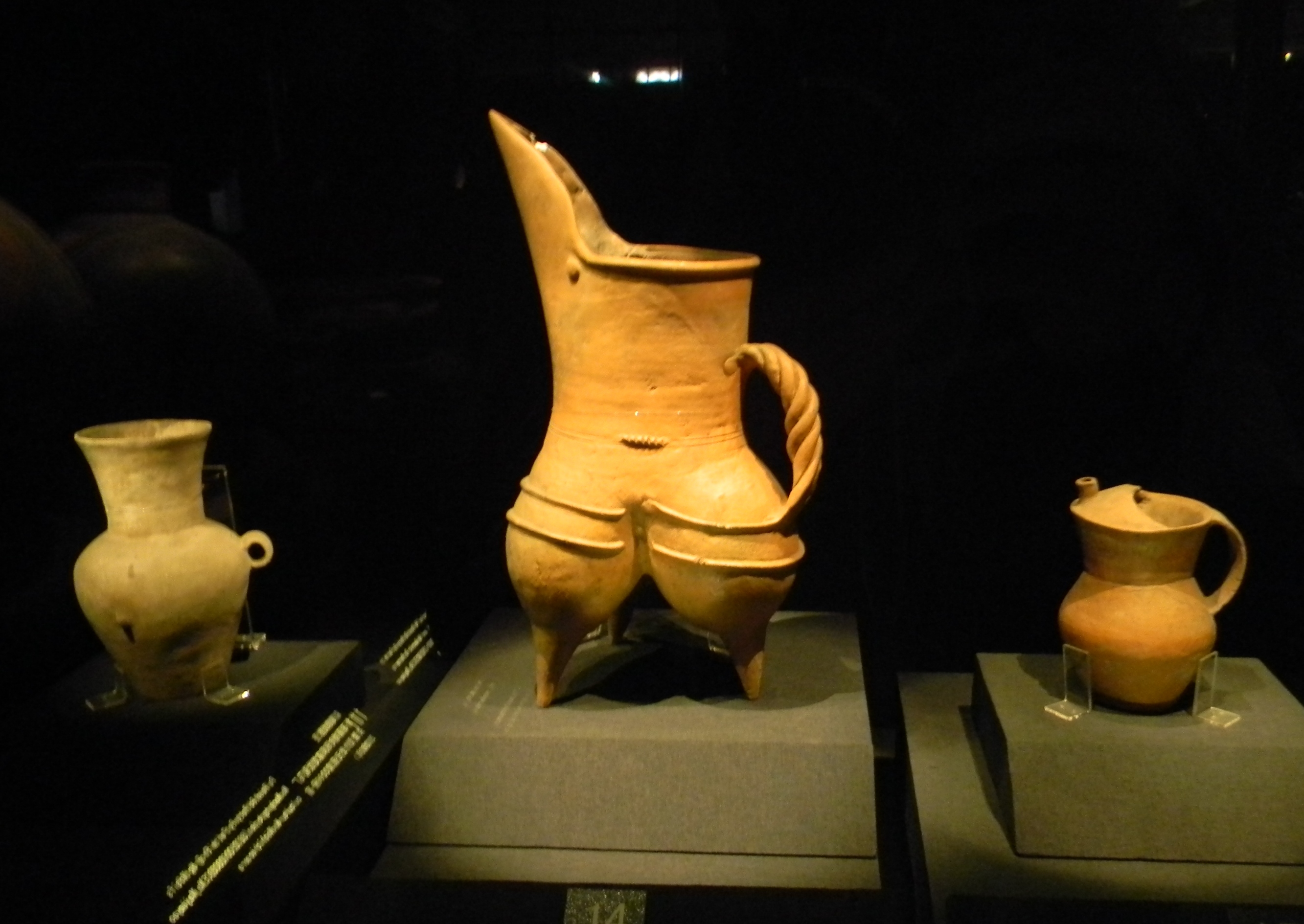
The one housing pottery was especially interesting, displaying vases of exquisite design, some of which were an astonishing 7,000 years old. As we were in Beijing during the May 1 holiday break, the site was packed with people, and to be honest, the Forbidden City was not particularly noteworthy. It was impossible to see into the larger buildings, and what we did see was threadbare and careworn, as were the grounds and the buildings themselves. The garden at the north end of the property was nice, but small, and far too crowded to be restful in any sense of the word.

Exiting through the north gate brought us back onto a road thick with holidaying people. Getting a cab was out of the question, so we walked down the east side of the wall until we found a little tea shop with a rooftop restaurant where we got very slow service and a rather pedestrian meal. However, the tea was lovely and refreshing and it did give us an opportunbity to plan out the rest of the day. Pam and Shelley decided to go shopping at a nearby mall, while Moochi and I opted to brave the crowds at the zoo to see the pandas.


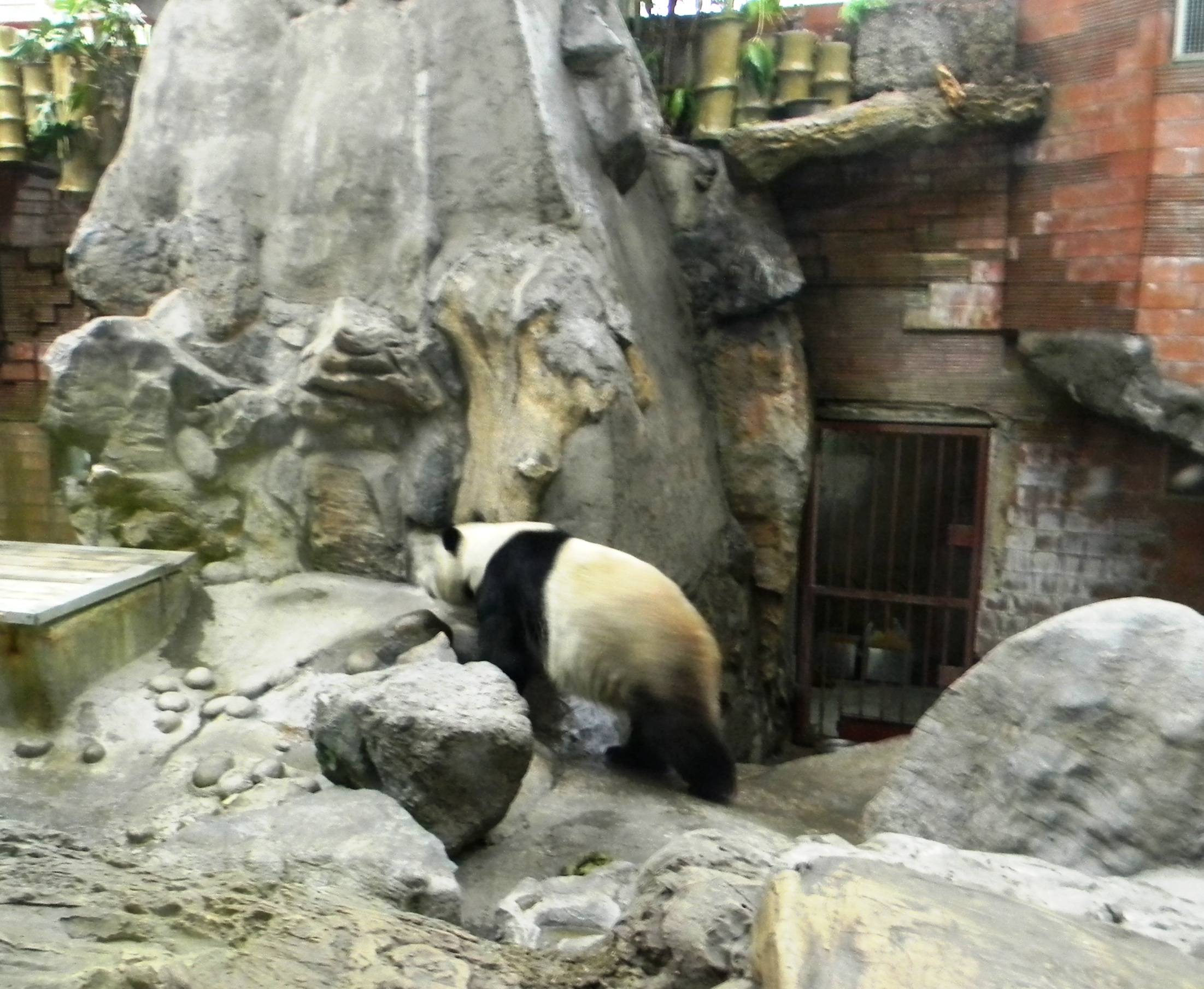
The zoo suffered from the same neglect and wear as the Forbidden City. Clearly it had been well planned and nicely located at one time. But it was not up to the traffic of a population of 20 million people in Beijing. The grass had long since been trampled bare; cages were rusty, enclosures dirty. The pandas were lovely to see, but encased in a glass enclosure (for their protection?), and packed with crowds seven or eight rows deep, it made viewing seem rather more a chore than a pleasure.

As we had arranged with Pam and Shelley to meet at the Bell and Drum Towers, and the crowed outside the closed subway station packed densely from the sidewalk to the first lane of traffic for the entire block, we caught a waiting taxi and paid the 50 Yuan he insisted on to get us out of there. The ladies were not there and through a text message (thank you Maxis!) we found out they had gone back to the hotel. After walking fruitlessly to find someplace affordable to eat in the trendy hutong district, Moochi and I caught a subway and bus back to the hotel in time to join the others for a bite to eat and plan out the next day’s activities.

We decided that given the difficulty of getting around town by either cab or subway, we would hire a driver for the day. Pam and Shelley had been given a card by someone on the street who seemed nice. We called and she was happy to arrange a van for us for 400 Yuan to go out to the Summer Palace and “whatever else we wanted to do,” provided that it did not exceed 8 hours. I agreed to her terms, and set a pick up time for 8 o’clock.

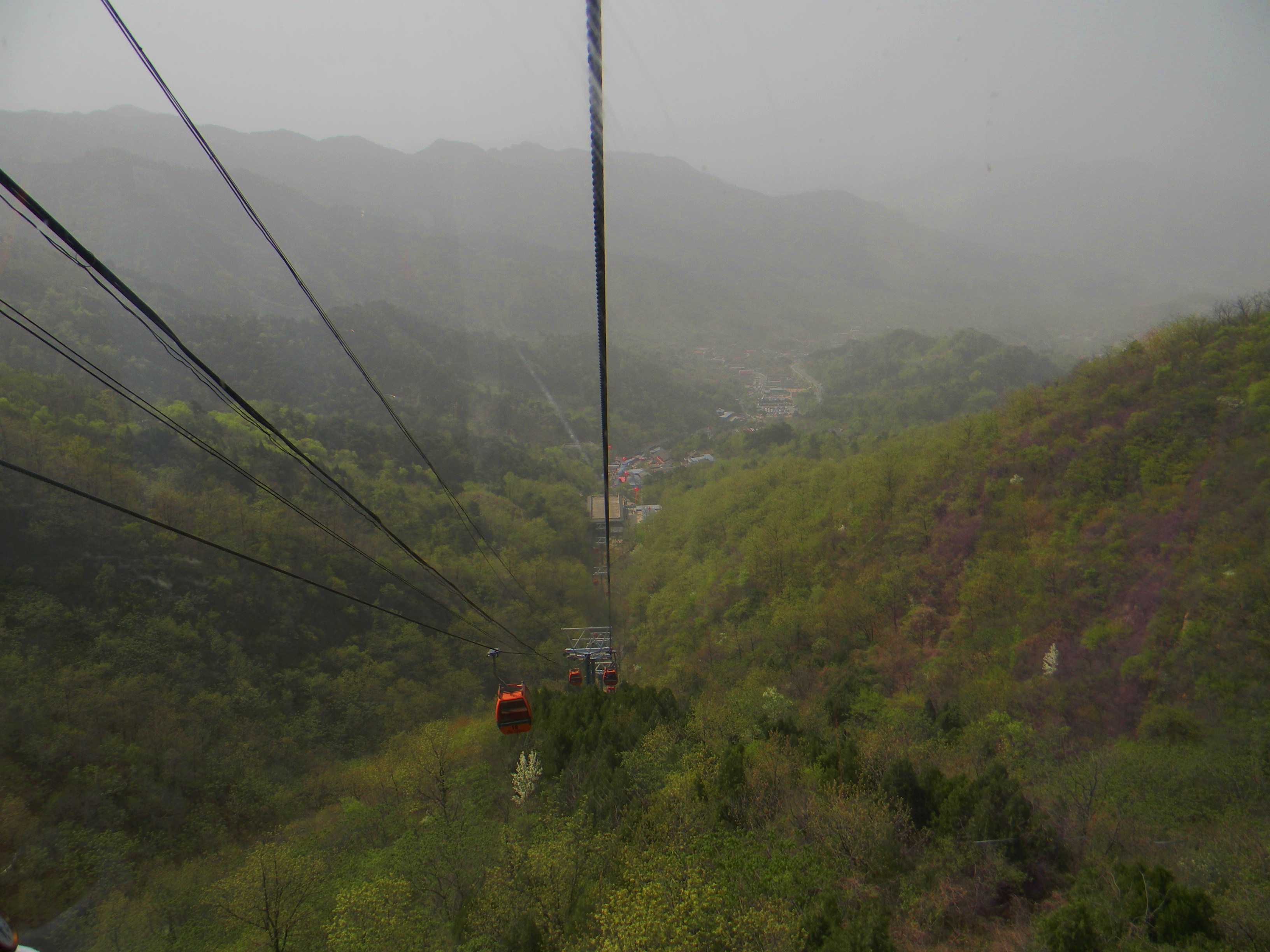
The Holiday Inn Express may be a modest hotel ($70 a night in a pricey city), but the beds are terrific and we had a great night’s sleep. Breakfast was a minimal affair; some watermelon chunks and a couple of hardboiled eggs. But the driver was right on time and we were away in a very nice vehicle driven by an excellent driver who knew the backroads and could avoid a lot of the traffic headache. He also knew the outside dimensions of his vehicle as if it were a second skin and we made the trip to Mutianyu in under two hours. We figured were going to do plenty of walking that day so we took the gondola ride to the top of the wall to begin our hike.

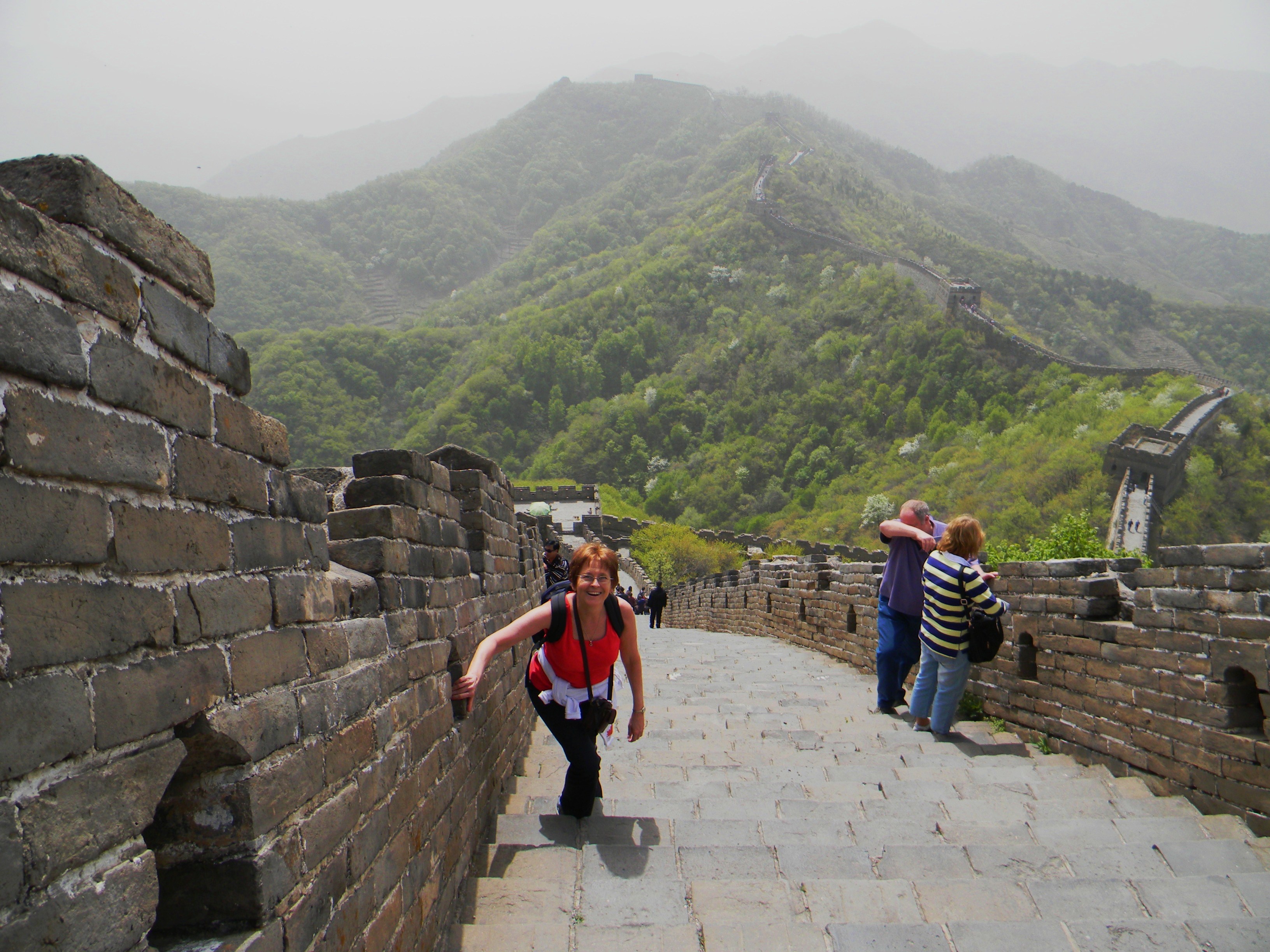
The wall is built along the top of a ridge; several hundred ridges in fact, as the wall winds its way across 7,000 kilometers of China’s northern and western borders. Originally built around 200 B.C. of stamped mud, it was expanded during the Han Dynasty and again under the Jin in the 12th century A.D. However it was unequal to the task of keeping Genghis Khan and his Mongol troops from conquering China begining in 1206 and continuing until the death of his grandson Kublai Khan in 1294. After the restoration of imperial China in the Ming Dynasty, 1367 to 1644, the wall underwent an extensive repair and rebuild, this time with more substantial building materials of rock, brick and mortar. It is this wall, some sections of which are nearly 650 years old, that has survived to the present age. Although nowhere near as artistic or inspiring as St Paul’s in Rome, which was finished at around the same time, it is impressive not only for its massive size but also for the beauty of its natural surroundings.

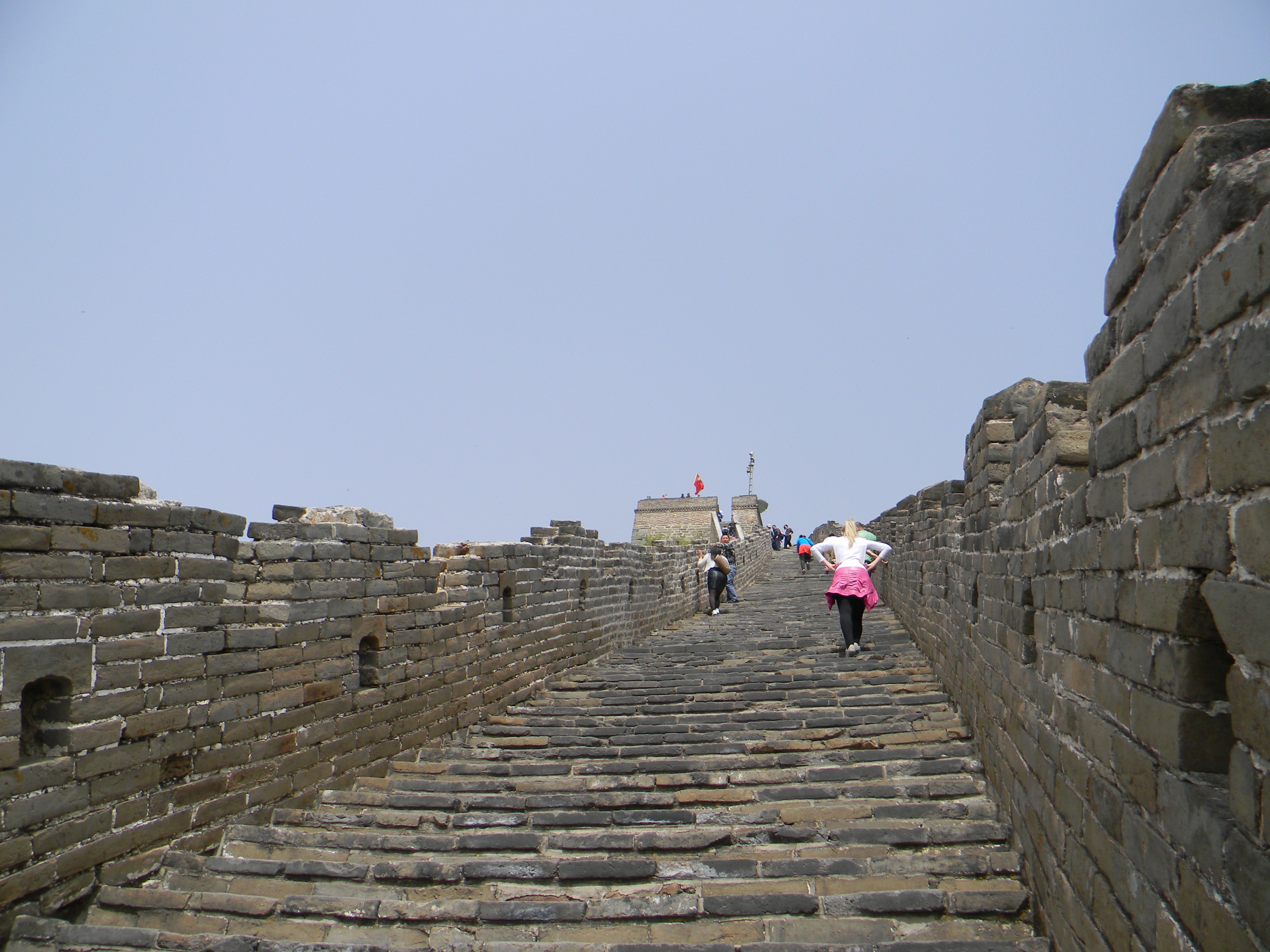
The gondola let us out at tower 14, and faced with the decision of either going uphill to the left/west, or downhill to the right/east, we chose uphill, figuring that once tired it would be better to go downhill. The rebuilt sections are wide enough for six to walk abreast, and the crowds were minimal at this hour, so we strolled easily, without jostling, admiring the view from each watchtower and the audacity and perseverance it must have taken to build such an enormous fortification. In addition to the watchtower, there were cannon placements and gun/arrow slots all along the wall.

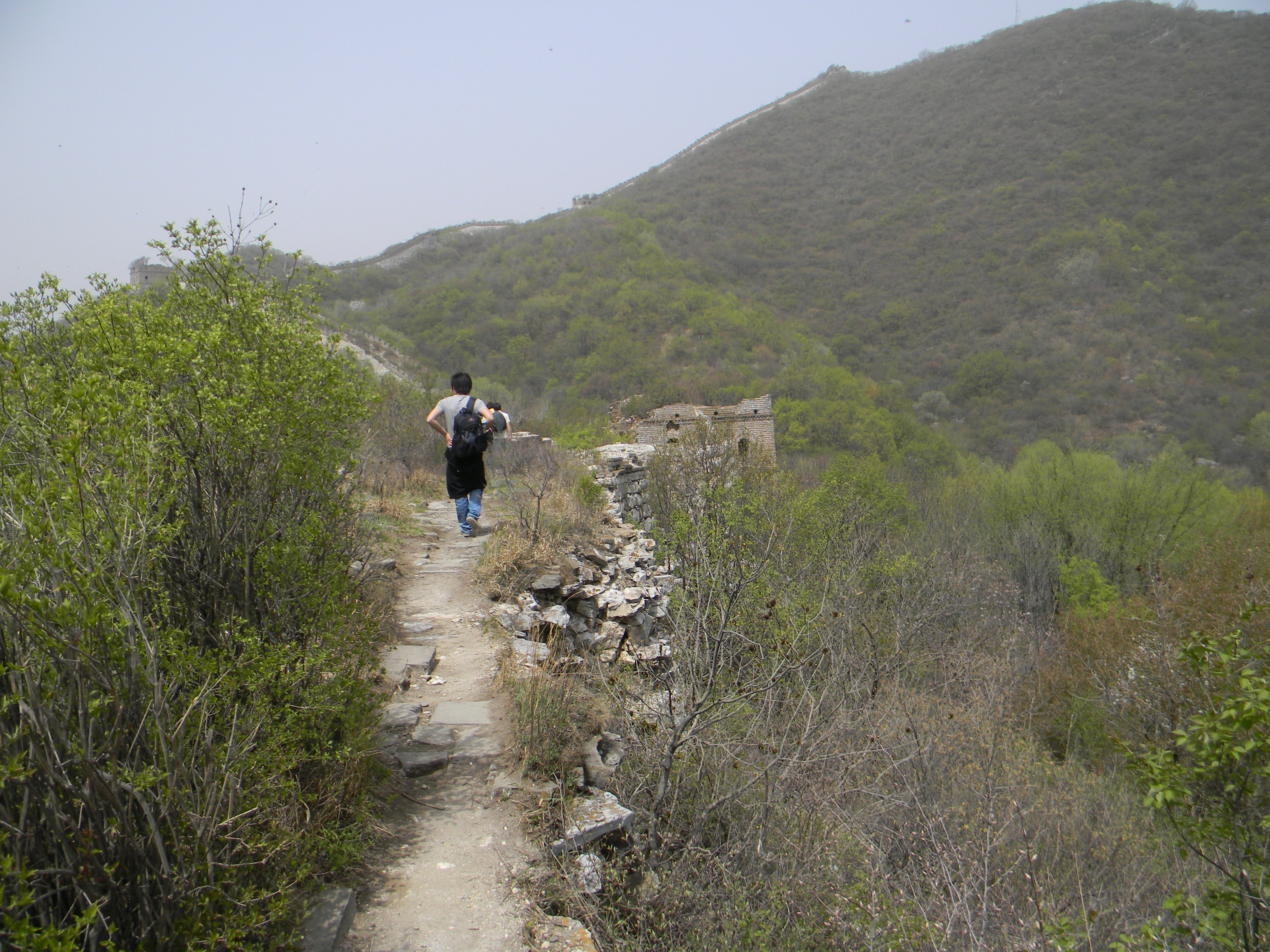
Pam and Moochi had run out of steam by tower 18, the last row of very steep steps proving too much. Shelley went on to tower 19 and took some videotape of me doing Tai Chi on the wall before she went back. I struggled on past tower 20, onto a stretch of unrestored wall. This is where it gets a little tricky, with no restraining wall and the ground dropping steeply away beneath a crumbling trail. I contented myself with one more kilometer before I too allowed discretion to overrule my enthusiasm for exploration. With a week of walking through Beijing and Shanghai before me, I did not want to risk twisting an ankle for the sake of amateurish bravado and bragging rights.

Back at tower 14 we considered our options. We could return the way we came, or we could go on by exploring the wall to the east. Moochi was pooched, and went back down the hill, but Shelley, Pam and I went on downhill, which given the wear on our quads and calf muscles, was a lot harder than it sounds. We soldiered on, treasuring the rare flat sections of the wall and enduring both up and down sections as they afforded the better views. It really is a spectacular setting and we enjoyed every vista to the max, pinching ourselves as we went that this was in fact us who were walking along the Great Wall of China!

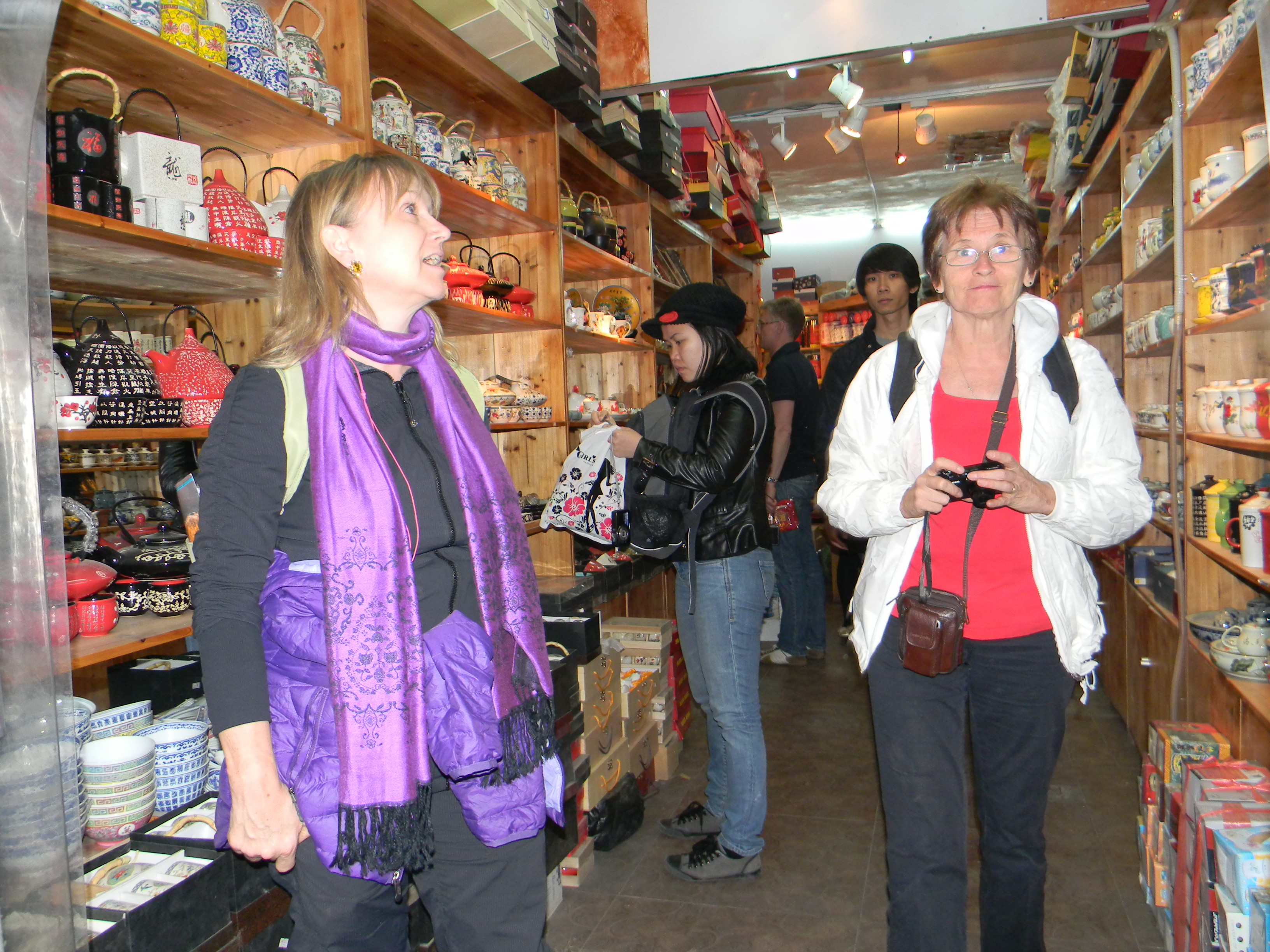
At Tower 4 we caught the slide to the bottom. That’s right, a tacky metal slide like you would find at Wonderland, with a tacky plastic toboggan that had a joystick handbrake and nothing else. It was wild and it was fun and I don’t care if it was comically out of place; we all enjoyed it! Our driver was waiting for us at the bottom, eager to be on the way to beat the Beijing traffic. But we were in no hurry to leave and bought a few souvenirs for the grandkids before we bundled back into the car for the trip back to Beijing.

Rather than go back to the hotel, we had our driver drop us at the Bell and Drum Towers just north of the Forbidden City where we got a bite to eat on a rooftop restaurant overlooking the square. Suitably refreshed, we explored the little shops around the square where Pam and I found a wall hanging for that bare space above the television at a Chinese art shop. Then we headed into the hutongs, the little alleyways that line this side of town, bordering one of the many ponds and little lakes that dot the city. The ladies bought some scarves and we wandered until we could walk no more and then grabbed a taxi for the ride back to our hotel. It had been an amazing day!

We got up at 4 am for the morning cab ride to the airport. It helps if you go to bed early. It also helps if you sit in the front with the cabbie, who at this hour is always a little sleepy. Can’t say that I blame them; these guys work awfully hard to scratch a dollar in this economy. All the same, they do love to drive fast in this country, and 140 clicks down the highway in the backseat of a cab driven by a guy who is nodding off can be a little unsettling.

Check in was a breeze, as it always is with Air Asia, and we were settled in the airport’s Coffee Bean with our lattes long before Shelley and Moochi, our companions for this trip arrived. The flight to Tianjin was uneventful. We had this Chinese lummox crammed in beside us who clearly needed a much larger seat than is available in economy class. But he got himself moved to somewhere else and Pam had room to stretch out and sleep for a good part of the journey.

Tianjin airport was clean and efficient and we easily found the ticket booth for the train to Beijing. The bus at 40 yuan was cheaper, but the train at 60 yuan ($10) is a better option. There was a connecting bus, which was not pleasant, but not terrible. The train however, was marvelous. We hummed along at nearly 300 kilometers an hour and the ride was a smooth as your grandma’s rocking chair. Outside the rice paddies and vegetable plots eased peaceably by. There seems to be some kind of reforestation program going on, as there were acres of newly planted poplars everywhere along the train tracks.

Reforestation sound like a good plan for China as there was not much on the way of natural forest left that we could see. The result is air that looks a lot like grey soup. You will see it in all the pictures that we took, although the photographic lens does lie to excess in that the diffused smog distorts the camera’s light sensors. The reality is better, but not by much. The smog is not localized, like it is over Toronto or New York, but seems to be pretty much regional. It was if anything thicker on the ride to Shanghai. But I am getting ahead of myself.

The train station in Beijing was impressive; very modern and efficient, much more like an airport than anything else. The line up for a cab was at least a hundred people long, but it was moving pretty quickly and we opted not to take up the offer a ride in a private car for 200 yuan ($35) as we had deliberately chosen our hotel for its proximity to this particular terminal. The meter on our cab was 20 yuan. I paid the cabbie 30 and we unloaded at the Holiday Inn Express Temple of Heaven. I assure you there was nothing heavenly about our surroundings but only a rather dreary commercial landscape with grey streets and grey buildings joining the grey air in a dismal harmony. I scouted the area for a suitable restaurant while the ladies unpacked, then we went out to a local eatery for a sampling of Beijing fare, which was tasty, but heavily salted and loaded with MSG.

After dinner we tried the hotel’s internet only to find that this was going to be severely limited during our time here. We could view our website, but as soon as we tried to enter the site to upload a post, it went offline. Facebook was similarly blocked. Google was fine and we did gain access to our email long enough to email a message to our kids, but that was about as far as we could get. Blocked from access to the outside, we turned our attention to the task at hand: plotting out our trip to the Great Wall.

We had obtained a couple of leads from colleagues back in KL, so I gave them a call. With the May 1 holiday around the corner, people were reluctant to brave the traffic for the drive to the Great Wall, our destination for Day 2. But we did find one guy who was willing to drive and who knew the way to Mutianyu, our preferred section of the wall. The catch was that he didn’t know English, but here is where Moochi came to our rescue. She is fluent in Mandarin and Cantonese and handled all of our translations for the week. We booked the driver for 7:30 and called it quits for the evening. We were going to need our strength for the following day.

Five years ago today we began an amazing new leg of the journey of our lives.  We said goodbye to the people who are dear to us and packed all the things that were important to us into four suitcases.  Steve had the promise of a one year teaching contract with Taylor’s College in Malaysia and I had a draft and brief description of a missionary position with TWR- Asia to work with HR and media resources related to a health program in Cambodia.  Both of these have unfolded as God intended, with Steve now completing his fifth teaching year and a health program well underway in Cambodia.

Along the way we have had some amazing experiences and learned much about ourselves and the joy of serving in Asia.  We both came into this with a love of new places, cultures and people and a real joy in learning to understand what makes people tick.  We were unprepared for the extent to which these cultures and people would get under our skin and how quickly they would become a part of who we are.  Now when we think comfort food we think of dosa masala instead of steak and baked potato.

We have seen a degree of poverty and suffering that shocked us out of our complacency, and have gained an entirely new understanding of the difference between want and need and are often startled to find how little we actually need.  This allows us the privilege of living in such a way that we appreciate more fully the daily miracles of God’s love, provision and protection.

We have learned that a decision such as this demands a huge commitment on the part of our own family and that without the support and willingness of our children and other family members to pick up the slack caused by our absence this would not be possible. We have learned that you can miss your family terribly, and still survive the distance, and even find ways to be there when they need you.

We have learned much about friendship and the people we have been blessed to have as friends.  Some friendships span the years and some remain friends no matter where you live or how often you see each other, while others come into your life for only a short time yet have a huge impact while they are there.  We have Canadian friends, expat friends, national friends in various countries, each filling a very special place in our lives.  Our lives would be so much poorer if we had not had the opportunity to know each of them

We were reminded by our Pastor this morning that when our life is over we will leave four things behind: memories, souvenirs, trophies and legacies.  Memories will fade, souvenirs and trophies can be lost or broken but our legacy will remain.  Generations to come will reap what we sow whether that be joy and blessing or sorrow and havoc.

We live in an age where people are encouraged to do what is best for them and are led to believe there will be no consequences for their actions. This is so wrong; everything we do, both good and bad, plants a seed that will inevitably grow into something much larger and more lasting. We write our legacy with every action, every word. Five years on in Asia we are trusting that the Lord may continue to use us to plant more seeds for His glory here.

We relaxed on the deck outside our cabin until we estimated that it was time to head out to the observation blind that we had spied out earlier in the day. We thought that dusk might be a good time to observe wildlife, and we weren’t disappointed as we were just in time to watch an Asian jungle elephant stroll into the clearing and make his placid way to the waterhole.

After a drink and spraying himself with mud and water, he strolled off again, as unconcerned as a British copper on his evening rounds. We also made our way to a very nice restaurant for some local food and the chance to chat about our day. When we returned to our cabins, however, we found that our friend the elephant had paid us a visit. His tracks and his dung were all around our place, and quite unaccountably, he had taken Joan’s wet shorts off the porch railing and trampled them in the mud!

After a 5 am wake up for all of us, an early bedtime seemed in order. I am happy to report that the beds were well above the usual hard spring pallet that seems to be the Asian preference, and Pam and I quickly fell into a deep sleep. Not so Pete and Joan, who were woken by our elephant friend snuffling through the peanut shells we had thrown on the ground beyond the deck. They tried to wake us, to no avail; we were sleeping too soundly. So they took some pictures and went back to bed themselves.

In the morning I woke early and went back to the observation blind again in time to see our elephant friend in the clearing at his mud hole getting a good, gooey bath. Then he strolled to a tree in the clearing for a scratch and a few choice leaves, and ambled off back into the jungle. By the time I got back to the cabin the rest of the crew were up. We shared elephant stories over breakfast and planned out our morning activities.

We decided that the weather being fine we would walk to the canopy bridge, about two kilometers away on a good trail. Evidence of elephant and either wild boar or tapir were everywhere alongside the trail. After about 45 minutes we came to the canopy walkway; at 40 meters high and half a kilometer in length, the longest arboreal walkway in Asia. Entrance fee: 5 ringgit! Even at that height the trees in this ancient forest tower another 40 meters above you. And yes, the walkway does sway, rather alarmingly in fact. But there are rangers at every lookout post making sure that not too many people are on one section of the walkway at a time, and we were fortunate to be there when the traffic was light. It was quite an adventure, but definitely not to everyone’s taste, especially if you experience vertigo.

With time running short we caught a boat back to our resort, 10 ringgit each, showered and checked out. A short ride across the river brought us back to our car, and with a few brief stops along the route, we made our way back into the city just as the sun was setting. If we had rented a car, there would have been plenty of time to return it. As it was, we just had to park ours and unload. Despite its years and relatively small size, the Satria performed admirably on some pretty rough roads. But with the memory of some nasty pothole bumps on this trip I think I might just want to have someone look at the front end before we head out again. We are not done touring through Malaysia and having a servicable car to do so is a real blessing.


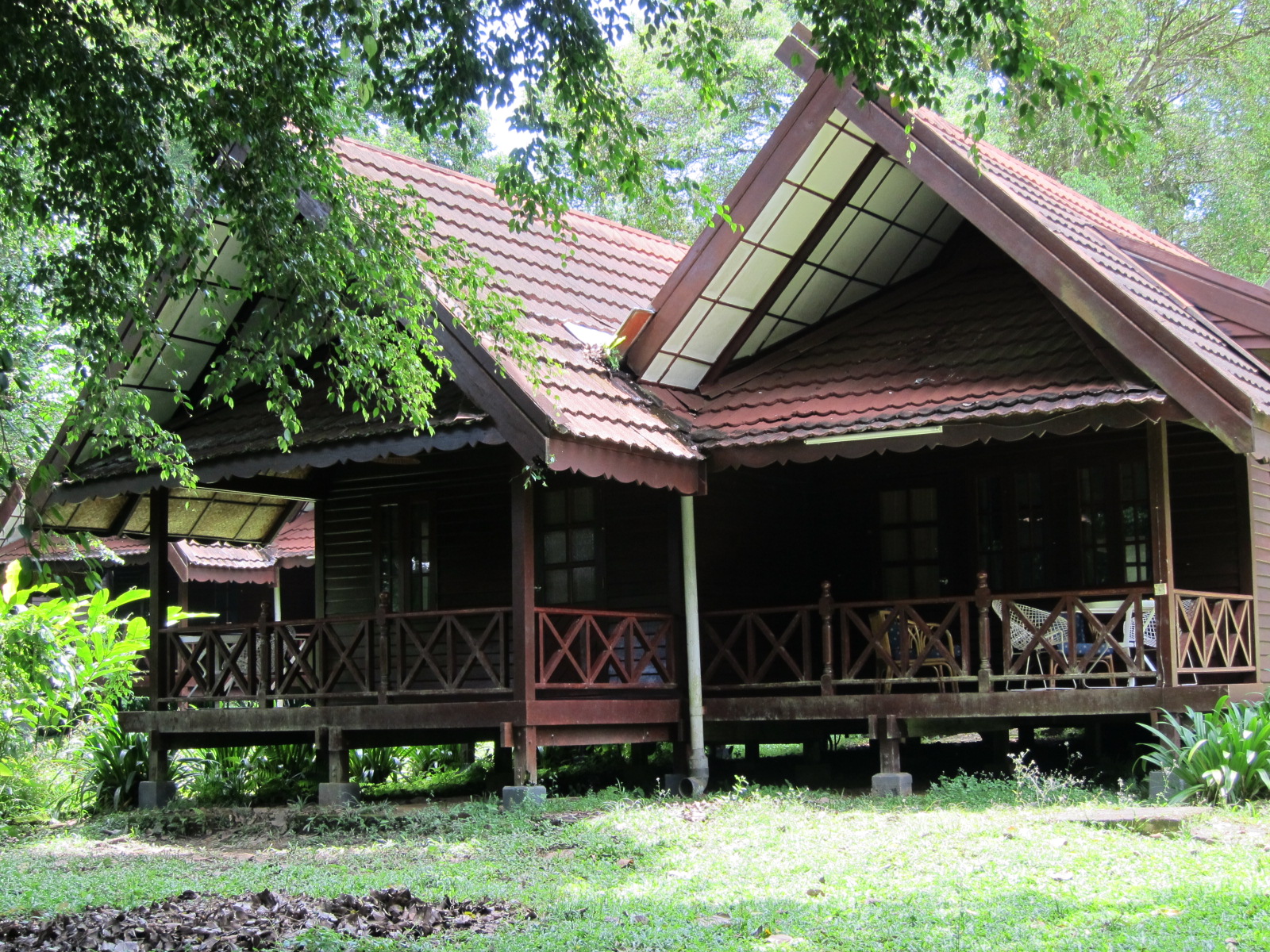
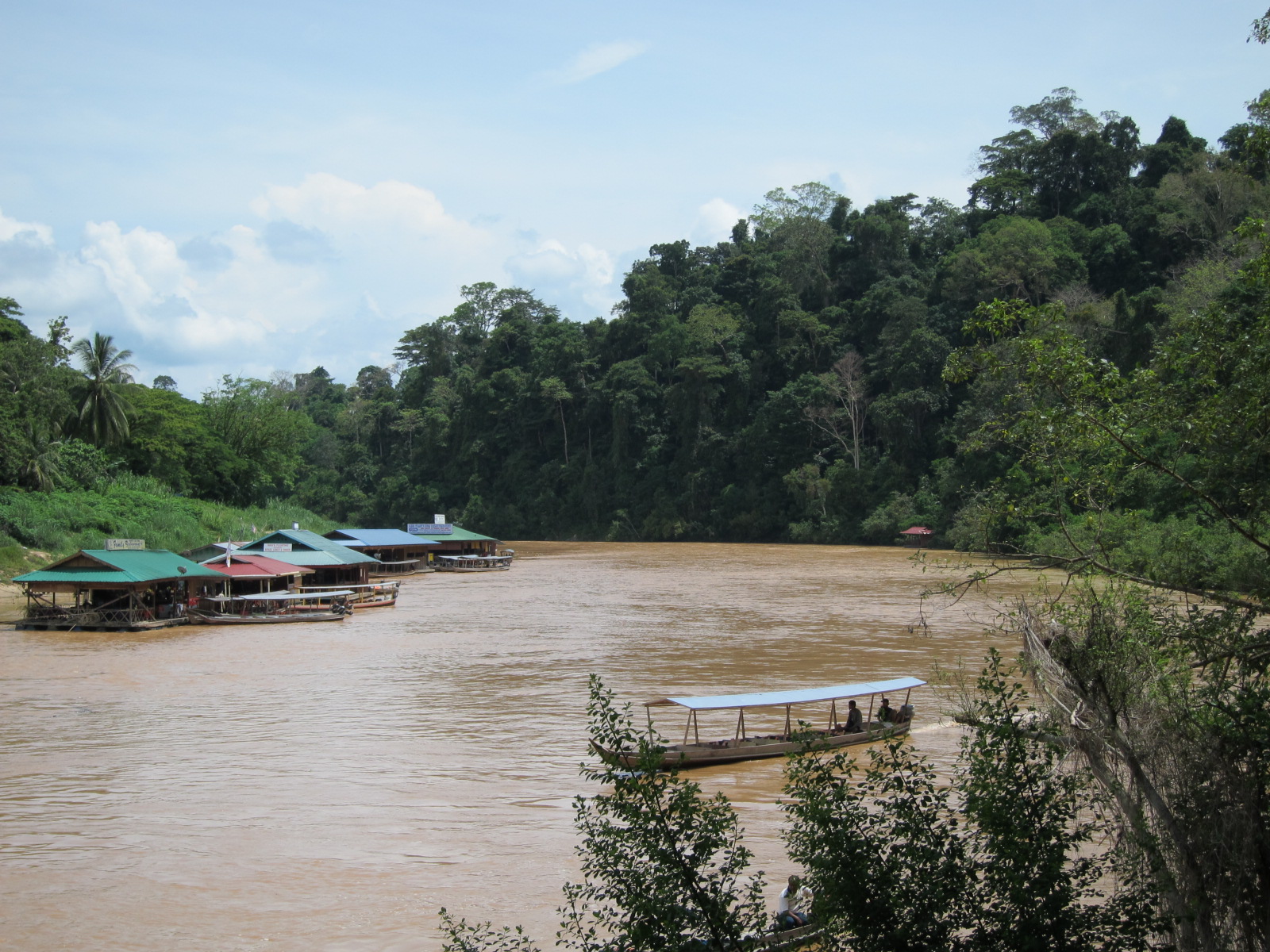
We unloaded our stuff on the dock, parked the car, and caught a one ringgit taxi ride across the Pahang, a turbulent muddy river that can become a destructive torrent in the rainy season. There is a marker at the top of the stairs leading from the jetty that shows the high point of the 1971 flood where the river rose an amazing forty feet! Mutiara Resort is a collection of private two bedroom chalets and larger hostel-like bunkhouses. Our cabin was at the end of the property, down by the river; quiet and restful, with a nice little deck out back, two comfortable beds, a decent bathroom, a fridge and a safe. It was clean and comfortable, and with the aircon and fan both going, nice and cool after a sweaty jungle walk.

We dumped our stuff and sent Pete out to investigate river options while we relaxed on the deck. When Pete got back we did a little reconnaisance tour of the compound. Pete and Joan explored the pathways to the jungle canopy walkway while Pam and I investigated the beautiful foliage and found an observation blind that gave a nice view of a clearing in the jungle containing a meadow and a watering hole. We spent a pleasant half hour watching the butterflies dance over the meadow, but there were no tigers or tapirs to be seen at this time of the day.

Back at the cabin we considered river options. There was a cruise on the larger branch of the river that was longer and offered the option of running some rapids but had the disadvantage of minimal tree cover from the blazing Malaysian sun. Or there was a shorter trip up the narrow branch of the river that offered more tree cover and possibly more wildlife. Both were 50 ringgit. We opted to go upstream on “the smaller river” and this turned out to be the right decision. The boat held the four of us, the driver – who knew the river well – and a fellow who sat in the bow and kept a sharp eye out for rocks. It was a frisky river, and a challenge to make our way upstream against a strong current that was just as muddy as the main course.

About half an hour upsteam the river branched out and taking the right fork we found ourselves in a stream as clear as many you would find in northern Ontario. Another ten minutes brought us to a shallow berm in the river marking the end of the navigable course. It was there that we pulled in, and from there we could hike to the nearby waterfall, if we chose. We chose to swim instead. It was mentioned at the resort that this would be a possibility, so both Pam and Joan came prepared with bathing suits under their clothes. Not being strategic thinkers Pete and I were unprepared, so we just went swimming in our shorts.

The water was brisk and refreshing and there was a smooth ledge running alongside a deeper trough in the river that made it ideal for jumping in and allowing the current to take us downstream and then back to shore for another round. We swam until we were tired and then quickly dried in the Malaysian sun for a much quicker ride downstream back to the resort.

Taman Negara lays claim to being the oldest tropical rain forest on earth at 130 million years, older even than the Amazon. I don’t know how you verify that kind of thing, and it really isn’t all that important anyway. We just wanted to see some natural growth forest instead of all the plantations that you see in the countryside around Kuala Lumpur. At over 4,000 square kilometers, there is a lot to see in Taman Negara besides the old growth forest, including elephants, tapirs and the elusive Malaysian tiger.

There are any number of bus tours that will get you there. The cheapest and most direct ones start at the Five Elements Hotel on Jalan Sultan on the edge of the Chinatown district in KL. They offer two or three day all inclusive packages that range from around MYR 150 to MYR 650, depending on the type of accommodation you choose. Our advice is to avoid the bus. You will spend all of your time travelling to and fro, and no time in the park. It is not a good deal. For MYR 300 you can rent a car for two days that will carry four of you comfortably and allow you to come and go as you please and stop when you like.

We took our 15 year old Proton Satria, and friends Pete and Joan and left at 6 on Saturday morning. We took the LDP (E11) out of town, which at that hour was deserted, picked up the E8 around Batu Caves, sailed past Genting and over the range of hills that forms the spine of Malaysia and didn’t stop until we left the highway at Temerloh, where we woke our sleeping passengers for a break.

About an hour up highway 98 brought us the sleepy little town of Jerantut. Turn right at the t-junction and 8 clicks down the road you come to a left that is well signposted for Taman Negara. The road is a little rough at first, but once you hit the stretch alongside the plantations it gets better. Then it gets worse again, a lot worse. There are potholes that eat little cars like ours for breakfast. An hour up this road brings you to Kuala Tahan, quite literally the end of the road as the Pahang River is in front of you. Across the river is the Mutiara Resort, quite possibly the nicest Malaysian owned resort in the country and our final destination.