Steve: Thanks for joining me for lunch

Murthi: Let me pay this time

Steve: Sure; you’re such a rich guy, right. How’s the family? Siti wasn’t feeling well the last we spoke.

Murthi: Good. She’s fine. Pam?

Steve: Well it is a little tough for her at this time of year. Christmas is a time for family, you know

Murthi: Will you be going to church?

Steve: We always do. Why, do you want to come?

Murthi: We have our own Festival of Light, you know.

Steve: I do know. I love the little coloured rice things in the mall when Deepavali comes around.

Murthi: It is the celebration of good over evil

Steve: But it is just story, right? You don’t actually think it took place, do you?

Murthi: It is story, but it is story that tells a deeper truth. Much of Hinduism is like that

Steve: C’mon Murthi, you have a Master’s degree. Doesn’t the rational side of you want some historical fact to back up what you believe?

Murthi: Doesn’t all belief come down to a leap of faith? Isn’t that what your faith teaches you as well?

Steve: There is a lot of truth to that. There comes a time when you have to make a decision based on what you already know. We will never know everything about anything, so to that extent a leap of faith is necessary. But for rational beings there has to be reason as well as belief, otherwise it is just nice stories we tell ourselves

Murthi: Your faith is full of stories as much as mine is

Steve: But in my faith there are historical markers that can be verified in history. There was a Roman Empire, there was an Emperor called Augustus, there was a governor of Judea called Pontius Pilate, they did use crucifixion to execute political prisoners in order to subdue revolt; these are historical facts that can be verified by Roman history. There was no historical event where some giant threw handfuls of rocks that became the islands leading out to Sri Lanka so he could pursue his enemy. You don’t believe that any more than I do.

Murthi: And Christ fed five thousand people with just a loaf of bread?

Steve: Ah, now you are confusing reason with scientific reductionism.

Murthi: No, I am saying you cannot feed five thousand people with one loaf of bread.

Steve: Several loaves and a couple of fish, according to records. But yes, logically that is impossible. But logic and reason are not necessarily the same thing. Logic would tell you that according to the Second Law of Thermodynamics all closed systems move towards entropy: things wind down. Yet as we look around the world we see that this has clearly not been the case on earth. Systems have become more coherent, not less so. Clearly there are other dynamic forces at work. The same is true with the feeding of the five thousand. Logic would tell you that this is impossible. But reason would instruct us that there are other forces at work; in this case the presence of the One who made all matter in the first place. This event demonstrates His claim to be that Creator: able to make matter out of nothing.

Murthi: To my mind, just a story.

Steve: Then why were the people so impressed, if He had just told them a story? Why were they so insistent that He declare Himself to be King?

Murthi: They weren’t. That is just part of the story as well.

Steve: I suppose that line of reasoning holds for the crucifixion as well?

Murthi: People do not come back from the dead; not if they are truly dead. Therefore if Christ appeared again it follows that he was not truly dead in the first place

Steve: And therefore just a story.

Murthi: Just a story, like Lord Rama pursuing Ravana to Sri Lanka

Steve: Ok then explain this rationally: You take 11 guys with no formal education but well steeped in the school of hard knocks, subject them to some of the most rigorous theological training the world has ever heard and then get them to witness a total sham where some guy who up until now has never told you anything except the absolute truth, even when it was hard for you to hear, and now fakes his own death in one of the biggest frauds in history and on the basis of that you go out and devote the rest of your life through hardship, toil, floggings and death to spread his message? Have you any idea how illogical that sounds?

Murthi: I admit that is a stretch.

Steve: Peter, when he was arrested and condemned to be crucified ask to be hung upside down because he didn’t consider himself worthy of dying the same way that Christ did. He did that knowing that Christ faked his own death? The followers of Christ, many of who were alive at His death and witnessed His resurrection suffered the loss of all that they had, including their lives, and not one of them said, “Why am I doing this? The man was a fraud.”?

Murthi: Ok, you made your point.

Steve: And here is the point. No human has ever come back from the dead, just like no human has ever walked on water, or given sight to the blind, or cured leprosy with a touch, or fed five thousand people with a few loaves of bread. These things were not done in the remote reaches of unrecorded history, but took place in one of the mightiest empires the world has ever known in one of the most educated parts of that empire. People were circulating written portions of the gospel story within months of the events they record. We have thousands of written historical documents that record the same events. They were systematized and codified into books within a decade or two. Peter writes about these records and calls them scripture in his own letters as an older man and we know he was crucified in AD 64, barely thirty years after Christ died.

Murthi: Look Steve, I don’t want to argue with you

Steve: I don’t want to argue with you either, Murthi. But I do want to contest the view that everything that counts in this world can be counted. Some things are not subject to the laws of physics. My emotions aren’t, and even my thoughts aren’t. Why is it that I can dream a future for myself – a future where I spend the last part of my career teaching in a foreign land and even taking my Master’s when I am 65 – and by effort, by strength of will make that a reality? And I am just a human being. Why can’t God – however you conceive him to be – by the force of His will bring into being whatever He decides in his sovereign will to do? Once you accept the idea that there is a God, then why limit Him to just the things that any human could do? How would that be a witness of His God-ness?

Murthi: But why would God – who presumably made the laws of physics in the first place – want to violate those laws?

Steve: I can think of three reasons why. The first would be to declare that He is sovereign over those laws: He made the laws, the laws didn’t make Him, which is what you would get if God couldn’t overrule the laws of physics. Secondly, to demonstrate that there were larger truths than the laws of physics. People in the past used to know this a lot better than we know it now. There is no law that binds us together as friends. There is no law that makes you love your wife or your children. Some things exist outside of physical laws. All the really great truths of life lie outside empirical truth, not within it. Perhaps God ‘violating’ the laws of physics is just a way of alerting us to larger truths. Then finally what I just said earlier: if God didn’t overrule physical laws, how would he have witnessed that he was God? As Paul says in his letters, “If Christ is not raised form the dead then our faith is useless” (1Cor. 15:14); it is no more than just another set of moral principles

Murthi: Moral principles are all we have

Steve: If moral principles are all we have, my friend, then we are of all people to be most pitied. For it is a wicked world out there, ruled by wicked people who enjoy doing wicked things and rejoice that there are moral people like you and me to do them to because that makes their wickedness a whole lot easier to get away with. If we all carried guns and were prepared to shoot anyone who took advantage of us in the slightest, it would harder for wicked people to rule.

Murthi: It would be hard for anyone to rule

Steve: That’s my point. The wicked rule because moral men allow them to. Because to oppose them with them same force that gives them power would make us as wicked as them. That is why it is not enough to have moral principles to live by; there has to be a moral force in the universe opposing that wickedness, or we are all lost.

Murthi: There is a moral force; that moral force we call karma

Steve: You can call it karma if you like. But what you can’t do in my view is say that this is an impersonal force. To the Christian, the moral law is the expression of a personal God who has set the rules for mankind to follow and has every intention of having mankind adhere to those rules

Murthi: Which none of them ever do.

Steve: Which none of us ever do; which is why we need a Saviour. Look, I do not deny that there are good moral teachings in your faith tradition, or in Buddhism. There is even some moral teaching in the Koran, although it is pretty thin on the ground, if you ask me. But good moral teaching will not get you into the next world any more than it will get you through this one. If all moral teaching comes from God, and He is the Author of it, as Christians believe, and not subject to it, then that makes Him greater and more holy than the holiest moral law. Why would that God, infinite in holiness, want me – a good moral man and yet still crawling with sin and moral error – in His presence? Wouldn’t He be defiled just by my being there? This is the great conundrum of every faith, and only Christianity has an answer to this riddle. Christianity says that Christ paid the price for my moral error, and His sacrifice washes away my impurities. I take on the nature of Christ in some way that even I can’t fully understand, so that when God looks at me He sees the holy, risen Christ who died for me. Isn’t that a truth that the world is longing to hear?

Murthi: Let me pay this time

Steve: You can pay for my lunch, but you cannot pay for my sins, my friend.  Only Christ can do that. And just for the record, He can pay for yours as well.

dream-wall-1280-1024

I had a very nice letter from a student who is overseas studying for a degree and is delighted to be fulfilling a childhood dream. But she wonders if wanting something badly enough that you risk your heart being broken is worth the dreaming in the first place. This is my response:

Dear Student:

When I was young I had a dream. Oddly enough, for one so young, my dream was about getting married. The woman I married would be my equal in every way: equal in determination, equal in vision, equal in ability, equal in intelligence, equal in compassion. We would raise our children to see the world without race or gender barriers. We would understand that character was more important than wealth, and we would provide a launching pad for our children to explore the world and find happiness in it. Every woman I met I compared against this dream. I would not settle for anything less than that, but neither would I fail to investigate every possibility. I waited 15 years until I met the woman who came the closest to all I had envisioned. I pursued her for a year until she agreed to marry me. We raised three children who are all that we envisioned they would be.

Once we married and had three children, I became captured by another dream. This dream was to go for the Lord to those who were not as fortunate as we were in the West and to see if the Lord would have us serve him there. In 1986 we went to Bangladesh, and served the Lord for year. But He reminded me that my previous dream was as yet unfulfilled, and asked me to postpone this new dream until it was complete. When we returned we conceived another dream that would unite the dreams we had for our children with the dreams we had to serve the Lord. We would see our children through their education until they were safely launched on their lives, and then we would go back to Asia. We nurtured that dream for 20 years, taking short and longer missionary assignments to keep the dream alive. In 2007 when the last of our children had graduated, we came to Malaysia to serve the Lord here.

Now I have another dream: to complete both my Master’s and Doctorate and serve the Lord through development, both in teaching and in directing development projects. Like all dreams, this will change as it takes on reality, but I have no doubt that it is God who has given me this dream – just as He gave me the previous dreams – so that He could bring about His work in me. In short, my dear, dreams – good dreams – are from God. We should not be surprised at this as He says in His word “I know the plans I have for you, says the Lord, plans to prosper you and not for harm, to give you hope and a future” (Jeremiah 29:11). Do not be afraid to dream godly dreams. My whole life has been the fulfillment of the dreams that the Lord gave to me. Have a Blessed Christmas!

To all who dream, I give the same advice. But I would also add this caveat: Dreams may motivate and empower to you to achieve more than you thought you could, but dreams require hard work and dedication. Christ had a ‘dream,’ if you will forgive the metaphor. His dream was to liberate all those who are oppressed by the evil in this world and make a way for them to enter into the presence of an unutterably holy God in an eternity of happiness. For this reason He entered the world some two thousand years ago. Look at the cost He paid to make this ‘dream’ come true. This was no idle, pleasant fantasy; He literally had to sweat blood to make it a reality. Reckon on the cost of your dreams before you make them the focus of your life. Then submit them to God, for He is the Author of all godly dreams.

Dr Fernando

We have been engaged in pursuing our Master’s in Intercultural Studies with Fuller Seminary in Pasadena, California for the last year. We looked long and hard for a program at the Master’s level that would be useful in our ministry in Southeast Asia; something that would allow us to deepen our understanding of the people that we work among and provide a forum for an exchange of ministry ideas with others who were likewise engaged in other corners of the Lord’s kingdom. The program at Fuller’s has a terrific online platform that contains video and slide lessons of great depth and quality.

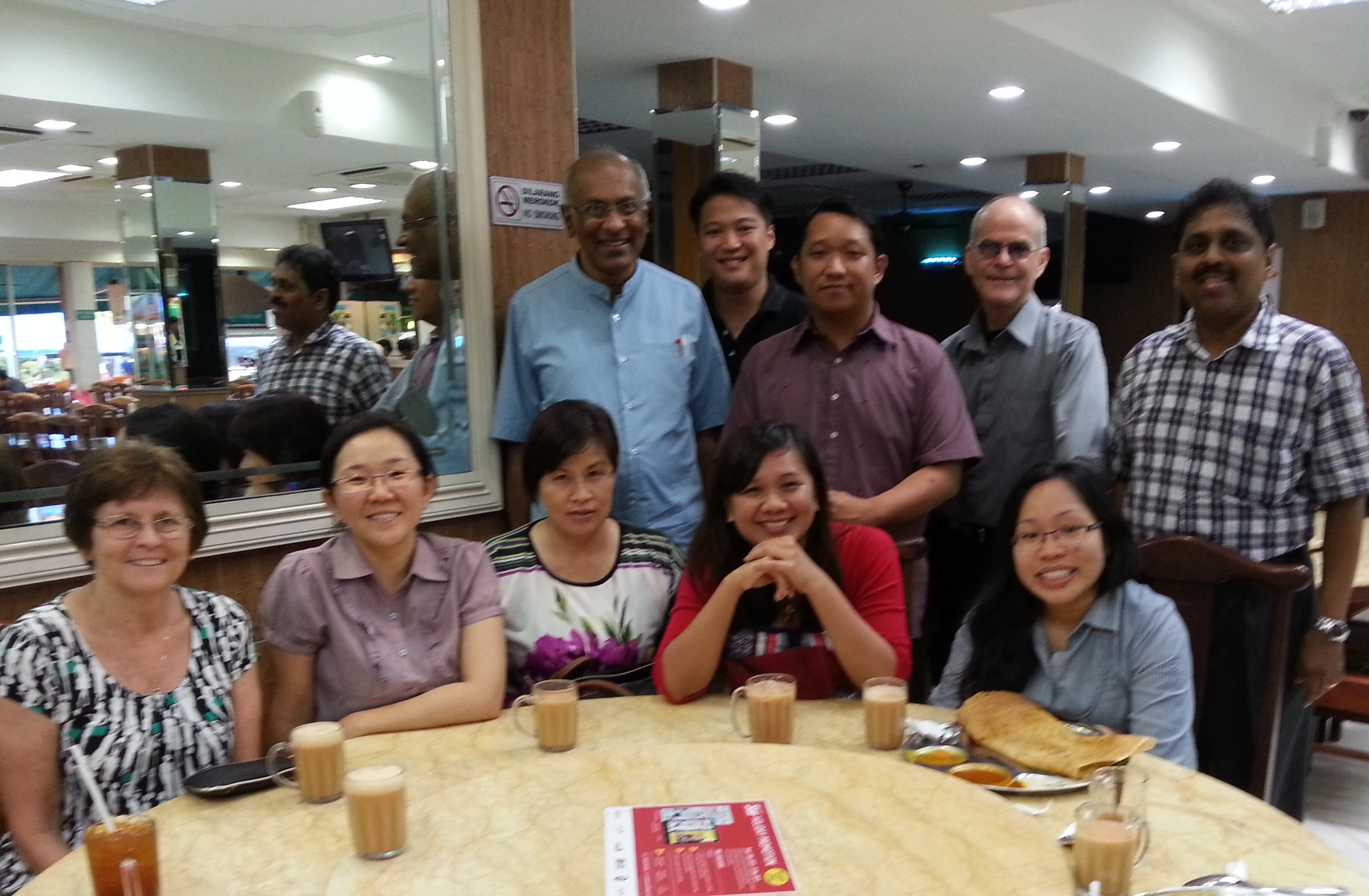
What it doesn’t have – except on the rare occasions when we can be in Seattle where Fuller’s has a campus – is face to face interaction with other students, and the privilege of asking real time questions of the professor giving the lecture. So it was with great joy that we discovered there was a Bible College in Kuala Lumpur whose courses would be accepted for credit with Fuller. This past week we have been engaged in a course called Sharing the Gospel with People of Other Faiths, which was taught by Dr. Ajith Fernando (the tall fellow in the blue shirt, pictured above).

Dr. Ajith (everyone in Asia uses the friendlier first name in addressing others) is a Sri Lankan Christian who has been country director for Youth for Christ for many years. He is the author of two dozen books and has been engaged in a teaching ministry in his native Sri Lanka and internationally. His own books formed the core of our study, and it was a great privilege to be in a classroom setting with him and listen to him illustrate his teaching points with a wealth of stories from his own ministry over the last forty years. He had a warmth and humility that in the words of scripture ‘adorn the gospel of Christ.’

It was a great joy as well to interact with Malaysian believers both in the classroom and in the meals that we would share together between classes. Malaysia is not an easy country in which to be a Christian these days, as fundamentalism is on the rise and restrictions on the Christian faith seem to be increasing. Recently the appeals court overturned a ruling by the Supreme Court regarding the use of the name of God, an issue that has led to the banning of Bibles being brought into the country by less intolerant countries such as Indonesia.

Yet Christians remain steadfast in their faith and joyful in their fellowship. They are also extremely gracious to those who come from other lands to help them. It was our joy to share with them in learning to be better equipped to serve the God of Glory in this part of the world and we look forward to taking other classes locally in the New Year that will make it possible to reduce our costs and speed up the completion of our Master’s degrees. It also allows us to share our walk in the Lord as we seek to share our faith in love and encourage others to do the same.

Visit Dr. Ajith’s website at: http://www.ajithfernando.org/

Or listen to him speak at: http://www.youtube.com/watch?v=QsXYCG7WED8

One of the many things that Taylor’s College does well is honour their staff. I have been on staff for six and a half years now, not the longest I have been at any one school, but longer than my stretches at Scott Street, where I started, or Elgin Court, where I went next. I have watched many staff come and go during that time, as teaching overseas is a pretty transient position. In fact I am now the longest serving expat at the school, as my good friend Easton Hanna who arrived the same year as I did went home in July.

Malaysian teachers tend to stay longer, and in fact one of them, Ungku Nazli, received her 15 year recognition at this ceremony, and two other staff Joanne Ho, and Rowena Valberg were both recognized for twenty five years. There are staff in other programs who have been at Taylor’s even longer, as the company seeks to foster commitment and contentment. Other staff arrive in our program all the time; some stay for years, others for only a year. It is always good to have new interests and new commitments. But it is also good to have those who are prepared to invest their lives in this institution.

Education is a business in much of Asia, and that is just a reality. Some are offended by this; some like myself see the potential for a lot of good. I am currently engaged in developing this company’s corporate social responsibility, and it has been both rewarding and encouraging to see so many willing to commit to the larger good of the larger community even though their present workload is heavy and their days are long. Celebrating that commitment through happy get togethers like this is one way of encouraging that commitment.

See the slide show of this event at https://www.youtube.com/watch?v=k2s70w2IKfA&feature=youtube_gdata_player

This is a long read and I will not leave this up permanently as this is not what this blog is for. But there are a couple of people I would like to have read this essay, and this is the simplest way. It is also a good explanation of why my blogging is way down this year. Forgive!

Marks of Woe:
The Marred Identity of the Poor

“I wander through each chartered street/Near where the chartered Thames does flow/And mark in every face I meet/Marks of weakness, marks of woe”
William Blake “London”

Introduction

William Blake, England’s poetic social conscience, wrote a scathing and concise description of the social ills of his day in his immortal poem, “London.” In sixteen fiery lines Blake castigates both church and state for their oppression of the children whose cries “every blackening church appals,” and the soldier whose “sigh/runs in blood down Palace walls.” His condemnation runs deep, piercing to the moral fibre of the city and its how its treatment of the poor marks not only their faces, but their very identity with its “mind-forged manacles” (Blake).

Writing two hundred years later Jayakumar Christian’s God of the Empty-Handed takes a similar approach to poverty and oppression as typified by those “mind-forged manacles” that Blake addressed. Christian explores the effects of poverty as a marring of human identity as forces beyond individual control seek to capture the poor in a web of lies and disempowerment. According to Christian, in order to reach down to the roots of their poverty the holistic practitioner needs to see the state of the poor as one that includes a poverty of being: the poor are people whose identity has been marred; a poverty of relationships: the poor are people whose relationships work against their well-being; and a poverty of purpose: the poor are people who have forgotten their true vocation. (Christian 1999: 139-144). Mitigating the effects of poverty at this level is not a simple task, for we need to assist the poor to recognize their true identity; to restore their right relationships; and to recover their true vocation. Poverty is fundamentally a spiritual issue (Myers 1999: 15).

Poverty of Being

Bryant L. Myers in Walking with the Poor writes, “the deepest form of poverty is poverty of being, ontological poverty” (Myers 1999: 130). This is a situation where the poor have come to believe that their poverty is ordained by God, and is “immutable and unchangeable,” they are therefore valueless, worthless human beings. The phrase Myers uses comes from the article “African World View” by Augustine Musopole who wrote, “This is where the African feels his poverty most: A poverty of being, in which poor Africans have come to believe that they are no good and cannot get things right” (qtd. in Myers 1999: 76). In an earlier article, Musopole discussed the relationship that ought to exist between God and His creation, “If humanity is at the center of creation spirituality, then God is the over- arching reality embracing the whole creation … to assert that out of this felt- kinship-relationship with God, humanity recognizes God’s greatness or God’s all sufficiency” (Musopole 1992: 255). But this relationship either never existed or has been broken for those who see themselves as worthless.

Compounding the problem are the non-poor who assume the place of god in the lives of the poor. They seek to bind the poor in the immutable present that has no promise of a better future, in a pervasive power structure that cannot be challenged within a worldview that emphasizes the importance of power, and the prestige of those who wield it. Christian calls this a ‘god-complex’ and explains, “These god-complexes operate throughout all the domains of poverty relationships, including the religious system, to perpetuate powerlessness” (Christian 1999: 123). It is not simply that the poor feel worthless; it is the studied contrivance of those with god-complexes that they do so. In this they are assisted by ‘principalities and powers’ that empower such misuse of other human beings. As Walter Wink writes in Engaging the Powers:

It is characteristic of the Powers that, though they are established, staffed, and perpetuated by people, they are beyond merely human control. It was the experience of a total system operating (as it seemed) autonomously and even, at times, malevolently, that gave rise to a perception of the role played by the Powers in human destiny… The Powers are the structures and institutions, in both their outer and inner manifestations, that embody the Domination System in any historical moment.” (Wink 1992: KL638-642)

Wink and Christian are on solid Biblical ground, for Paul writes about these same forces noting, “For our struggle is not against enemies of blood and flesh, but against the rulers, against the authorities, against the cosmic powers of this present darkness, against the spiritual forces of evil in the heavenly places” (Eph. 6:12).

The effectiveness of this ontological oppression of the poor is evident in their own reflections, collected and published by the World Bank in its remarkable collection, Voices of the Poor. The authors report that insecurity and vulnerability are deeply imbedded in those who are poor and note,
Together these generate worry and fear: of natural disaster, of violence and theft, of loss of livelihood, of dispossession from land or shelter, of persecution by the police and powers that be, of debt, of sickness, of social ostracism, of the suffering and death of loved ones, of hunger and of destitution in old age (Narayan-Parker 2000, 36).

It is this overwhelming combination of woes that lead those who experience these extremes of deprivation to say that “Life is like sweeping ash,” or “life is like sitting and dying alive,” or “life is like being flogged” (Narayan-Parker 2000: 33).

Poverty of Relationships

In seeking to underline the importance of relationships to our understanding of the poor, Christian writes, “Poverty is relational. Similarly, power is relational. Social power is an interactive process that resides within social interactions and relationships” (Christian 1999: 121). However, in many instances – rural isolation, social discrimination, public mistrust – the poor are cut off from access to social networks that could help them alleviate their problems and seek redress for their grievances. Both flawed and fewer relationships are characteristic of the poor. As John Friedman points out in his insightful analysis of what he calls the “disempowerment of the poor,” due to the difficulties of obtaining food, water, fuel, and medical services, and the time taken for work, transportation, and domestic chores, surplus time is limited, and “Without access to surplus time, household options are severely constrained. It is the second most prized base of social power” (Friedmann 1992: 68); and one that like many other resources, one of which the poor are chronically short.

These feelings of social rejection are also brought to light in Voices of the Poor. An old man in Nigeria reports, “We poor men have no friends. Our friend is the ground” (Narayan-Parker 2000: 35), and a woman in Bulgaria explains, “Young people have nothing to do here. You can’t imagine how I feel, as lonely as the dawn, but I was the first to prompt them to move to the city. I would have felt even worse watching them waste their lives here” (Narayan-Parker 2000: 35). Christian writes, “There is one reason, I believe, that there is a greater appreciation among the poor for expressions of love…Flawed relationships involve hurt. This hurt further weakens the poor and destroys any potential for a security net” (Christian 1999: 131). These hurts, this loneliness further mars the poor and traps them in their poverty. This situation is not helped by societal attitudes that see the poor as ‘lazy’ or ‘dirty,’ or by the institutionalization of the poor by social constructs such as the caste system.

Christian then discusses the self-destructive behaviours of the poor and how they further isolate and embed them in a vicious cycle of oppression:

The poor do not have the same options that the non-poor have. Therefore the devil, the well-known tempter entices the poor to choose destructive options. When the poor respond to their frustrations under the influence of the devil, death and destruction follow. Compulsive habits or behaviour then results in the further socioeconomic captivity of poor households (Christian 1999: 152).

It is these limited options that the non-poor then seize upon in further labelling and enslaving the poor in a worldview that is toxic to their welfare.

Poverty of Purpose

A third area of marring occurs in what Myers calls ‘vocation.’ He writes, “I believe that poverty mars both parts of the identity of the poor. The result of poverty is that people no longer know who they are, (being}, nor do they believe that they have a vocation of any value (doing).” (Myers 1999: 77). A poverty of purpose is not unique to the poor. Rick Warren published a very successful book addressed to the well-heeled congregant in the West, to whom he writes, “You have dozens of hidden abilities and gifts that you don’t know you’ve got because you’ve never tried them out” (Warren 2002: 251).

From the perspective of the poor, however, these “dozens of hidden abilities” simply don’t exist. Voices of the Poor captures some of this inadequacy. A poor man in Ethiopia reports, “A bad life is where you cannot find employment and have no money and no useful knowledge” (Narayan-Parker 2000: 245). A young man in Jamaica is more fulsome, “Poverty makes us not believe in ourselves. We hardly leave the community. Not only are we not educated, but we also don’t have a street-wise education” (Narayan-Parker 2000: 246). Another in Ecuador reports, “An uneducated man can be dominated just with bread and water” (Narayan-Parker 2000: 260). These comments are indicative of a life that has been ground down by exigent circumstances to a point where a poverty of uselessness, of unknown vocation and unseen purpose coalesce in a feeling of worthlessness that further mars the identity of the poor and demonstrates the depth to which the poor have internalized the oppression visited upon them.

Under this oppressive regime, the poor become nothing more than objects to be purchased. Paolo Freire writes, “In their unrestrained eagerness to possess, the oppressors develop the conviction that it is possible for them to transform everything into objects of their purchasing power” (Freire 1970: 44). Trafficking in people as sexual objects, engineered economic slavery, and the forced displacement of millions of people for ‘economic development’ projects (a ripe, Orwellian phrase if ever one existed) are the natural consequences of such obliteration of purpose. Dealing with the consequences of such dehumanizing behaviour and structures is not for the faint-hearted, nor the “gifted amateur with his heart in the right place” (Myers 1999: 2), as Myers points out. Addressing these issues calls for academic thoroughness and the centrality of a Biblical-grounded approach.

Recovering Identity

If poverty is at root ontological, then its solution must be ontological as well. Unless and until we confront the issue of ‘being,’ then all other solutions are temporary at best. The Psalmist says, “The earth is the Lord’s and everything in it, the world and all who live in it” (Psalm 24:1).This is not a statement of greed or arrogance, nor is it a declaration of wealth and power. Rather this is the triumphant cry of Heavenly Liberator who declares to the wretched and weak ‘You are not bound to systems of slavery. You are My dearly Beloved and I am for you!’ (Isa. 41:10). Sharing with those whose lives have been marred by poverty that they are made in the image of God (Gen. 1:27) is a powerfully liberating tool in the process of development. Jayakumar Christian writes, “When god-complexes perpetuate the powerlessness of the poor, the kingdom of God is the only viable alternative spelling true and complete liberation for the powerless poor” (Christian 1999: 214-215).

We also need to be aware that this captivity of the poor in the depths of their being does not simply have a horizontal cause; there is a vertical dimension as well. The god of this age does not want to see the poor liberated and works feverishly to ensnare them in the world of evil spirits. As Paul Hiebert points out “Most people see the world as full of beings (spirits, ancestors, humans, unborn, animals, plants, and earth spirits) and forces (magic, mana, witchcraft, evil eye, fire, gravity), visible and invisible, that interrelate in everyday life” (Hiebert 1999: KL 493-495). In addition Hiebert points out that “In South and Southeast Asia there is a widespread belief in karma, the impersonal cosmic moral law that governs the universe, rewarding good deeds and punishing evil ones. A person’s present state is prescribed by the deeds done in his or her previous life” (Hiebert 1999: KL1082-85). These twin evils, spirits and karma, form a powerful ally with the forces of earthy evil to enslave the poor and keep them in their place. The horizontal dimension – obeisance to ancestor spirits, the structural discrimination of the caste system, the enslaving and demeaning doctrine of karma – in a sense mirrors the vertical dimension of slavery.

“If poverty and powerlessness are about the captivity of the poor to god-complexes, should not the response to powerlessness be defined as establishing the kingdom of God?” (Christian 1999: 125). However appealing this might seem from a Christian perspective, to those long oppressed it can seem like an impossible hurdle. Bryant Myers recounts the story of a tribal group in India cursed by its story of origin into believing that their destiny is poverty. He writes, “The tribal group has been deceived, and this deception is the most fundamental cause of the people’s poverty” (Myers 1999: 221). Nevertheless, escape from deception can only be the declaration of the truth. The Psalmist says, “I will praise you, for I am fearfully and wonderfully made” (Psalm 139: 14). The essential dignity of man is reinforced throughout the Bible and is our fundamental Christian heritage. This is the unique and transformational truth that alone can break the bondage of the poverty of being.

Restoring Shalom

When the shepherds were out in the fields ‘abiding,’ they heard the angels say “Peace on earth, and good will towards men” (Luke 2:14). To use an Old Testament word, the angels said ‘shalom.’ Shalom means more than peace and good will, however. It also means justice, restoration, freedom from want, harmony, and blessing. It is perhaps most completely defined by Christ Himself when He announced His mission in Nazareth “The Spirit of the Lord is on me, because he has anointed me to proclaim good news to the poor. He has sent me to proclaim freedom for the prisoners and recovery of sight for the blind, to set the oppressed free, to proclaim the year of the Lord’s favour” (Luke 4:18-19). In other words He said, ‘I have come to bring shalom.’

However, not only does God have a ‘preferential option for the poor,’ in Gutierrez’ poignant phrase (Gutiérrez 1973), but He is at root a relational God, as expressed most fundamentally in the doctrine of the Trinity. “Essentially Yahweh is described in Scripture as a relational God, yearning for relationship both with the people and with society he has created… The work of Satan is seen as the work of domination, of power over people and nations” (Linthicum 2003: 83). Satanic forces much more powerful than our puny efforts are at work seeking to keep the poor in this web of lies and disempowerment, and these forces have the rich and powerful as willing allies. To share this truth in the face of such forces of evil can mean death. Christian notes that we strive against “cosmic personifications that disguise the power arrangement of the state [and the] mystification of actual power relations that provide divine legitimacy for oppressive earthly institutions” (Christian 1999: 123).

Since this is at heart a spiritual issue, the spiritual deception runs deep. Myers recounts the story of one woman who responded to the gospel story by saying, “she could believe that God would let his Son die for a black man, but she could never accept the idea that God would let his Son die for a San woman” (Myers 1999: 76). Nor are feelings of worthlessness the only spiritual trap. Christ’s sacrifice is often taken as a model of how the poor are to accept their lot, rather than an act of liberating them from it. Latin American Christian writer De La Torre notes, “Forgetting that the cross is a symbol of evil allows for the easy romanticism of those who are marginalized as some sort of hyper-Christians for the ‘cross’ they are forced to bear. Such views tend to offer honour to those who are suffering, encouraging a form of quietism where suffering is stoically borne” (De La Torre 2004: 93). De La Torre argues that this is misinterpretation, since “the importance of the crucifixion lies in Christ solidarity with the poor” (De La Torre 2004: 94).

This passivity in the face of suffering is examined by another Latin America writer Gustavo Gutiérrez, who in his masterful exposition of Job observes, “The language of [Job’s responses] restores vigour to the values of popular faith by strengthening them and enabling them to resist every attempt at manipulation. It thus prevents the distortion that turns these values into fruitless resignation and passivity in the face of injustice” (Gutiérrez 1987: 95). As Gutiérrez points out, Job is rebuked for failing to give God His due, but never for appealing for justice.

Christ came for justice, to “set the captives free.” We honour Him by following in His footsteps and seeking to restore value and shalom to relationships by offering salvation through Christ and seeking justice for grievances. Though long deferred in evangelical thinking, the idea of social justice as a necessary adjunct to the gospel of salvation seems finally to be coming around again to its historical importance. David Korten notes:

Life has learned over billions of years the advantages of cooperative, locally rooted self-organization. Perhaps humans might be capable of doing the same. Such insights are a key to recognizing that there is a democratic, market-based, community-serving alternative to the unappealing choice between a socialist economy centrally owned and administered by government and a capitalist economy centrally owned and administered by an elite class of wealthy financiers and corporate CEOs (Korten 2006: 14-15).

Without addressing structural inequity at its root, our solutions remain partial. For this only our Saviour’s sacrifice will avail, for “The cross is the only power in the world which proves that suffering love can avenge and vanquish evil” (Bonhoeffer 1959: KL2031).

Realizing Potential

Paul the Apostle addressed the issue of vocation in his first letter to the Corinthians, teaching that God is the author of all good things and that through the Holy He gives gifts to men for their benefit and for the benefit of others (1 Cor. 12). James reinforces this elemental Christian doctrine, that God is the author of the gifts He gives, writing that “every good and perfect gift is from above and comes down from the Father of Light” (James 1: 17). The Old Testament prophet Jeremiah captures what this feels like when he writes, “Sing to the Lord; praise the Lord! For He has delivered the life of the needy from the hand of the evil doer” (Jer. 20:13).

And how does the Lord do this? The Lord is not bound. It can be miraculous intervention, it can be divine enabling, but more often than not it is through the hands and feet of those He has directed to help. “God needs people who ask for his will to be done; if no one is interested in it, he must leave his work on earth undone. But if there are people who stretch out their hands to him in longing, asking and seeking for his will to be done, then he can do something in this world” (Arnold 1997: KL176-180). Nor is He restricted to using Christian agency. Cyrus, who allowed the Jewish nation to return to Jerusalem, was not a believer; neither is Noble Prize winning economist Mohammad Yunus.

Dr. Yunus is the founder of the Grameen Bank through which 8 million people, mostly women, have been helped in Bangladesh. He searches out those who need to be enabled to escape from poverty, challenging them to identify what small gift our talent they possess and then funding them to start a business through microcredit. But for Yunus, it is not just about the money “The credit we offer the poor is not just a matter of entries in a ledger book or even a handful of bills handed over to a person. It is a tool for reshaping lives, and neither the staff of Grameen Bank nor our borrowers ever lose sight of that reality” (Yunus 2007: KL156-161). Yunus’ approach, to determine what the poor have to offer by way of vocation, is systematized in what Myers and others call Appreciative Inquiry. Myers writes, “The starting point for Appreciative Inquiry is the belief that a community that is alive and functioning … If we can determine what is for life and what is generating well-being, we can imagine its expansion” (Myers 1999: 175).

Chambers echoes this concern for determining from the poor themselves the strengths that they themselves see. He writes, “PRA (participatory rural appraisal) is a family of continuously evolving approaches … [that] seeks to enable local and marginalized people to share, enhance and analyse their knowledge of life and conditions, and to plan, act, monitor and evaluate” (Chambers 2007: 190). This seeking out and strengthening what the poor have to offer by acknowledging, affirming and supporting it, is one of the most useful strategies for development in this part of the world.
However the key to this approach appears to be women. Myers comments, “It is commonly agreed that women carry out a disproportionate share of the productive work relating to the community and are critically involved in areas that are key to development change” (Myers 1999: 190).

Mohd Yunus would agree. In fact 97% of the loans from Grameen Bank go to women (Yunus 2007: KL1006). Nor should we stop there, for as Myers points out “Just as women in families are in a position to influence the other family members, so too are children” (Yunus 2007: 191) He encourages his readers that “We need a change in thinking that allows us to see children as agents of transformation” (Myers 1999: 191).

The Holy Spirit of God is the power of God to transform lives. He is the One that gifts and equips the beloved of God to minister to His creation (1 Cor. 12). Through His agency, and the hands and feet of those He equips and sends, the poor can be led to realize their potential to escape from the web of lies and deception that the Evil One and his human agents have spun around the poor.

Drawing Conclusions

Just before His death Christ said, “The poor you will have with you always” (Mark 14:7). Rather than succumb to a simplistic and unbiblical fatalism regarding this statement, let us compare this to another He said after His resurrection, “Go into all the world and preach the gospel” (Mark 16:15). Why? Could not God, who is all-powerful and who has a multitudinous host at His command, simply send His angels into the world and announce this? Why use us? For the very good reason that God has chosen to walk at three miles an hour, the speed that humans walk (Koyama 1980). He wants us to partner with Him in the work of salvation. In a similar way God seeks to partner with us in the elimination of poverty. Why? For the very good reason that we need the poor just as much as they need us. We need to exercise our faith, or compassion, our sacrificial service and our devotion to justice and shalom. This is how the world will know that we are His; and how we will know as well. This is why the poor will always be with us until His return.

There is huge inequality between the developed and the developing world. Even as some poor in the developing countries have been catching up to the West, some – those identified by former World Bank researcher Paul Collier as “the bottom billion” – have been falling further behind. In these countries Collier notes, “Seventy-three percent of them have been through civil war, 29 percent of them are in countries dominated by the politics of natural resource revenues, 30 percent are landlocked, resource-scarce, and in a bad neighborhood, and 76 percent have been through a prolonged period of bad governance and poor economic policies” (Collier 2007: 79).

This picture is fleshed out for us in Poor Economics, whose writers note that the average poverty line among the 50 countries where most of the poor live is 36 cents a day. But since goods are generally cheaper in these countries, that equates to around 99 cents a day. “So to imagine the lives of the poor, you have to imagine having to live in Miami or Modesto with 99 cents per day for almost all your everyday needs (excluding housing). Can one live on that? And yet, around the world, in 2005, 865 million people – 13 percent of the world’s population – did” (Banerjee 2011: KL190-210). Some may argue over the actual numbers of the desperately poor, but as Jayakumar Christian points out, “Poverty is not about numbers. It is about inequality, and specifically about inequality in power relationships” (Christian 1999: 121).

But there is another dimension to the ‘problem of poverty’ and it is us. Charles Van Engen writes, “Without mission, theological education may be a professional finishing school or an entryway to graduate school, or a department of religious studies, but it is not formation for the manifold ministries of Christ and his church among the people in the world” (Engen 1999: xxi). In other words, without reaching out to a world in need, our faith becomes a mere intellectual exercise, a study in the art and science of phrenology or the caloric theory of heat.

Mission is the living heart of the church, and as Christopher Wright points out “Where else does the passion for justice and liberation that breathes in these various theologies come from if not from the biblical revelation of the God who battles with injustice, oppression and bondage throughout history right to the eschaton?” (Wright 2006: KL454). If we are sincere about our faith, then seeking to liberate the poor from the demonic and carnal forces that enslave them is not an option for us, for “Commitment to the alleviation of human suffering, and especially to the removal of its causes as far as possible, is an obligation for the followers of Jesus” (Gutiérrez 1987: 101). As Jayakumar Christian so convincingly points out, poverty has marred the image of God in the poor. It is our responsibility as those who affirm the image of God in humankind, to seek to restore that godly image.

References Cited

Arnold, Heini Hutterian Brethren. 1997. Discipleship : Living for Christ in the Daily Grind. Farmington, PA: Plough Pub. House.

Banerjee, Abhijit V. Duflo Esther. 2011. Poor Economics : A Radical Rethinking of the Way to Fight Global Poverty. New York: Publicaffairs.Kindle Edition.

Blake, William. Songs of Innocence and Songs of Experience. Project Gutenberg.

Bonhoeffer, Dietrich. 1959. The Cost of Discipleship. New York: Macmillan.

Chambers, Robert. 2007. Ideas for Development. London; Sterling, Va.: Earthscan.

Christian, Jayakumar. 1999. God of the Empty-Handed : Poverty, Power, and the Kingdom of God. Monrovia, Calif.: MARC.

Collier, Paul. 2007. The Bottom Billion : Why the Poorest Countries are Failing and What Can be Done about It. Oxford; New York: Oxford University Press. Kindle Edition.

De La Torre, Miguel A. 2004. Doing Christian Ethics from the Margins. Maryknoll, N.Y.: Orbis Books.

Engen, Charles Edward Van Thomas Nancy J. Gallagher Robert L. 1999. Footprints of God : A Narrative Theology of Mission. Monrovia, Calif.: MARC.

Freire, Paulo. 1970. Pedagogy of the Oppressed. New York: Herder And Herder.

Friedmann, John. 1992. Empowerment : The Politics of Alternative Development. Cambridge, MA: Blackwell.

Gutiérrez, Gustavo. 1973. A Theology of Liberation : History, Politics, and Salvation. Maryknoll, N.Y.: Orbis Books.

Gutiérrez, Gustavo. 1987. On Job : God-Talk and the Suffering of the Innocent. Maryknoll, N.Y.: Orbis Books.

Hiebert, Paul G. Shaw R. Daniel Tienou Tite. 1999. Understanding Folk Religion : A Christian Response to Popular Beliefs and Practices. Grand Rapids, Mich.: Baker Books. Kindle Edition.

Korten, David C. The Great Turning from Empire to Earth Community. Berrett-Koehler ; Kumarian Press 2006. Kindle Edition.

Koyama, Kosuke. 1980. Three Mile an Hour God : Biblical Reflections. Maryknoll, N.Y.: Orbis Books.

Linthicum, Robert C. 2003. Transforming Power : Biblical Strategies for Making a Difference in Your Community. Downers Grove, Ill.: Intervarsity Press.

Musopole, Augustine C. 1992. “Toward a Theological Method for Malawi.” Encounter No. 53 (3):247-259.

Myers, Bryant L. 1999. Walking With the Poor : Principles and Practices of Transformational Development. Maryknoll, N.Y.: Orbis Books.

Narayan-Parker, Deepa. 2000. Crying Out for Change : Voices of the Poor. Oxford; New York: Published By Oxford University Press For The World Bank.

Warren, Richard. 2002. The Purpose-Driven Life : What on Earth am I Here For? Grand Rapids, Mich.: Zondervan.

Wink, Walter. 1992. Engaging the Powers : Discernment and Resistance in a World of Domination. Minneapolis: Fortress Press. Kindle Edition.

Wright, Christopher J. H. 2006. The Mission of God : Unlocking the Bible’s Grand Narrative. Downers Grove, Ill.: IVP Academic. Kindle Edition.

Yunus, Muhammad Weber Karl. 2007. Creating a World Without Poverty : Social Business and the Future of Capitalism. New York: Publicaffairs. Kindle Edition.

HotelThis a school break week for CPU which means that Steve is off half days, but it is not a break for the University so he still needs to do that portion of his job.  However Tuesday was an off day for the Islamic New Year so we decided to take a short break away and booked ourselves a room at a lovely hotel in Putra Jaya. Putra Jaya is the new administrative center for the country and is located about a half hour drive out of town.  There is not much out there but exceptionally gorgeous administrative buildings on essentially a man made island surrounded by a man made lake. On holidays and weekends it is pretty much deserted.
???????????????????????????????
The hotel was pretty much deserted too which worked well for us as we had a very quiet little tapas restaurant all to ourselves for the entire evening. It wasn’t even staffed so the servers from a nearby bar just brought us our food and let us be. After a light meal we took a stroll along the lake to see the lights on the bridges and water and settled into our own private wing of the hotel and slept.
???????????????????????????????
It was only when we woke up ten hours later that it dawned on both of us that we actually live in an incredibly noisy part of the world. It being a major Indian festival this week, the firecrackers have been going off all night for probably the last three weeks- sometimes multiple little ones at a time and other times single explosions that echo through the building and shake the windows. We get a nice early start with the call to prayer. No wonder we feel exhausted at times.
IMG_1259

I got this email from a former student a couple of days ago. I thought maybe I would post the question and the response in case they might be of help to others.

Dear Mr. Wise:

Hello there. I hope you are doing fine. I am not sure if you still remember me. I used to be one of your students. I am currently in the UK doing hospitality and business management. I am going through a difficult spell just now and I am just wondering about my degree. I am kind of getting bad results in my first year (pass or D/C/B) and even if try my best to score in year 2 and 3, is it still possible to get a first class degree? Do certificates really matter? And why do people look down on hospitality courses? Is it not academic enough? Please give me some motivation and advice.

Sorry Millie: 

I have been off for a couple of days with Deepavali and Muslim New Year. I tend not to open email that comes to my work address while I am holiday, because that just gets me thinking about work. That is one of my Strategies for Sanity. Here are the others:

Strategy #1: Prioritize: Write down a list of the things that you need to do and rank them in order of importance. Usually watching television will be the last thing on your list. I hardly ever get there, unless it is a really slack time in my life. Then do the things on your list in the order of priority. Always do the most important thing on your list first, even if it is the hardest thing to do. In time this listing process will become internal and habitual.

Strategy #2: Compartmentalize: do the thing that is in front of you now. Don’t even think about the other things that you are not doing because you are doing that thing. When you get to the next thing, do that with all your attention as well, and don’t think about the last thing – how well you did, if others liked it, yada,yada – just doing as best as you can the thing that you are presently doing. Do each thing you do with the same level of concentration and commitment and before you know it you will be doing many things well

Strategy #3: Rest: Never work for more than 55 minutes before getting up to fix a cup of tea. But keep the break to 5 minutes, then get back to work. Life is short and there is much to do.

Strategy #4: Visualize: Remind yourself of the long view from time to time. Talk about it with yourself and with others. The more you talk about your goals the more real they will become. It is of absolutely no consequence what others think about what your goals are. They don’t know you, they aren’t living your life; you are. Keep your dreams alive by discussing your plans with others and be prepared to listen to their dreams as well, for this is how we build a network of friends and allies who will support us.

Strategy #5: Laugh: God gave us this life to enjoy, so enjoy it. Laugh at the folly of life and your own weaknesses. Laugh at the silly self-important posturing of egotists, especially those in positions of power. Don’t they know that one day they too will stand naked before God to be judged by their Creator? Laughter is a great leveler and stress reliever.

Strategy #6 Accept yourself: For all your faults and limitations you are the person your Creator intended to make when He made you. He also built in you an enormous capacity to grow and become more than you presently are. But if He is prepared to accept you now for the way you now are, shouldn’t you as well? Yes you do stupid things; we all do. Only the truly stupid fail to understand how truly stupid we all are. So what? Stupid is part of who we are. So is creative, persevering, stubborn, forgiving, forgetful, caring, callous, naughty and nice. God loves us anyway. Let’s just accept that and do the best we can with what He has given us.

You will notice that all of this things have to do with ‘doing’ stuff, and very little of it has to do with ‘being.’ That is because “We are what we repeatedly do,” in Aristotle’s immortal phrase. Don’t worry about the ‘being’ part; it will take care of itself. Concentrate on the doing, and you will become.

All the best!

???????????????????????????????

Sometimes there is a need and you can meet it, so you just do it.

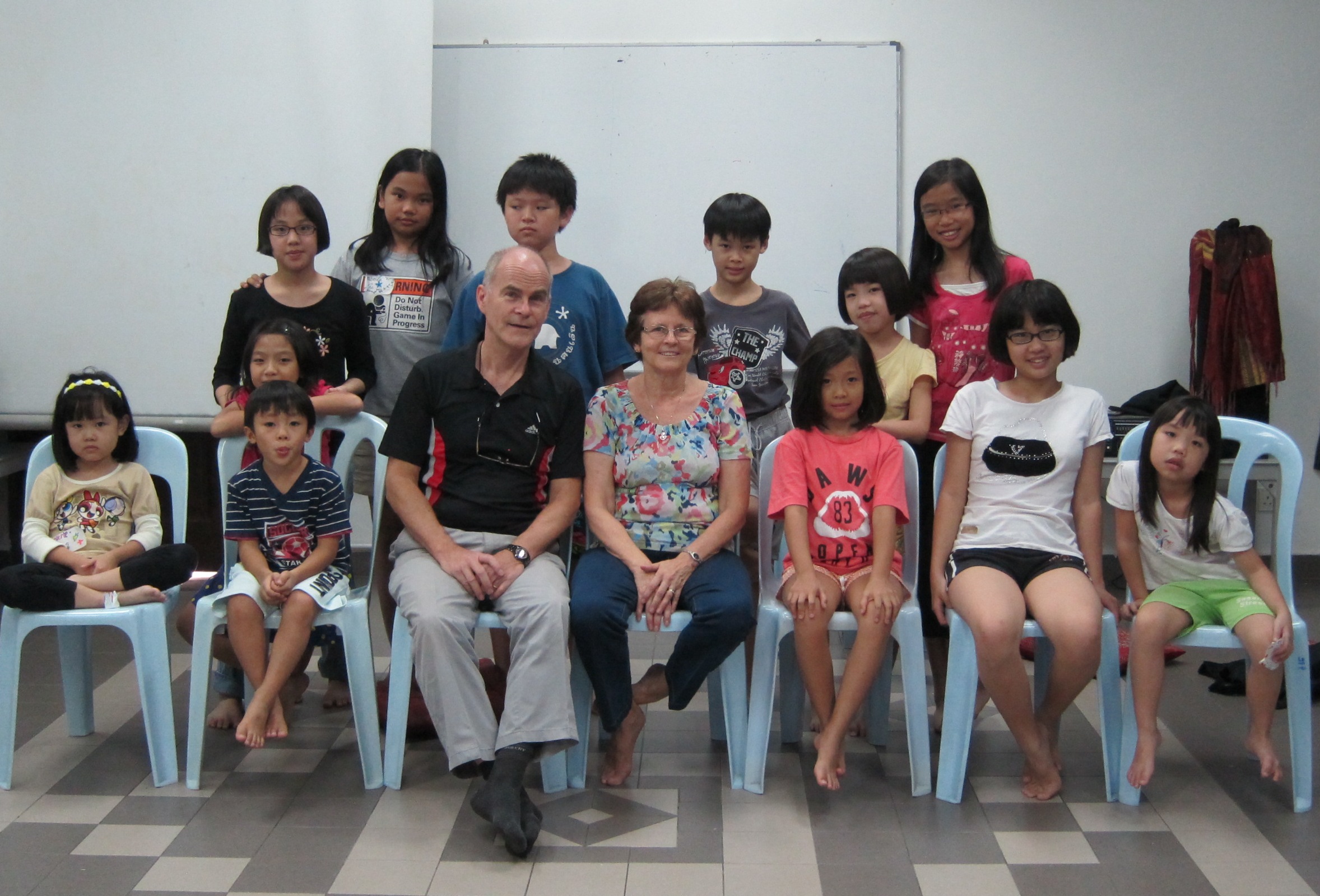
That was the case for us this past weekend.  We were meeting with one of the “Barefoot Leaders” of Malaysia and he mentioned that they were planning a leadership planning retreat and were in need of someone to provide a program for the children of the Planning Team, so we agreed to do it. Friday after work we drove up about a half hour north of the city to the lovely campus of Malaysia Baptist Seminary.

We had fourteen sweet and energetic young people aged between two and thirteen who were out for a good time. The Friday evening session went from 7- 10:30 so we were pretty exhausted by the time we made it to our hard little beds. The kids created a picture of their current world and shared their stories with the group.  We had them add “suns” to show us the happy things in their lives and then “clouds” to represent the difficult things. Even John, our little two year old was able to tell us what each scribble represented.  They totally got into the dramatization of the Joseph story, using the few props that we had taken with us

??????????????????????????????????????????????????????????????


Saturday we had the kids from 9- 4:30 straight and were very grateful for a couple of young people from Harvest Center who came to help us out.  Fortunately they all just loved drawing because in the morning we had them dream about they would like their lives to be in the future. Again they could  glue on rainbows for the easy things and clouds for the challenges ahead and again they shared their dreams with the group.  Joseph had his coat and was ready to go for the second part of the story, there is nothing like drams to get kids involved in the story.  In the afternoon the kids had cut-out ladders to join their two pictures and identify the steps they need to take to get to their dream and the challenges they would face along the way.

The biggest battle was the fact that the school has a fabulous swimming pool which the parents had promised they could use when their planning session was done at 3.  Those poor little kids had to be patient until 4:30 when the parents finally came, even as they listened the sounds of the approaching afternoon monsoon.  We don’t really consider ourselves “Children’s Ministry” kind of folks but we had fun, the kids were totally involved and we were able to be a blessing to the New Covenant Community so it was all good.

In spite of the fact that we have been to the north and south of Thailand on multiple occasions and loved it, we have not had much interest in seeing Bangkok. Every time we did consider a visit there the city was in a uproar, it was flooded or the airport was shut down by protesters. However, this past week everything lined up for us to see what our friends George and Deb describe as their favourite  place on earth.

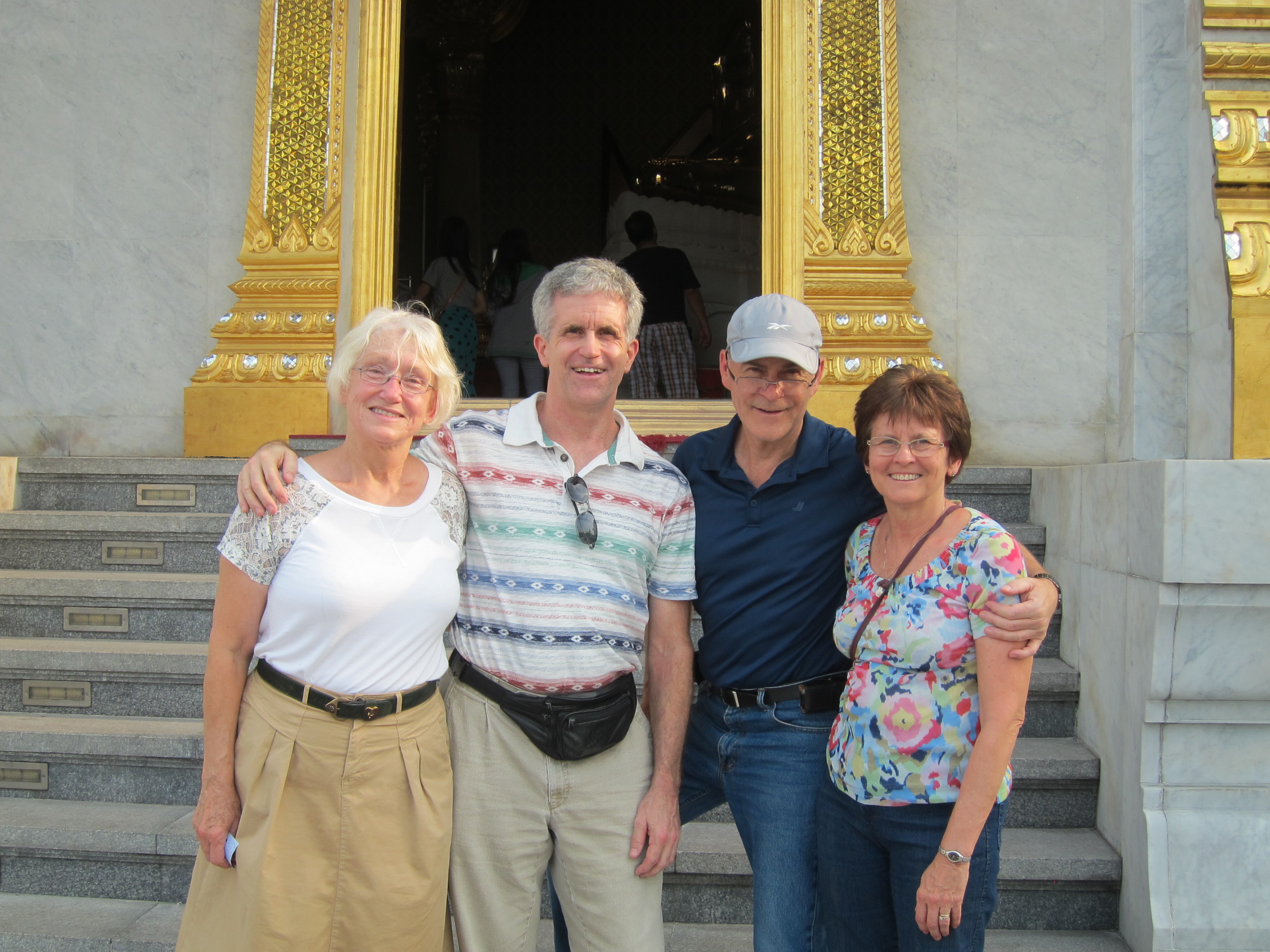
IMG_1121We had a wonderful weekend getting caught up with our friends Gary and Kveta who have now moved on to a teaching position in Pakistan. The hotel was lovely and very reasonably priced for a great little suite. We did make some effort at sightseeing but mostly we just sat around the hotel or the pool chatting.

Bangkok has endless malls, some quiet green spaces and incredibly beautiful temples, one with a solid gold Buddha that sits about four meters high.  We struggled through JJ Market which is supposed to be the largest such market in the world and walked forever to see the waterfront. Steve had to head back on Monday for work so he did some touring around on his own while the rest of us hit the pool.
IMG_1116
IMG_1142

IMG_1146
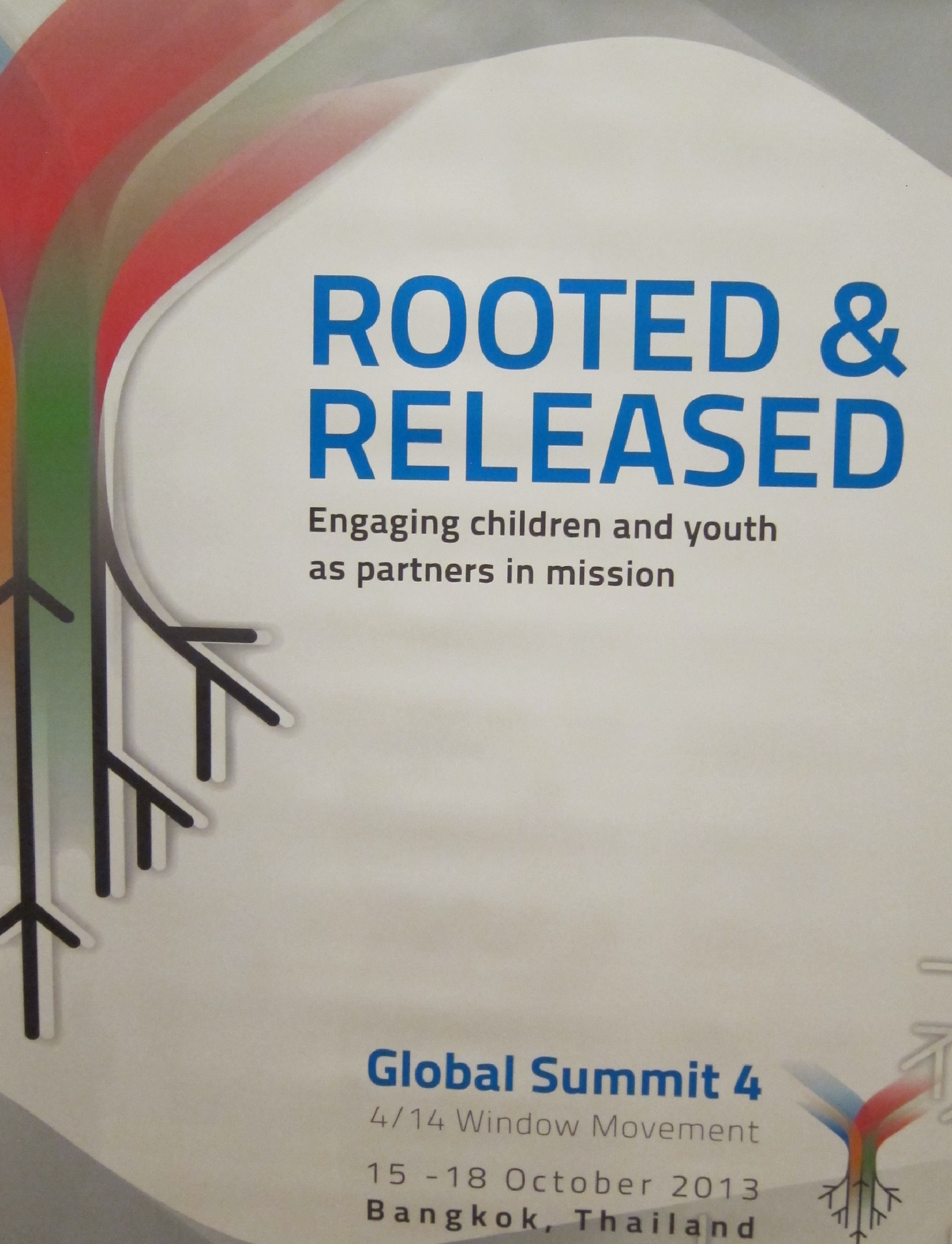
I stayed on to attend the 4/14 Window Movement Global Summit which was attended by almost 1000 missiologists, theologians, church and mission leaders and practitioners representing 70 nations. Hosted by Compassion Thailand and the Christian Broadcasting Network, and Promise Church in New York, it was an organizational marvel, especially considering that the organizing team only actually met face to face twice due to their geographical challenges. The 4/14 refers to the demographic of children aged four to fourteen who are our future leaders, and are marginalized by the world and the church yet have a significant role to play. The speakers and children themselves challenged us with the need to ensure that they are solidly “Rooted” and then “Released” with support to do the work they are being prepared to do. It was a very intense learning time but a privilege to hear the heart of so many who have dedicated their lives to serving “the least of these”.

???????????????????????????????Early Sunday morning I flew to Kota Kinabalu on the island of Borneo to speak at a retreat for a group of students with an interest in holistic community development. We loaded into two vans and travelled up some pretty scary roads that twisted their way up to this very strange, but quite lovely house with an incredible view of the hills and valleys around it. Electricity and water were definitely a challenge and I slept on the floor in that brown room at the third level. However,  the students had prepared a great BBQ of fish and chicken for dinner and the fellowship was sweet.


I thoroughly enjoyed sharing with these young people the things that I have learned about holistic community development over the past five years, especially since five of these young people had recently attended a training program facilitated by our TWR Cambodia team. These are very bright, committed young people with a real passion to see transformation in the lives of the indigenous people groups in Sabah and the orang asli people of the peninsula.  It was not only a literal mountain top experience but a spiritual one as well.

Group

We arrived back in KK late Monday afternoon in time for me to speak a second time at the final class for a group of seminary students taking a course in CHE which was being co-taught and translated by a couple of the guys who had been at my earlier session.  As I began to deliver the lesson from our retreat session, my translator got so excited about what he had just learned that I was able to step back and watch him share it with the others.  How fun to see your students become the teacher right before your very eyes.

Monday

On Tuesday I had meetings with three leaders from the seminary, a missions center and a major church group who are all beginning to realize that there is a need to look at education and community and missions from a much broader perspective. In this setting the centuries old debate between the Great Commission and the Great Commandment is very real and down to earth. Do you simply preach the gospel, or do you reach out in love to the whole community in need and allow the Holy Spirit to touch whose lives He will?

I am grateful for this opportunity to reach out in a new ministry in Borneo and am willing to let the Lord stretch me through new experiences of teaching and sharing to others what He has taught me in Cambodia. It is greatly rewarding to go to a completely new field and find that the Lord is there in the lives of His servants encouraging me and giving me an opportunity to support the good work that they are doing. Please pray for open hearts as we develop new initiatives for communities in need.