Ministry


I suppose I could be forgiven for thinking that my ministry over here is not that important. I don’t think God thinks that, in fact I’m sure of it. But if you get enough people who don’t see what you are doing as being significant to God, then you can’t help – on a human level – to start to wonder if you are doing what you think you are doing, if you follow my drift.

Here’s what I think I am doing. I am in the first place seeking to serve God. I wouldn’t be in Asia, miles away from my family and friends (thank you Jon and Nic for your visit; you don’t know how happy your being here for a few weeks made me!) if I didn’t believe with all my heart and mind that God did not only called me to come to Malaysia in the fall of 2006, but had in fact been leading me to make that decision for all of my life. From thumbing my way around North America and Europe in the early seventies, to serving Him in Bangladesh in the eighties and Germany in the nineties; from giving me a wonderfully successful teaching career that every year was a joy and an adventure, to giving me the worst teaching year of my life in 2006 and practically driving me out of my comfort zone; from seeing all my kids finally graduate from college and university, to listening to my wife plead with me to resign so we could go back to Asia; the Lord has been talking to me about this for years. I know I am where He wants me to be.

What I think I am doing is providing a support for my wife’s missionary endeavour in Cambodia that couldn’t be funded any other way. Not that what she is doing is too insignificant for a Christian agency, for example our home church or our church’s denomination to support. On the contrary, what she is doing is nothing short of miraculous. Her goal, if she can bring it to pass, is to put a Christian witness in every village in Cambodia through health care evangelism. That is a worthwhile endeavour, by any standard. That fact that I am her sole support is not a reflection on the importance of what she is doing, but rather on the woeful state of the Christian church in North America that seems to have lost its vision for the lost. I am a vital part of the support for her ministry. Without my support, it would not exist.

What I think I am doing is seeking to fulfil my responsibility to my God to give back to Him the gift of talent and capability that He gave to me: to become the best I can be at what I do. Parenting and teaching have been the two of the greatest joys of my life. I have poured myself into both of those things in order to honour the One who gave me the gifts to do those things. I can’t do much in the way of direct parenting anymore; my ‘kids’ are all approaching 30 and pretty much have got things worked out by now. But they still need me to model for them what a good Christian man does with the life God has given him. By leaving behind a good job with a comfortable income and lifestyle to serve God in Malaysia I am providing that modelling. This is what it means to be a Christian. God comes first, comfort comes later.

Not that our life over here is at all uncomfortable. You have seen the pictures; this is a beautiful place. But we had no idea when we left Canada that this would be so, and that is the point: we trusted God, put Him first. He honours that, and always has in our lives. As for my teaching, well that is my daily bread. I have always wanted to be a high school English teacher, and God has now given me that opportunity. I dreaded the thought of teaching high school in Canada: the drugs, the rudeness, the lack of motivation . But over here it is different; the kids are decent and well behaved, respectful and motivated. But teaching goes beyond a good working environment. The heart of my satisfaction is that I am committed to continue to grow as a teacher and as a person, and this challenge does that for me. Back in Canada I had exhausted every challenge. Over here I have taught one new English course every semester I have been here. It has stretched me and made me a better teacher.

I will conclude these thoughts in the next post.


I am very much a person who likes life to be well thought out and organized, even more so now that we are in Asia where things tend to be a bit unpredictable at best.  Before each visit to Cambodia I make a concerted effort to plan carefully so that I ensure that I maximize my time there.  Admittedly, I am pretty task oriented and something of a control freak.

My dear Cambodian friends are just the opposite.  They are very much about relationships; are gentle, accepting and totally unassuming.  It is often difficult to set up appointments from outside the country due to issues of language barriers especially in written form but there is also the reality of Cambodia.  There if you show up, people simply put everything else on hold and give you their full attention. I am trying to learn from them to be more flexible and focused on people not events but I have a long way to go.

Anyway, in spite of the fact that I arrived in Phnom Penh with very little in terms of solid appointments, God once again gave me a very full and successful week.  Since I was there this week with my friends Su Min and Sing Yu who have some class, I upgraded to the Billabong Hotel, $3 more per night but a much better location. It was a little frightening when we first pulled up to the gate but not bad once inside and it even has a pool
 
Monday night we had a lovely supper with a newly CHE trained couple from Partners Against Poverty.  Tuesday I met up with a nursing friend to give her  some children’s vitamins donated by a colleague of Steve’s to be used in her village project.  I spent the afternoon with TWR staff reviewing  changes to a funding proposal that we have been working on.  Another three hours on the proposal back at the hotel and I emailed it off at 10:30 at night, eight hours ahead of schedule.

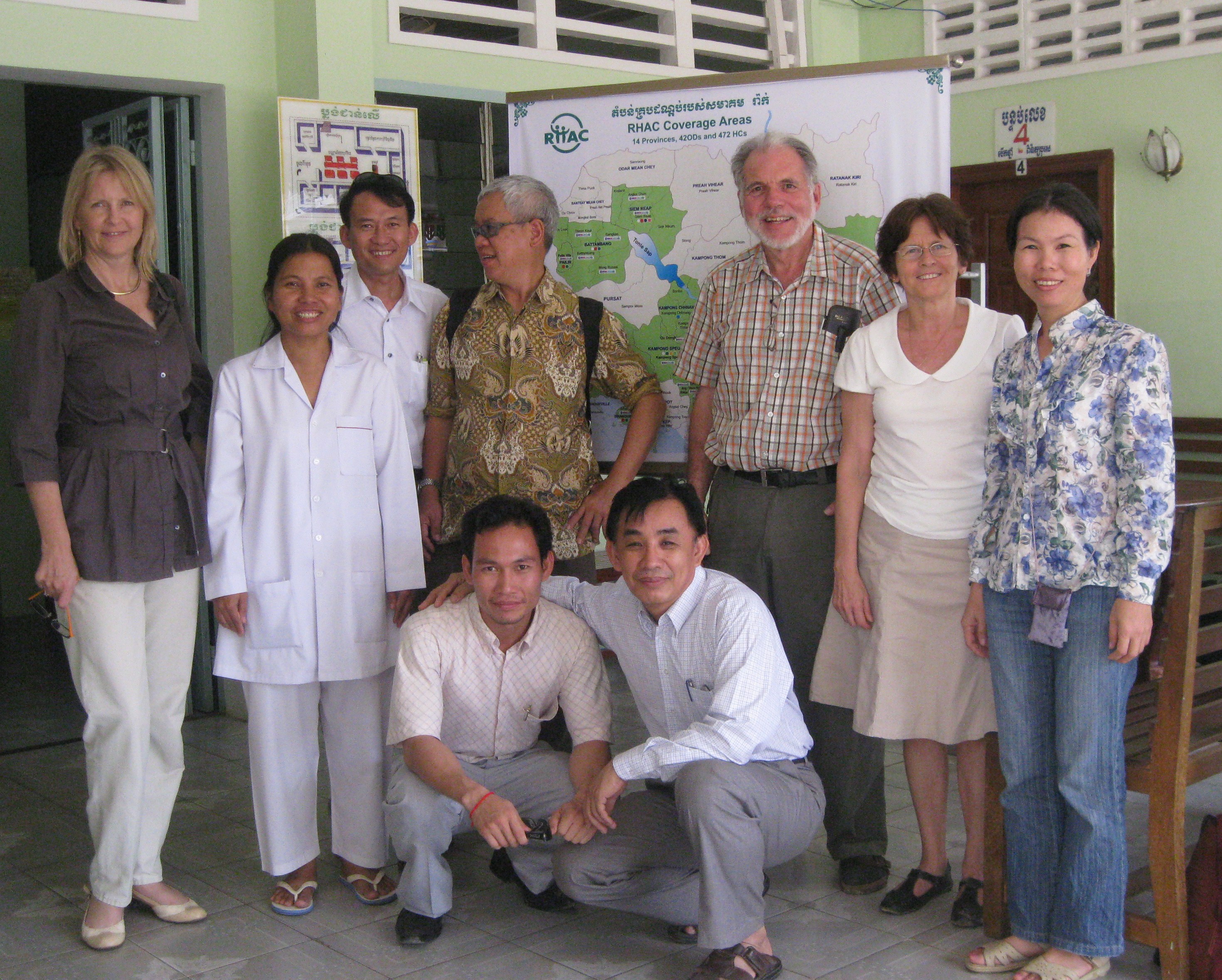
Wednesday and Thursday we spent with our partners from RHAC and CGA planning our up coming training sessions.  Thursday afternoon we did some shopping and had supper with the TWR Country Co-ordinator and his wife, Veasna and Sela.  Back at the hotel I struggled to stay awake for a Skype conference call with our co-workers in Calgary and Switzerland. 

I finally hit the sack at 1:30 knowing I needed to be up and going by 6 in order to have an early breakfast and see Su Min and Sing Yu off to the airport.  Always on the lookout for other networking opportunities, I still had one more meeting with a CHE trained Australian Social Worker before heading out to the airport myself.  As much as I love Cambodia, I was plenty happy to get home to our own little place in KL even if Steve is off in Bali for the weekend.

I love my weekends in Malaysia. I work hard all week to get here, and I treasure the time to relax, loaf around the apartment, get things sorted out for the coming week, get some marking done if I have to, read a little, watch some telly, go for a swim, play my guitar or cruise some malls with Pam. It is all good. The climate here is 32 degrees every day, so you don’t have to bundle up or think about how to deal with the cold; you can just stroll out in your shirtsleeves pretty much any day of the year.

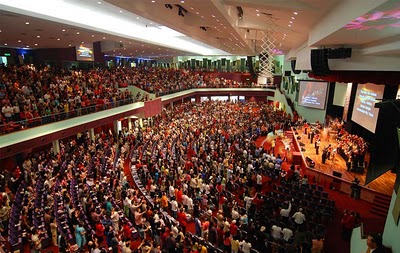
On Sundays we go to church at the Damansara Utama Methodist Church in Petaling Jaya. Yeah, we debated a bit about the whole Methodist thing ourselves, but having had a long look at a number of churches in KL, it is the best that we have found. Pastor Daniel Ho is a leader in the Malaysia Christian church and the founder of the church he still pastors. About 1,000 attend weekly, more on special occasions. The church has 200 cell groups and a pastoral staff of 16. They support 200 missionaries in SouthEast Asia, with a focus on Nepal, Myanmar (Burma) and Cambodia. It is the later connection that drew us to this church.

We don’t have a car, so for a while we attended a church in the local hotel. The people were lovely, but the church was essentially an outreach post, and the messages pretty basic. With regrets we felt we had to move on. Our present church is 15 minutes away by car, which when we came to Malaysia was almost insurmountable. But recently the government has cracked down on the taxi industry, insisting that they use the meter or face a $100 fine if they are caught. What used to cost us $20 to get to church and back – if you could find a cab to do it for that price – has now been reduced to $7 return and no hassling over the price.

This morning the service featured two pastors from Cambodia that the church supports. They spoke of their ministry in a very difficult province of that country, noted for its thieves and alcoholics. Starting at scratch, the work has now expanded to a significant Christian witness. Those who don’t know these pastors by name, simply call them Jesus. There was also a call for the Christians in Malaysia to confront Islam and Buddhism with knowledge and understanding by Pastor Ho, who has served as chairman of the evangelical churches of Malaysia.

After church I walk the few meters to the nearest mall – there is always a nearest mall in this city – and get myself a chai tea latte before catching a cab home again. There is a Jaya grocery store in that mall, so Pam and I will sometimes pick up a few groceries before we head back to the cool of our condo for lunch. I am grateful for the church of Jesus Christ in this country, and admire the faithful Christians who serve Him here and throughout the region. It is a privilege to worship with fellow believers on the other side of the globe and know that the God of heaven hears us in whatever language we choose to praise Him.


I spent many hours carefully setting up a very full agenda for this week in Cambodia only to have it completely fall apart on Friday afternoon so I admit I was pretty anxious when I arrived in Phnom Penh on Sunday. The other members of the team arrived on three separate flights early Monday morning and we began a marathon of meetings. It was fascinating to watch each step fall neatly into place in a far better and more thorough manner than we could have dreamed.

We met with TWR, RHAC, Mercy Medical Center, had supper with another doctor and then had a late evening meeting with a lovely Indian gentleman before Bill, Annelies and Su Min even saw their hotel room at 11:00 p.m. By 7 a.m. Tuesday we were on our way to Kampong Cham to see a Youth Center and watch an amazing young village volunteer conduct an education session in a “small pagoda” with a group of youth. On Wednesday we met with the managers and two trainers from each of RHACs programs to de-brief and do a presentation on CHE’s holistic approach to health.

RHAC had requested that we help them teach their educators moral lessons which they described as teaching Cambodians about love and compassion. When they saw a sample five day curriculum for HIV/AIDS that contained lessons with topics such as Fearfully and Wonderfully Made, Youth, Love and Lies, Family Violence and Self Esteem they were thrilled. Then they suddenly switched track and asked for training on Family Planning instead. While Bill and I panicked Su Min, a very creative OB/GYN simply went to the computer and created a new program in front of their eyes. I don’t think that this group of very educated Cambodians had ever seen anything like this before.

The last group to get on board was the Cambodia CHE Working Group and we were not even sure that we were on their agenda. No problem getting that group to recognize the opportunity. However, this is new territory for everyone both in terms of working with a large secular organization and in the use of many new lessons.

From the very beginning, this project has only been evident one step at a time and we are all thoroughly enjoying this experience of walking in faith.

Just spent two days sitting in a very unusual but interesting workgroup and again find myself wondering where this is all headed. There were thirteen of us invited and it was facilitated by a very capable local Consultant who is fluent in both English and Khmer. Hired simply to facilitate the process, she had no real history with any of the organizations involved. The programs represented were varied; blindness and disabilities, hypertension and diabetes, social work and counselling, microfinance and insurance, skills training and income generation, patient registration and health insurance, and of course, media.

The only thing we had in common was that we each have funders or partners in the Netherlands. These Netherlands organizations have formed an Alliance which is intending to submit joint funding proposals for money available through the Dutch government’s development program. As there have been a number of limitations to the success of previous programs, a decision has been made that all future proposals must use a “Programmatic Approach”, something none of us had ever heard of before.

Our task was to make recommendations to the Alliance for a strategy and specific target areas on which to focus. It was amazing to talk about the roadblocks each have faced and to watch as our small working group came up with a design for an ideal approach. Those of you who know my passion for CHE will understand my joy as they mapped out a CHE approach and then were delighted to hear that this strategy has already been in use for some time.

Even more delightful is the fact that the proposal that we have written uses a Programmatic Approach, and of course a CHE partnership and this group all want on board. Not sure if this group will ever get together again formally but I am sure we will be calling on each other to share our expertise as we go about our work.

Does God expect Christians to condemn the culture we live in, or merely critique it? Does He want us to opt out, or to opt in? How do we go about being salt and light to our generation, to our culture? Is taking part in culture even part of our mandate as Christians?

Pam and I have always tried neither to condemn our culture, nor merely to make our way through it without too much of it sticking to us, but rather to recast it in His image through our own God-driven effort. Our relationship is part of that remaking. We have tried to make it a true partnership, along the lines of Aquila and Priscilla in the book of Acts, and not fall into the expectations of others in either the church or our workplaces. We wanted to live within our means and give freely to those in need to create a model that was not beholden to cultural expectations of unnecessary expense and debt. The Joneses far outstripped us long ago, and we let them.

We left our jobs for a year during our careers, not once but twice, not to increase our earning potential by advancing our educational degrees, but to devote ourselves to the cause of Christ irrespective of the cost. We have now left our jobs at the peak of our earning potential , not because we despise comfort and ease, but because we value serving the Lord with the best of what we have to offer, rather than wait until our power to effect change has waned.

This is what we want to show to our families, our friends, our church and the world. We want to be part of those who are trying to create new ways of living a life, a life that has meaning beyond a consumer-oriented economy, a life focused on Christ and His call on our life. We want to show His love to the world in a tangible way.

You don’t have to leave where you are to do that. We did so because the Lord directed our hearts to this place. How is the Lord directing your heart? Would you not rather have a life of purpose, whatever they may cost you, than to live a life totally circumscribed by cultural demands and expectations? How many hockey games do you need to see; how many technological marvels do you need to own; how much mortgage debt do you need to assume? Are you living for God, or for the culture that surrounds you?

God intends to redeem culture every bit as much as He intends to redeem individual lives. And all cultures need to be redeemed, perhaps none more so than our own. We are striving to be part of that work of redemption in Southeast Asia, and we appreciate your prayers on our behalf. We also want to encourage you to rethink your role in your own culture; to be caring, thinking and acting as agents of cultural redemption. We also covenant to pray for you in this crucial work: to serve the Lord in His great act of redemption in individuals and in cultures.

Almost two years ago I began a campaign on behalf of a wonderful Cambodian lady that I met in my search for health information and resources for our Cambodian Project Hannah team.  Dr. Vathiny is the Executive Director of an organization which provides family and reproductive health and HIV/AIDS services to much of Cambodia.  She works through an extensive network of clinics and health stations, providing clinical services and  training village health volunteers.

In a very early conversation she confided in me her heartache that although she can provide the mandated services, she has seen little positive impact on the overall life of Cambodians, particularly women.  Her comment was that the hearts of the people needed healing and she was unable to meet the emotional, moral and spiritual needs of her patients. She asked me to help her meet this need.  Although I have been able to  help with a few minor initiatives and have even written a proposal that would allow TWR to provide her with some media based resources, I know that what is needed is much more involved.

Through my connection with the International Community Health Education Network, I was able to present her need to a group of doctors who are willing and able to assist her.  I am now headed to Cambodia to introduce Dr. Vathiny to one of the group of physicians who will offer their expertise and experience to assist.  Please pray that Dr. Vathiny’s heart will be open to accept this offer which has the potential to impact the health system of Cambodia in a very significant way.

Following our meeting on Friday, we will either form a “consultation group” working out of Singapore to begin training village health volunteers in a holistic approach to health and village development, or this particular avenue of my work will come to an end.  I believe that we have seen God’s hand in the building of the team and would ask for your prayers for guidance and sensitivity as we meet together on Friday.

Life of Pi is an endearing novel, if such can be said about a book that deals with isolation, unspeakable brutality and cannibalism, among other things. I found myself being charmed and disarmed as I made my way through it over Christmas while we traveled through Australia. My purpose, as is true for nearly everything I read, was how to compass its idiosyncratic nature within the confines of a classroom study.

There are of course plenty of online resources for this kind of thing. But I have learned to my chagrin that any novel study that I take from the internet can be answered by my students in the like same manner. Tit-for-tat, as it were. Besides, online studies have a tendency to ask closed questions (‘How many animals were on the boat?’, for example) instead of open ones (‘If the hyena were a man, what would he be like?’). The objective of a closed question is to determine if the student read the chapter. The objectives of an open question are to ensure that the student not only read , but understood the chapter, encourage discussion and inquiry, and stimulate the student into writing which is going to strengthen his/her abilty in English. Like most in my profession, I cheerfully despise closed questions.

I determined on a structure that divided the text into nineteen sections of about 24 pages each, with two open questions per section. My intention was to have the students read the section aloud in their small group, discuss the two questions for that day, and write down a one page answer for each. What was not done in class would become homework. I must confess I had my doubts when none of the groups even finished the reading on the first day, but I made adjustments. I scrapped the ten minute lesson on grammar that I had used in the first unit, and kept my opening remarks to ten minutes, no more. By the end of the first week my students were meeting my objectives.

Then I had to introduce the essay topic for this unit: a fifteen hundred word research paper that had to cite at least half a dozen secondary sources. Some of the students had been through this process last term; some were brand new to this task. I booked library computer time, went through the MLA style guide in painstaking detail and met individually with dozens of students. The results were impressive. Some papers had bibliographies that ran to fifteen entries; some were absolutely letter perfect in their grammar; most pursued their thesis with consistent vigour; nearly all passed through the SafeAssign plagiarism check with flying colours.

The unit fell exactly within the time parameters I had planned. I collected their response journals in which they recorded their answers to the forty questions on the novel, and they were as impressive as the essays. We even had time for a fun day of illustrating a scene from the novel, and a day to get them prepared for a reading assignment over the March Break. On top of all that I got all of their marks for this unit uploaded to Markbook and sent off to admin in time for their mid-term report.

Those who do this for a living will understand what this feels like. For those who do different things, it’s like building a bookcase that you have planned, or writing a program that does exactly when you wanted it to do. A well planned and executed unit is a deeply satisfying experience. My students feel accomplished and well rewarded for their labours, and so do I. We part company for a week happy in how far we have come this term, and confident in our continued success. Both us deserve a week to rest and renew ourselves, and I plan to do just that.

This has been one very intense week and it seems to have been a particularly long one for both Steve and I.  It was one in which I experienced the best aspects of our current life but also some of the worst aspects of it.

I arrived in Chiang Mai last Saturday morning and spent a wonderful afternoon with a couple of women from our team.  Prior to returning to my hotel room, I decided to check my email only to receive a message that my Dad had suffered a major heart attack. While Steve tried to make contact with family in Canada, I tried to figure out the quickest way to get back to KL.  Unfortunately the next direct flight, not until Sunday morning, was fully booked, meaning I would need to fly through Bangkok.  By the time I thought these things through, I had heard back from Steve that Dad had had surgery to remove a clot and was stable. 

We made a decision that I would stay put at least long enough to get the conference underway as I had stepped in at the last minute to act as registrar due to a family emergency of another lady. Even as I was getting people checked in for the conference, I was hearing that Dad was doing very well post-op, and within days was joking and saying he had not felt so well in months. This seemed to confirm a decision to stay in Thailand.

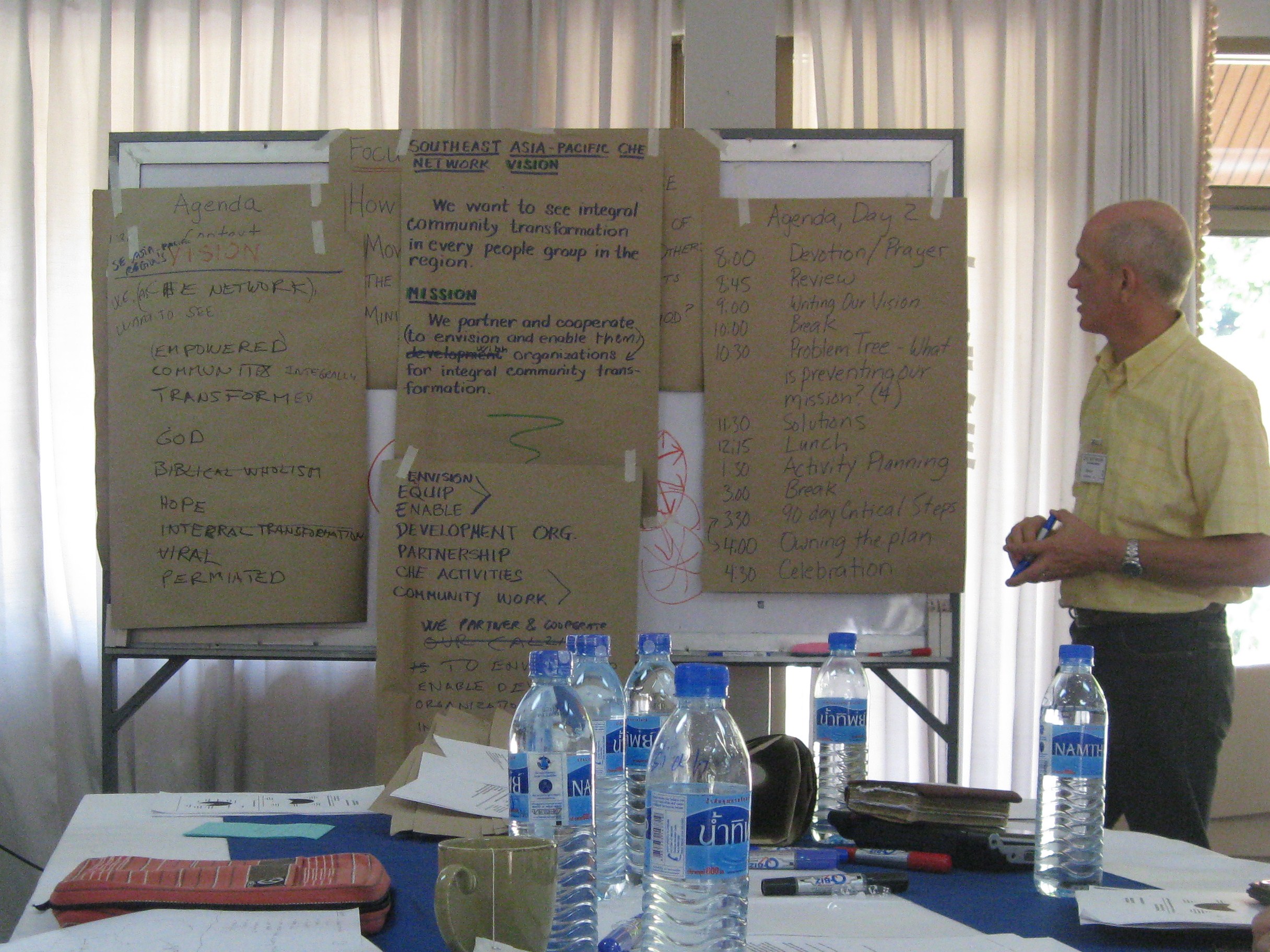
Throughout the SE Asia and Pacific CHE Consultation, our days were booked from 7 am to 9:30 pm with exciting reports from a number of countries, opportunities to network with other organizations, and numerous learning activities. I thoroughly enjoyed spending time with people who are committed to the people in their countries of service and to the CHE strategy of community development that emphasizes the development of ongoing relationships with people in need.

Wednesday marked yet another birthday spent alone in a strange place. My birthday present was hearing that Dad had been discharged from hospital, tired but feeling well.  Also on Wednesday, I finally got to share a burden that has been growing on my heart for two years with a large group of people who not only fully understood my hopes but had the training, credentials, network and desire to meet the need.  There were four doctors in the room who were excited about the potential of taking on the challenge.  By the time I packed it in on Friday night we had a plan in place and the needed documents completed to move to the next level.

Thursday and Friday, were spent in a Founders Meeting for the International CHE Network creating vision and mission statements and developing an action plan for this coming year.  This will mean another set of responsibilities and another huge learning curve as I am leading a task group to explore the many issues involved in translating, contextualizing, cataloguing and storing lessons and materials in the many languages of south-east Asia.

In a week like this you realize not only what a privilege it is to be serving at this stage in our lives but also the cost involved. In the middle of all that happened this week Steve is alone in KL dealing with the challenges of his own work with its constantly shifting requirements, trying to provide me the information I need on my Dad, supported by a wife who only gets to communicate with him through text messages.

We are well aware that our families also share in that cost as they are left dealing with issues at home and that without their support we would not be able to continue here. We want to thank them and our many friends who have prayed for my Dad, and have sent us messages of encouragment and support during this eventful week.

The Canadian Pre-University Program where I work shares a building with two other educational programs: the Cambridge A-Level Program and the South Australian Matriculation Program. Both CAL and SAM are twice as large as our program. They are both well supported by the universities in the countries that promote them and well advertised in this growing Asian education market. Foreign language students studying in Australian universities are that country’s third largest industry.

By contrast, the Canadian program is not well-known, either in Asian, or back home in Canada. In fact the Canadian government just this month cut off funding for the small office that advises Asian students on the Canadian option. In addition, this program is expensive. In order to be licensed by the Ontario government, the school must employ Canadian teachers, which requires a salary that is high enough to recruit Canadian staff. Understandably, with a smaller per student profit margin, it doesn’t pay Taylor’s College to promote this program, despite its clear pedagogical superiority.

The CAL and SAM programs have continued to expand at this program’s expense, and in order to make room for all their new students, the Canadian program is being asked to leave. In two weeks. Yesterday we got a tour of the office building they are moving us to. It is enough to make one weep. The previous tenants have only just moved out, and the place is a disaster. Taylor’s has promised to renovate, but have set themselves no deadline for those renovations. When we were there we saw two painters working without much effort covering up the yellow stains on one wall. At the rate they were moving the  renovations should be finished in a mere forty years.

I know that change is inevitable, and heaven knows I have been through enough of them in my lifetime to get used to it. I know that change can sometimes bring renewal; but I also know that change is not always for the better. From what I saw yesterday, this is one change that I could do without.

The upside on this (and there is always an upside) is that I don’t work for Taylor’s College, anymore than I ever worked for Thames Valley District School Board, or before them Elgin County Board of Education. Since He got hold of my life some 35 years ago, I have worked for the Lord. It is He that sent me to Malaysia, and it is He that will send me home when He is done with me here. As for the circumstances of my employment, well that is for Him to decide. He knows my frame. He will at times test me and try me in order to purify my motives and keep me in line, but He will never allow me to be overwhelmed, and if this change proves to be an impossible situation, then that will be His way of telling me it is time to move on.

« Previous PageNext Page »