2018
Yearly Archive
May 25, 2018
Posted by Steve and Pam Wise under
Current News
Leave a Comment

We have been most fortunate to have lived in Europe and Southeast Asia, which afforded us many opportunities for travel. As a result, there aren’t many things that remain on our “bucket list” of sights to see in the world. However, one of those things has long been Machu Picchu.

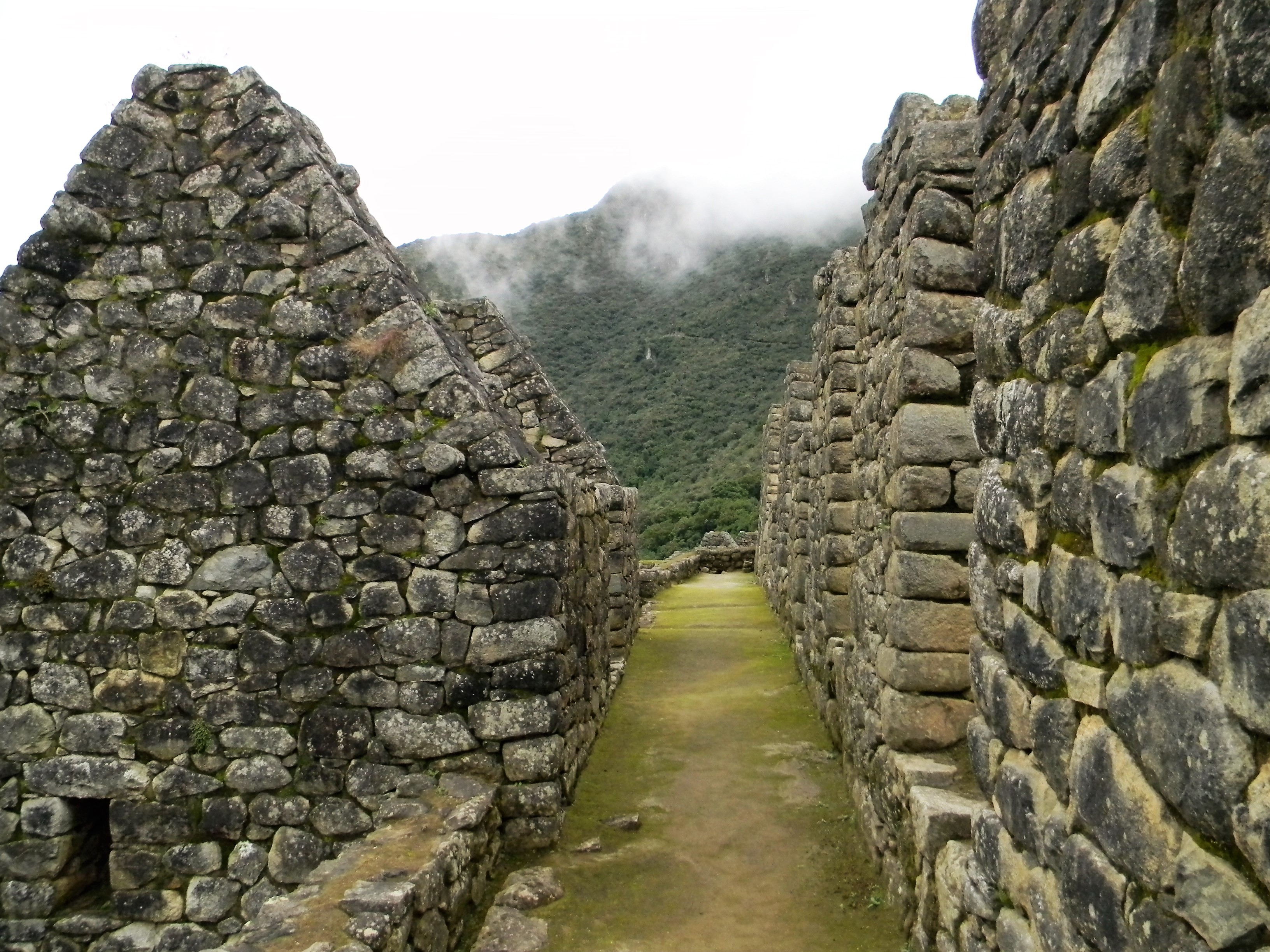
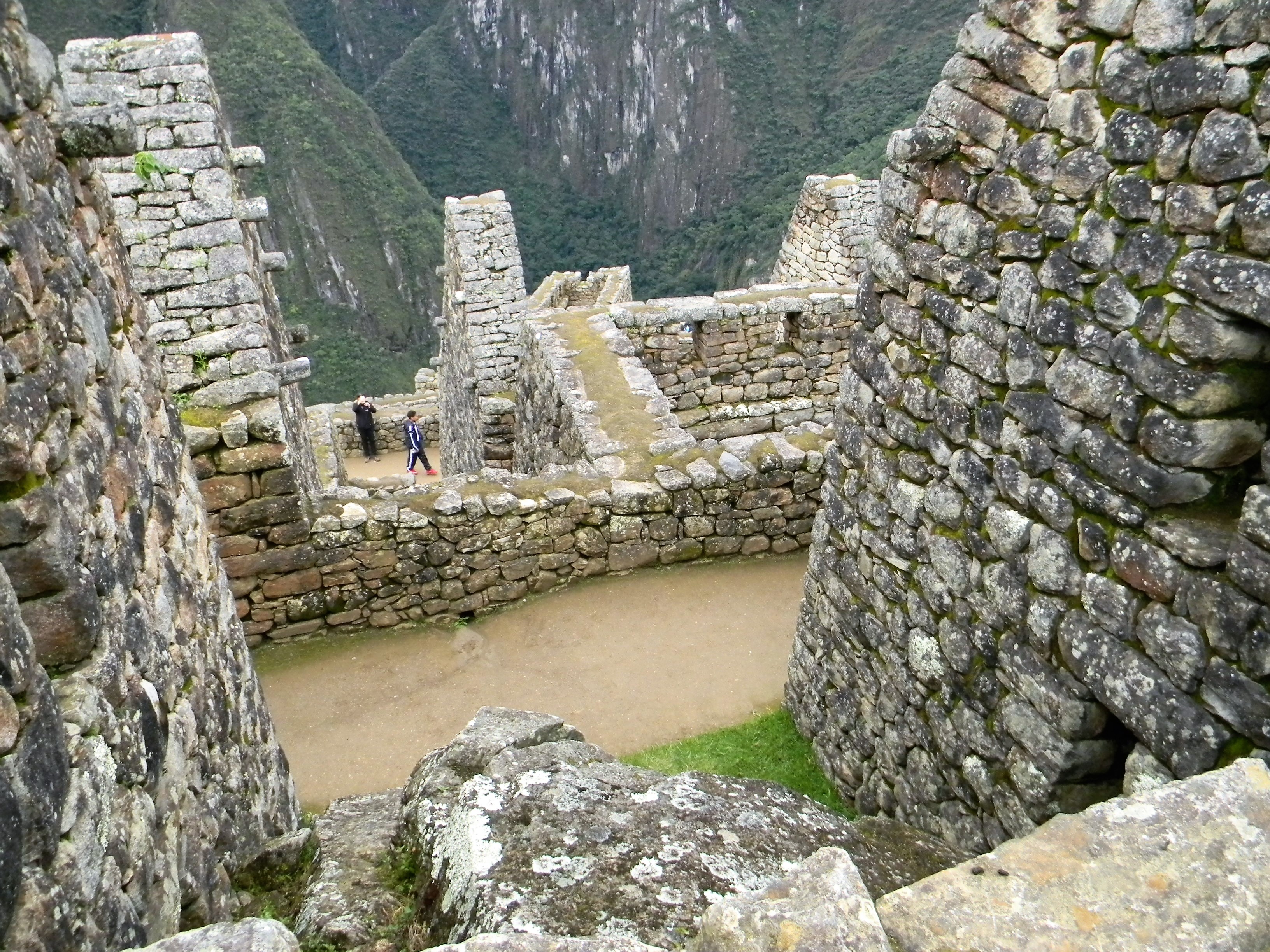
Machu Picchu is probably the most amazing site of the Inca Empire at its height, justifiably famous for its beauty and inaccessibility. Its giant walls, terraces and ramps seem as if they have been cut naturally in the continuous rock escarpments. At just under 8,000 feet above sea-level, the site is in the middle of a tropical mountain rainforest, surrounded by even higher peaks in an extraordinarily beautiful and breathtaking setting.

There are approximately 200 structures each with religious, ceremonial, astronomical, agricultural and residential purposes built on the side of a steep mountain and reinforced by stone terraces. The city is divided into lower and upper areas, separating the farming from residential areas, with a large open square between the two. The massive architecture of Machu Picchu blends exceptionally well with the stunning natural environment, which is intricately linked by an extensive road and trail system, irrigation canals and agricultural terraces bear witness to longstanding human use. The fact that the rugged topography makes some areas difficult to access has resulted in a unique mix of developed areas and diverse natural habitats.

Adding to its aura and charm are the legends surrounding both its building and its abandonment. Hiram Bingham, who discovered the site in 1911, wasn’t even looking for it, and when he came across it he quickly moved on, thinking it to be of particular significance. Local farmers has known about it for years are we happily working its ancient terraces exercising squatter’s rights and avoiding government notice and taxes. Having failed to find the fabled El Dorado of legend, Bingham returned to the site and began excavations. It was only then that the true genius of the site began to emerge from the overgrown ruins.
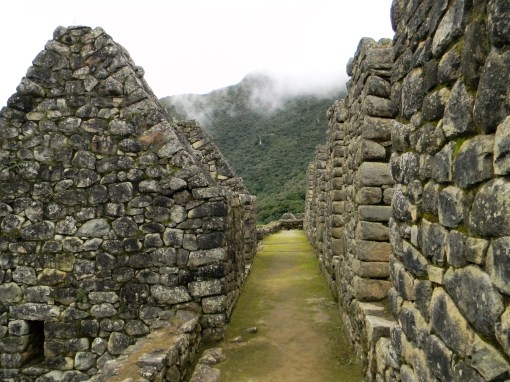
The site is now almost completed restored and well preserved by the Peruvian government who recognize its worth not only for its historical significance, but for the powerful draw on tourists. We woke early and were up in time to catch the 7:00 a.m. train for the 90 minute journey to Agua Calientes. There we were met by a guide who ushered on to a bus for the 20 minute, death defying trip on mountain switch-backs to the gates of the fabled site. Our guide explained that he had been required to take a four year certificate course in the geography, history, and agriculture of Peru in order to be certified for Machu Picchu. He knew everything about the site, and was an excellent guide for our tour.
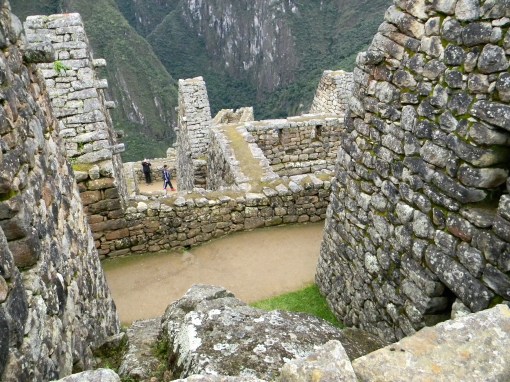
Built without the use of mortar, or even metal tools, Machu Picchu remains one of the world’s engineering marvels. Adding to its mystery is the fact that it was abandoned, most likely around 1570, for no apparent reason. There is no damage to indicate that it was invaded, and indeed it had no strategic value to the invading Spanish. The most likely explanation is that the residents of Machu Picchu left their secluded enclave to assist a neighbouring village to ward off an attack by the Spanish and were all slaughtered in the effort, leaving Machu Picchu undefended except for its inaccessibility until it was rediscovered 100 years ago.
May 24, 2018
Posted by Steve and Pam Wise under
Current News
[2] Comments

After our lovely Sunday in Lima, we were refreshed and excited to get going on the rest of our trip in Peru. Our early morning flight on Monday to Cusco went smoothly over the Andes Mountains, and we were able to book a cab at the airport to take us on our almost two hour road trip to our next landing spot. Cusco is at about 11,000 feet above sea level, so we were not feeling particularly comfortable, despite the cocao tea. We were happy for the slow descent into the town of Ollantaytambo and the Sacred Valley at a mere 9,000 feet.
Just to put that in perspective, there are 25 mountain peaks in Peru that are over 20,000 feet, and many hundreds over 10,000. Cusco is actually on the jungle side of the Andes and in Peruvian terms, is no more than a foothill. Incredibly, though we were only just over 200 miles from the Pacific, all the rivers flow into the Amazon from here and out into the Atlantic, a journey of more than 4,000 miles. Even this far away, the snow melt from the Andes produced rivers of considerable volume and speed
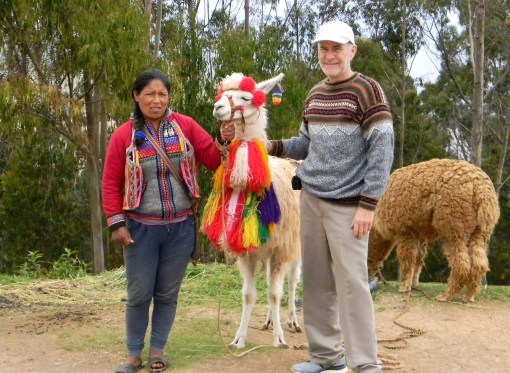
The road trip down through these foothills was most pleasant and scenic. We stopped for the occasional picture of llamas and alpacas, and the locals in their colourful dress, but we were eager to arrive at our destination in order to confirm our tickets and contact our tour guide for Machu Picchu for the following and didn’t dawdle much.
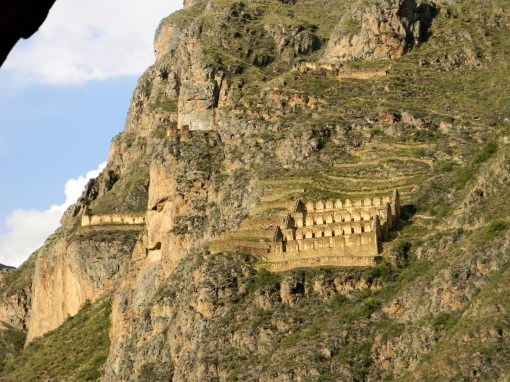
Ollantaytambo was a delight. An original Inca village, there were still the remains of buildings perched high on the surrounding hills, and the village itself was a marvel of cobblestone streets and stone walls. Water coursed through the streets in stone channels less than a foot wide and deep, and the city plaza was alive with colour and noise.
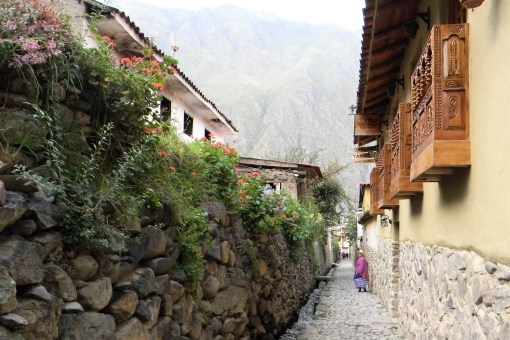
The Parwa Guest House was down the side of one of the narrow walled streets that intersect this village, and our host, Jorge, was most welcoming and kind. Our room was small, with barely room for the queen sized bed, but there was internet and quite a nice ensuite bathroom, so really everything we needed. Jorge was most persistent and helpful in making contact with our tour guide for the next day, and with that down, we went out for astroll to the train station to secure our tickets for the following morning.
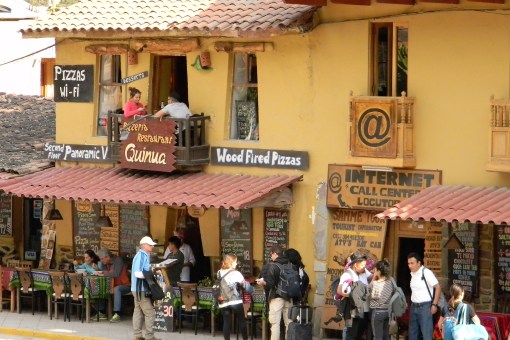
On the way back to town we stopped for a meal beside one the many streams that irrigate this little village. For the second time I was intrigued but refrained from the alpaca on the menu and opted for something more familiar. We stuck with the bottled water as well, not wanting to jeopardize our trip to Machu Picchu with someting too exotic.
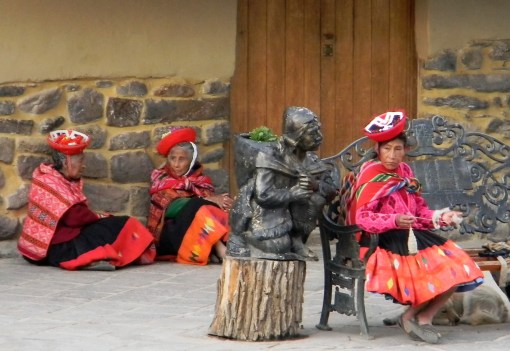
After a quick stop at the guest house to freshen up, we headed out the the main plaza to take in the evening sights. There were lots of tourists and plenty of locals in town. Ollantaymbo is one of only two or three jumping off points for Macchu Picchu, and by all accounts the nicest of the three. Urubamba, furthest away is the starting point for the train, but is mostly an industrial and commercial centre without much local flavour. Agua Calientes, the end point of the train and the beginning of the bus trip on to the site itself, is tourist central, with all the tackiness that such a designation implies.

After our trip to Machu Picchu, we took another day at Ollantaytambo to take in the sights. We also needed a day of rest to recover from our climb up Machu Picchu and a nasty little stomach bug that Pam had picked up along the way. More on Machu Picchu tomorrow.
May 23, 2018
Posted by Steve and Pam Wise under
Current News
Leave a Comment
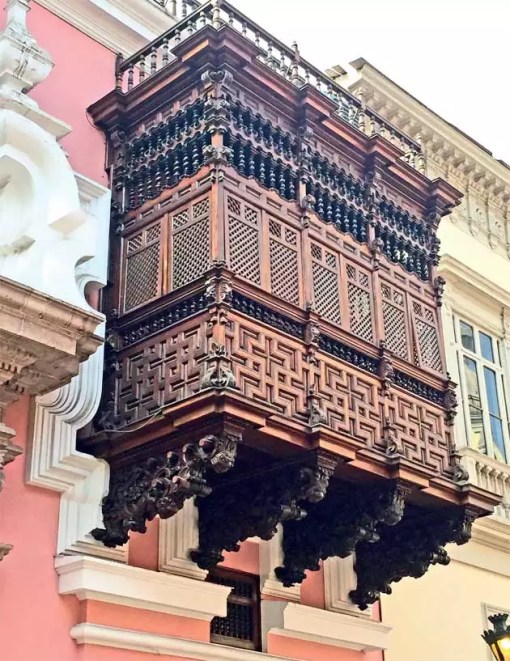
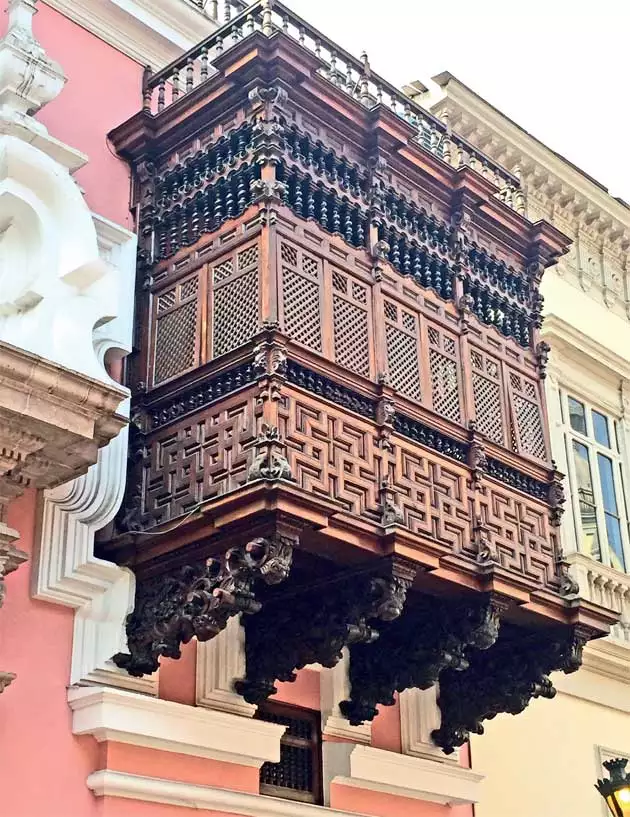
One of the key factors in UNESCOs designation of the center of Lima as a World Heritage Site is the profusion of ornate balconies that brings to the city center a sense of harmony and beauty. These balconies not only bring light and air to the graceful homes of the city, they are also a window into the history of the country.
The noble and wealthy European immigrants who arrived in the capital built their houses with similar styles to the Spanish and Moorish architecture of their roots. In North Africa and the Middle East it was not culturally acceptable for women to walk out in the streets. The balcony provided fresh air and warmth as well as protection from the rain while women of nobility and wealth could discreetly observe the comings and goings of the city without leaving their homes.
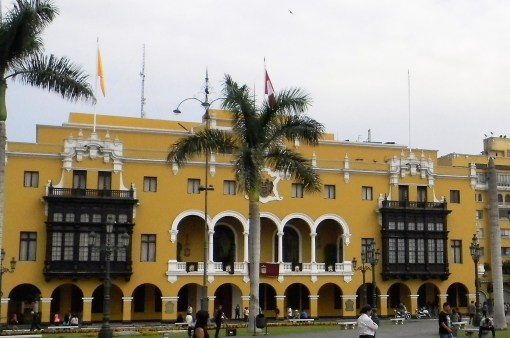
The luxury and ostentation of these beautiful balconies are unique, never repeating the same pattern. While some balconies are open and without enclosures, others are closed or built into corners. Many were built with trusses that contributed to the passage of light and air, while offering the necessary privacy to prying eyes from the street.
Many balconies in Lima were built in the Renaissance, Baroque, Neo-Baroque and Neoclassical styles and had Mediterranean, Middle Eastern, Moorish, Andalusian and Caribbean influences. The Renaissance idea that the nobility of a building characterized a city’s grandiosity permeates Lima’s architecture. The Baroque architecture of this period, characterized by exuberance and heavy ornamentation, is prevalent as well. In the 18th century, the Rococo style came to Lima as a result of French influence. This style embraced ornamentation and playful themes.

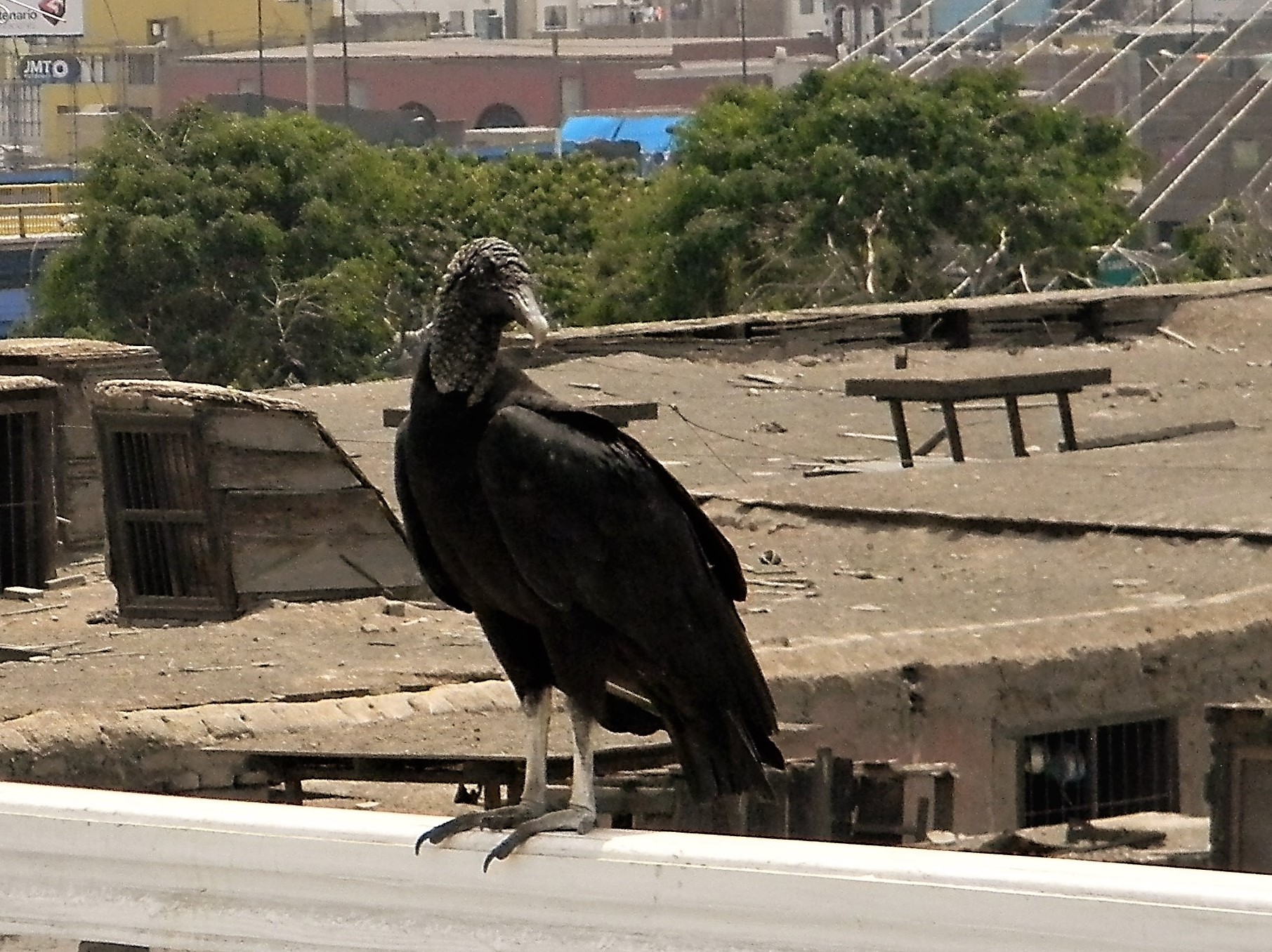
Our own interest and enthusiasm led us to inquire at one lovely building if we might have a closer look. Our impertinence was rewarded with a personal guided tour that ended at a rooftop cupola. We were delighted to find a nesting condor in this space who didn’t seem to mind sharing his view of the entire city!

May 21, 2018
Posted by Steve and Pam Wise under
Current News
Leave a Comment
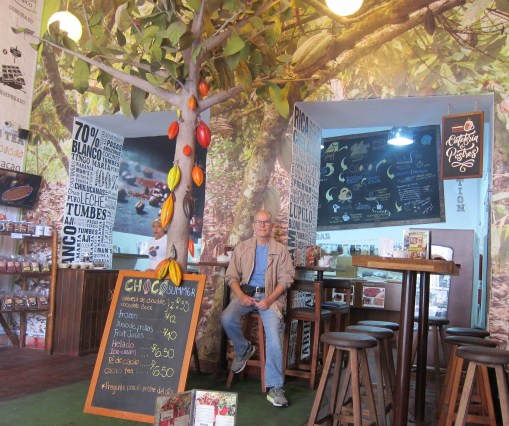
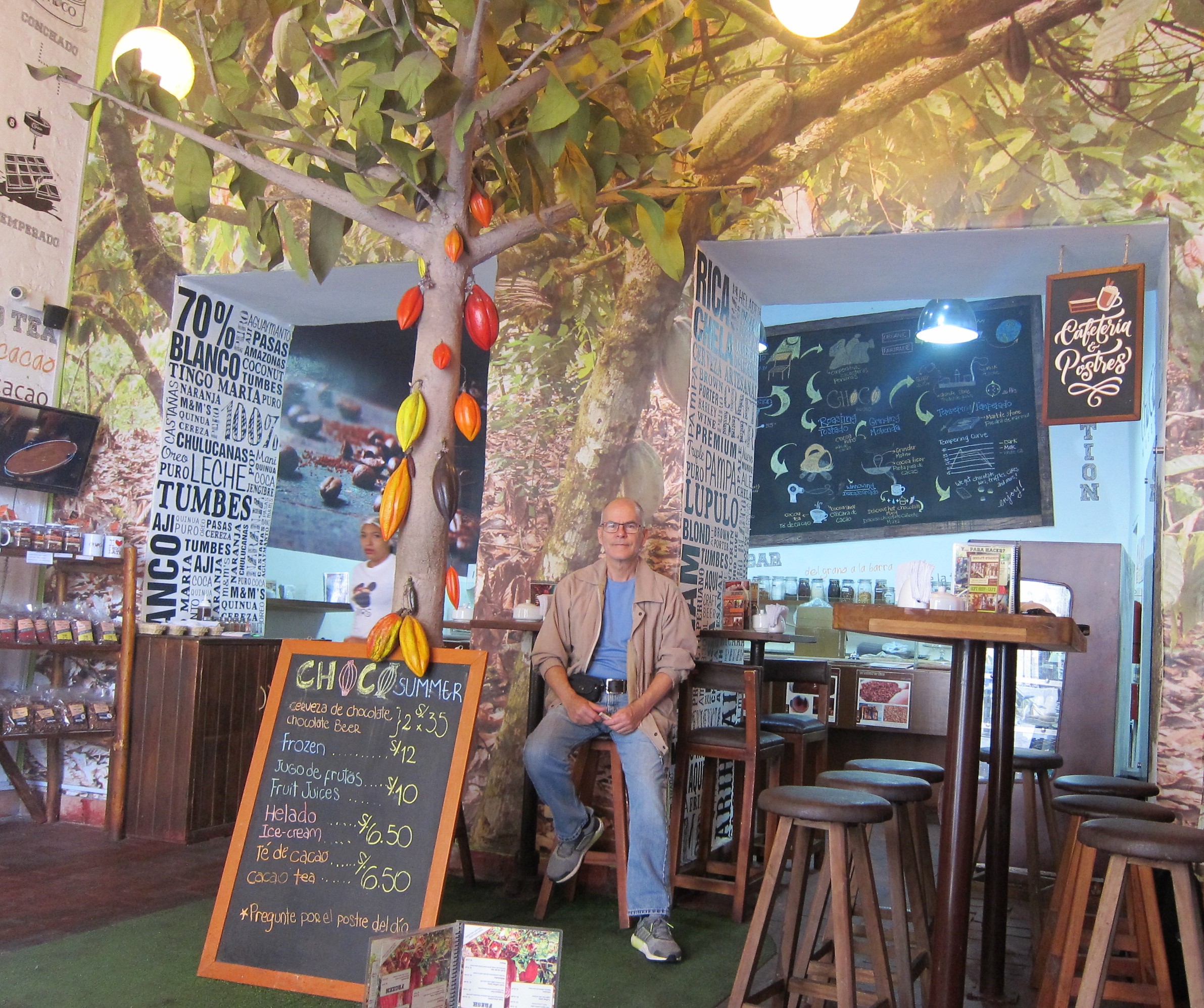
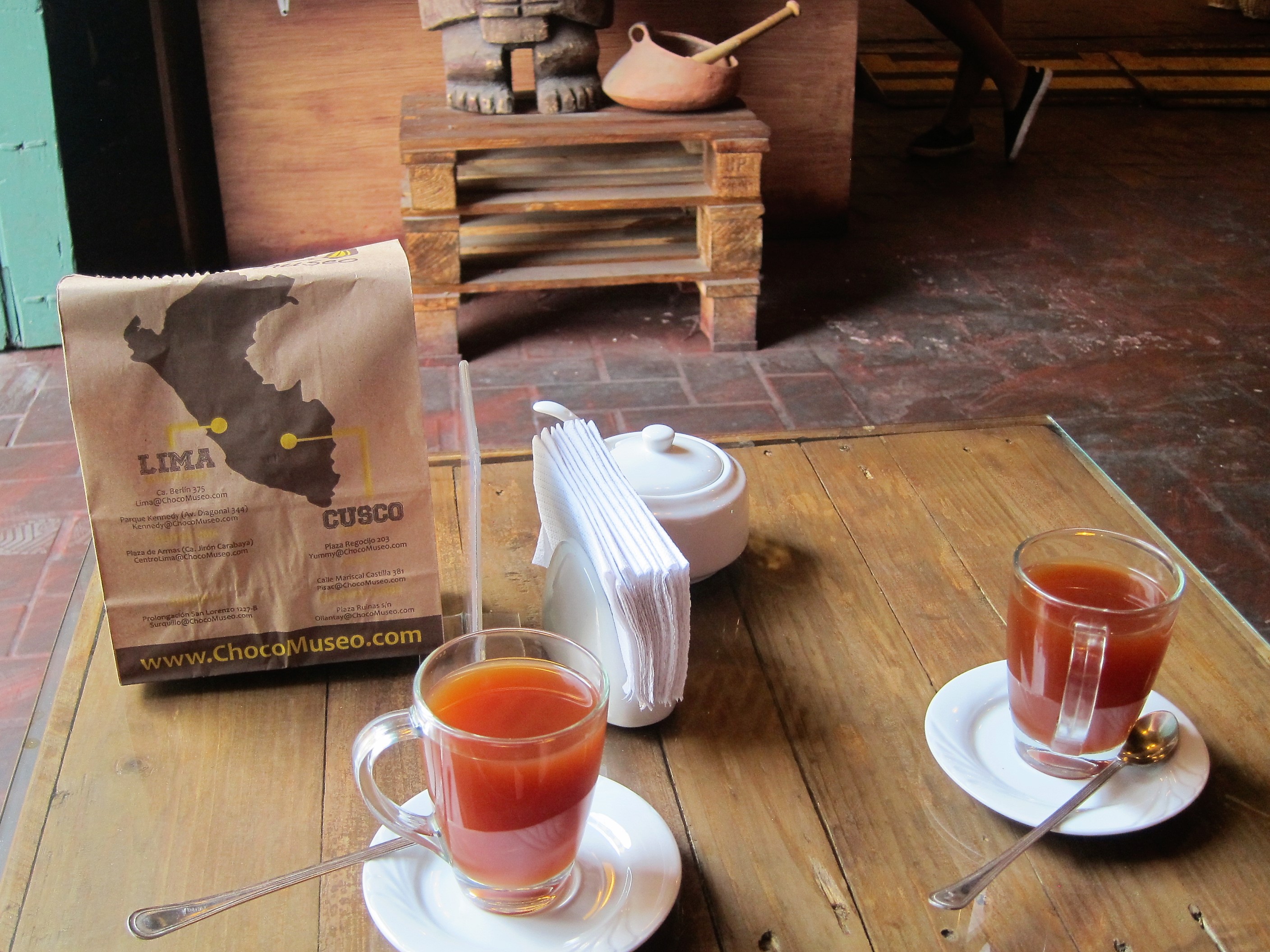
As the procession wound down, we headed off to do some exploring of the old city center and just around the corner we came across a lovely little Choco Museo. Here the chocolate is artisanal, and prepared right from the cacao bean. They had an impressive array of chocolate bars with fruits and spices, chocolate candies, truffles , cookies and nuts as well as chocolate jams, and chocolate liqueurs.
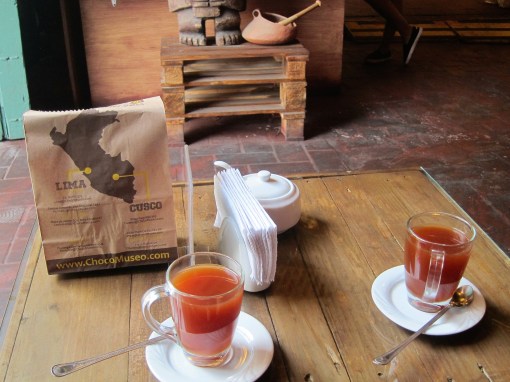
As all of these products were advertised as “unbelievably healthy and positive for your frame of mind”, and our feet were getting a bit tired; we took the opportunity to enjoy a cup of their famous cacao husk tea. It was to die for.
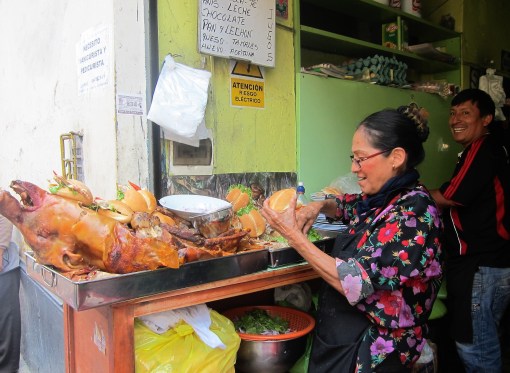
Cayman is a lovely place and the beaches are beautiful, however the street life is limited and what you do see tends to be artificial; set up for some event or other. In Peru, life happens on the streets and it made us so happy just to wander and enjoy the sights and sounds.
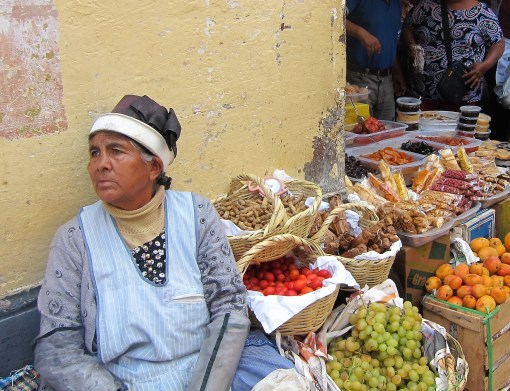
We loved watching the Peruvian people just going about their daily lives, dressed in their bright, colourful clothing and beautifully distinctive head wear.

We were tired but it was a beautiful evening when we got back to Miraflores so we decided to walk down to the beach and have tea at this lovely gazebo at the end of the peer.
May 21, 2018
Posted by Steve and Pam Wise under
Current News
Leave a Comment

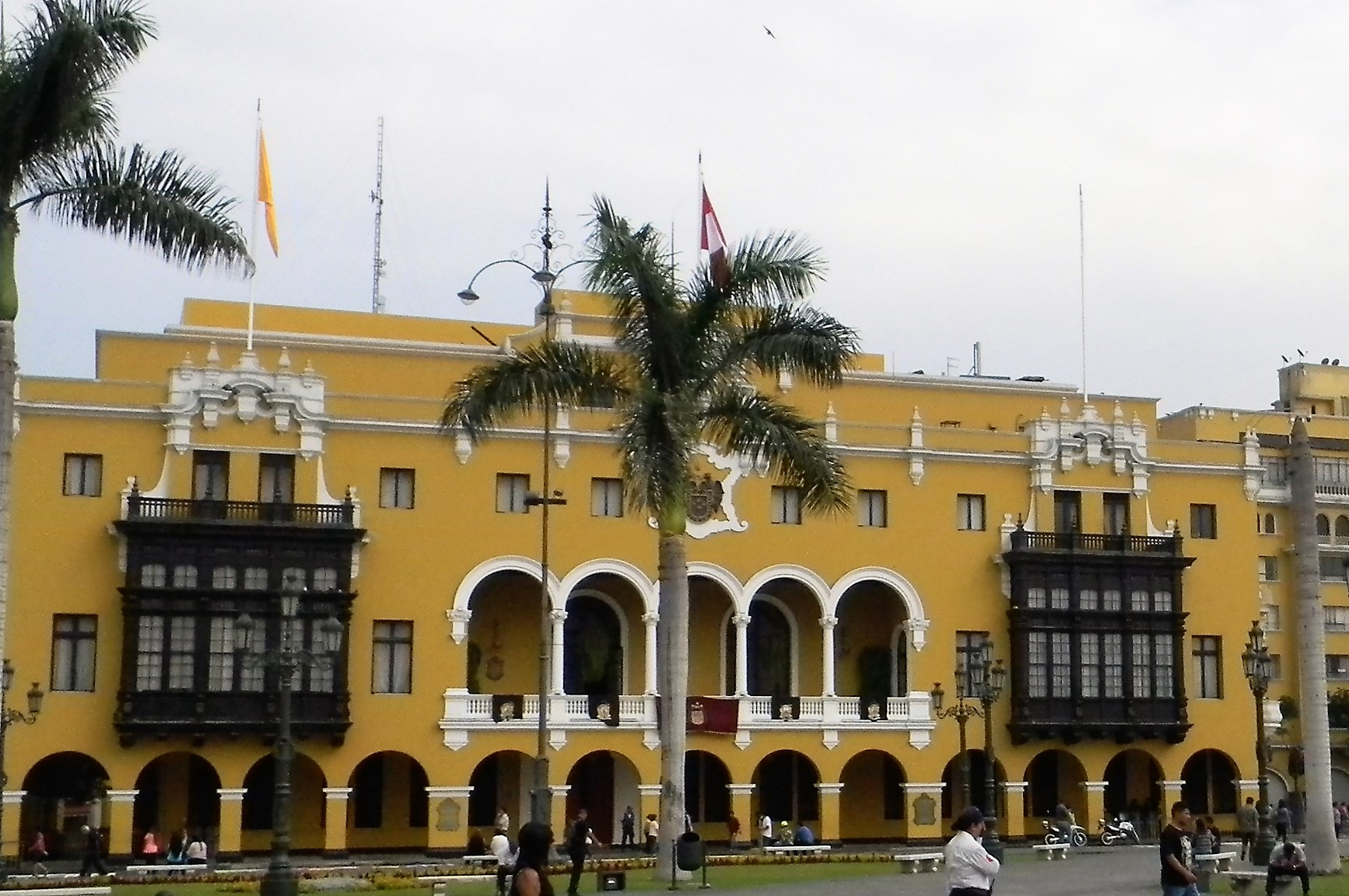
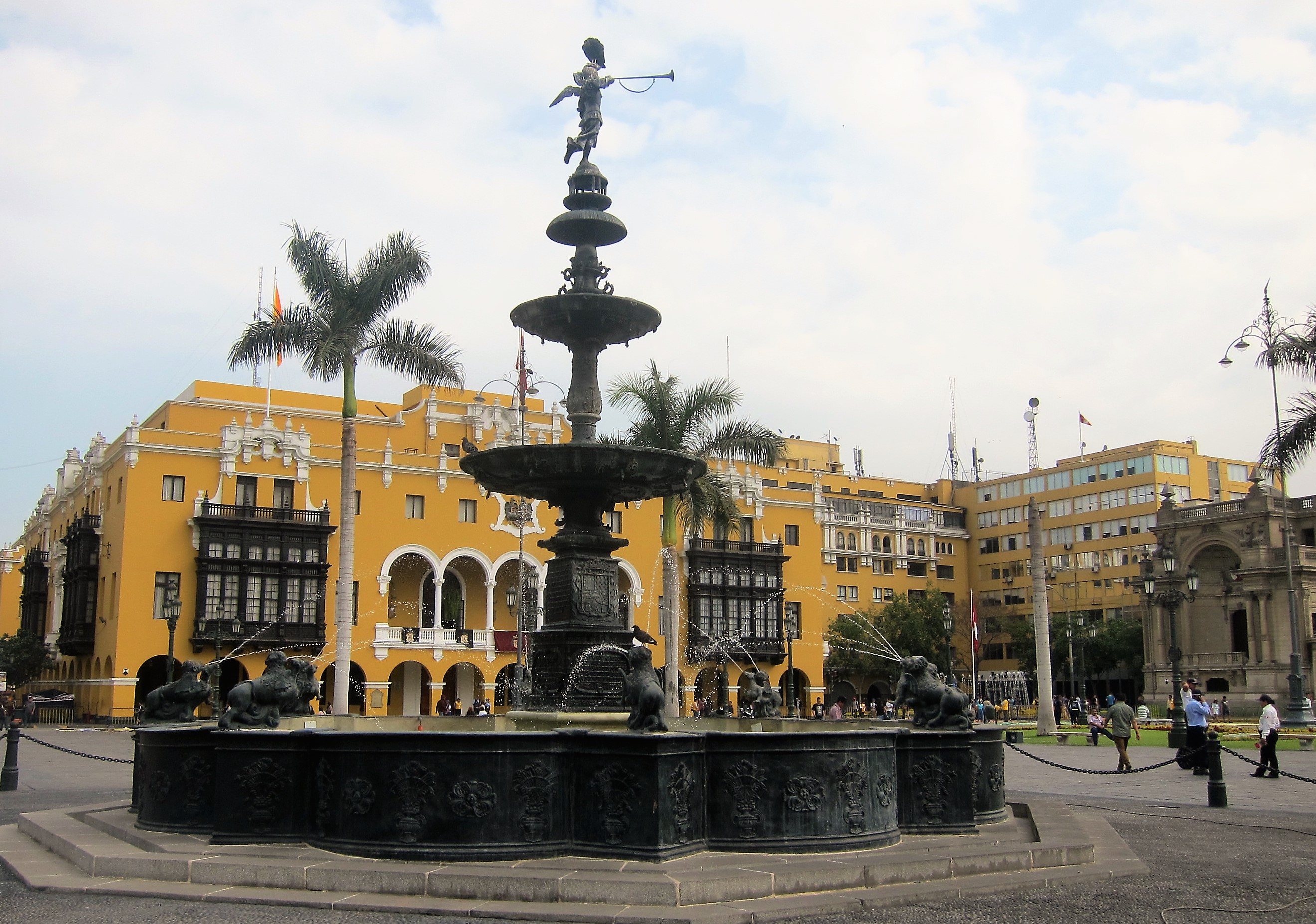
Like many Latin American nations, Peru’s predominant religion is Roman Catholicism, which remains a powerful influence in both state affairs and daily activities. Church activities and personnel are centered in Lima, with its most important and impressive cathedral in the Plaza de Armas along with the National Palace and Lima’s Municipal Office. The institutional role of the church has slowly declined over the years but the ceremonial aspects of the Catholic religion, its moral convictions and cultural values remain deeply embedded in Peruvian culture.

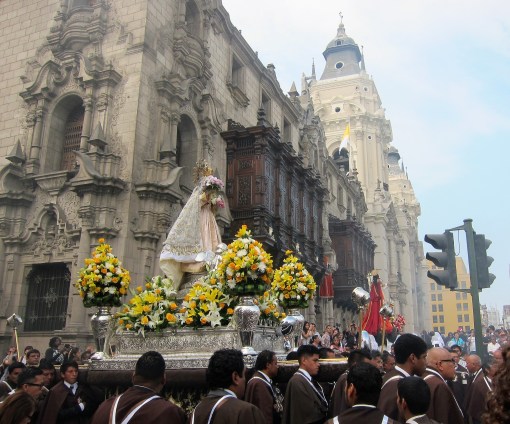
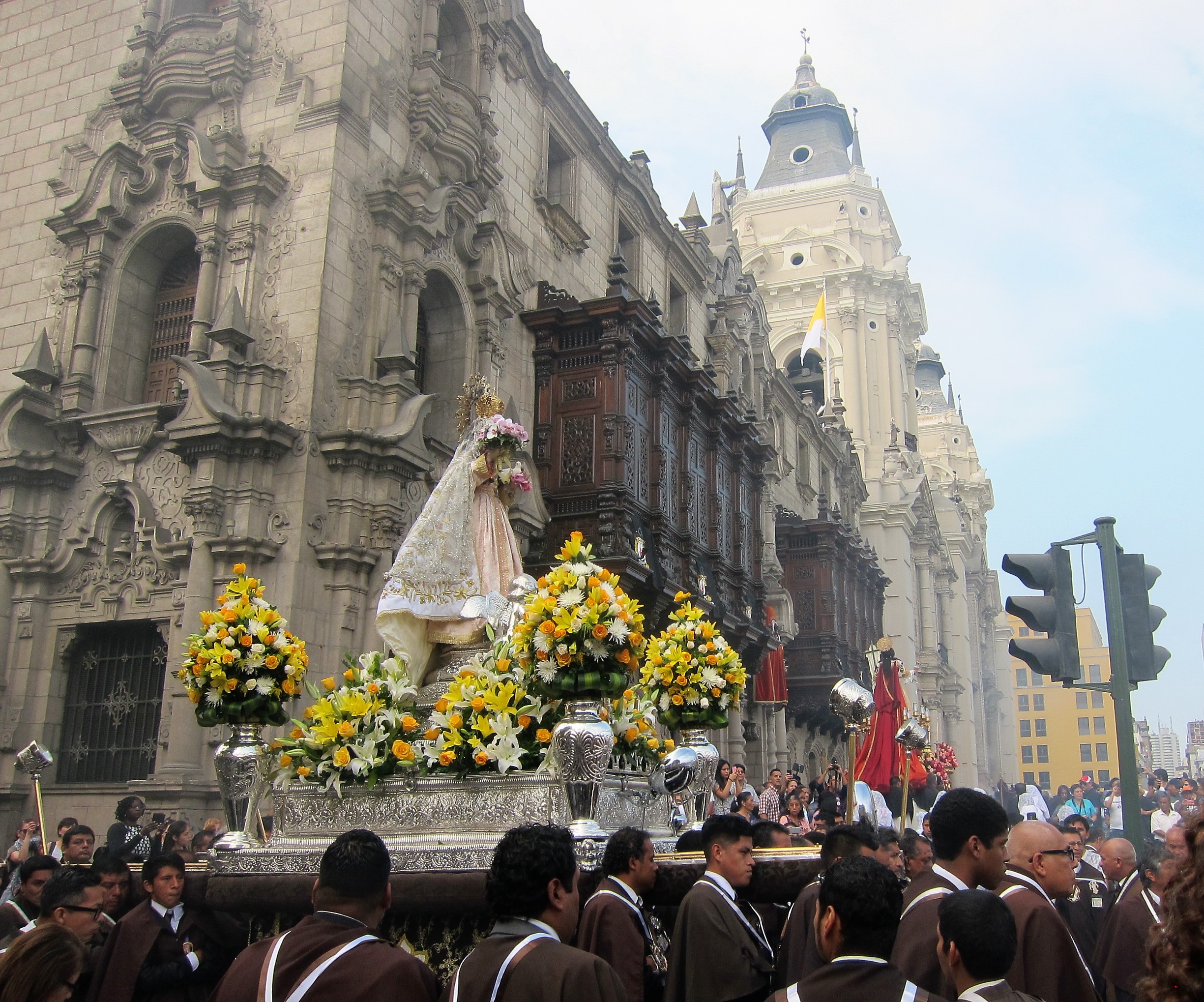
We were up in good time on Easter morning and grabbed a cab to take us into the center of Lima to do a little sight-seeing and possibly catch a church service. Our timing was perfect and we arrived in the Plaza in time to witness the gathering of the faithful to celebrate the Risen Christ. All of the streets around the Plaza were decorated with incredibly beautiful murals made of flower petals.

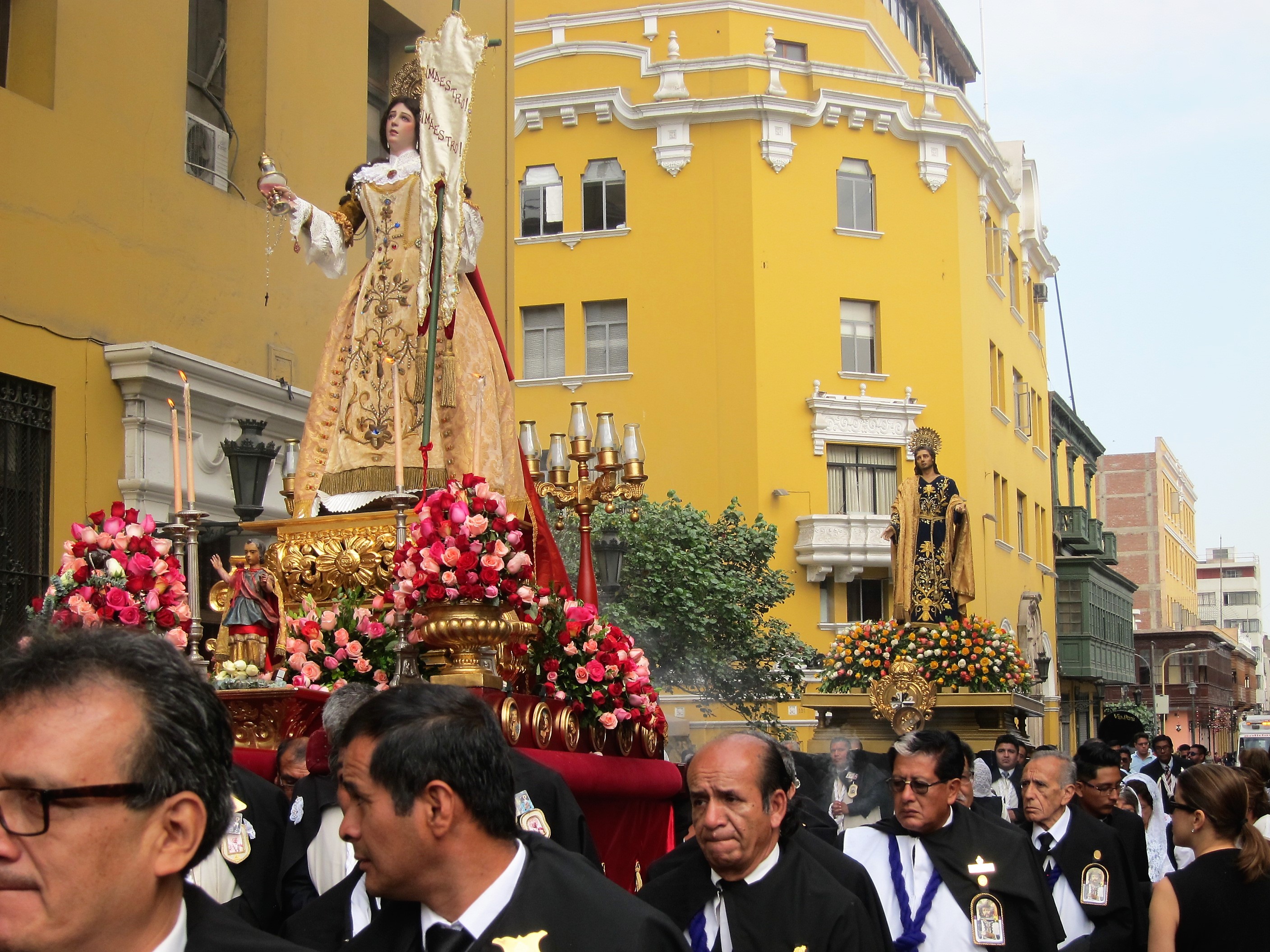
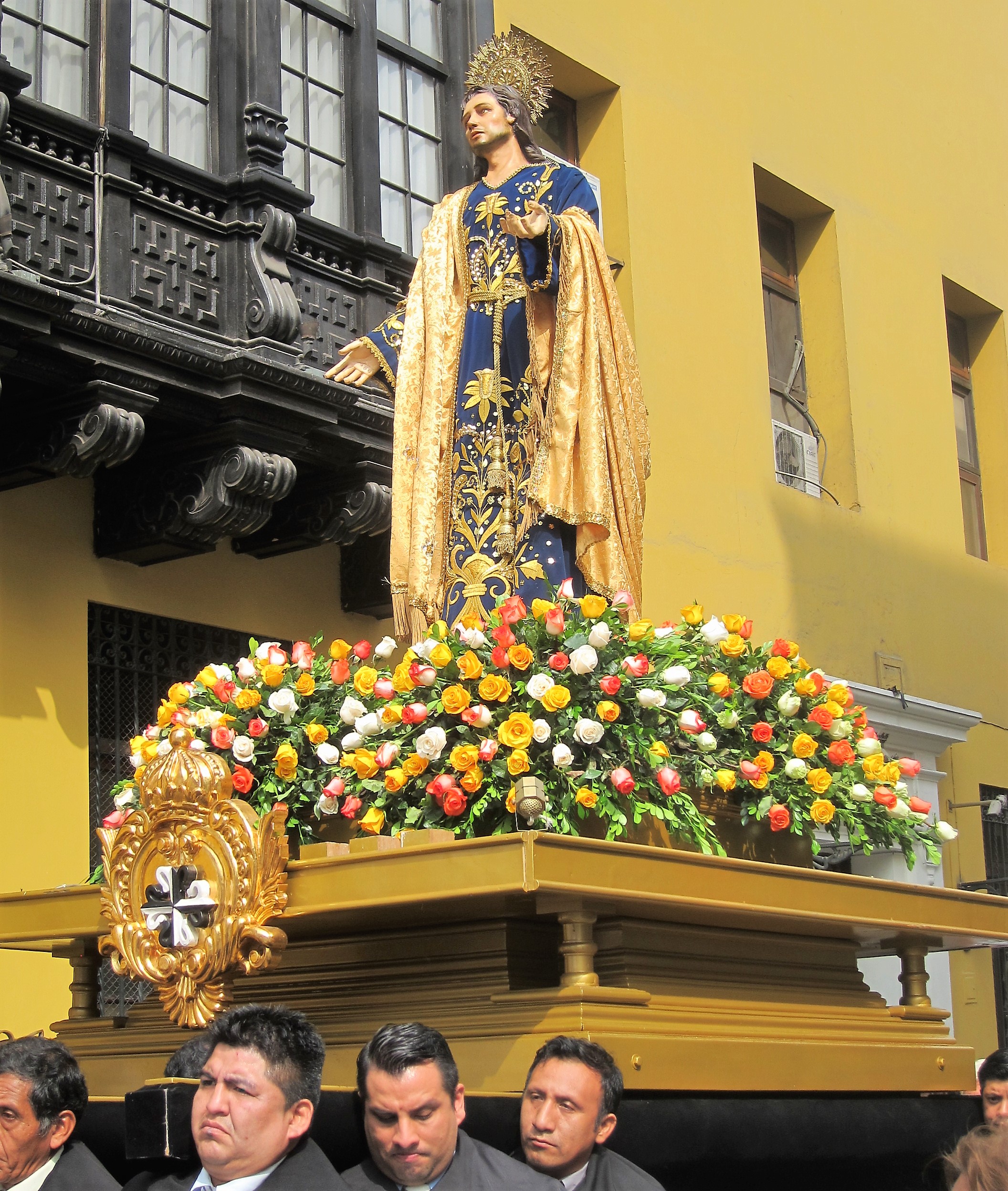
We followed the sounds of music to a side street in time to witness the arrival of two processionals coming from opposite directions, to converge at the 16th century Cathedral in the heart of old Lima Centro. Each group carried four figures of about ten feet in height, balanced on a platform on the shoulders of 14 to 16 men. They were each accompanied by a marching band, incense burners and columns of worships and came to a halt every few minutes to allow the men to rest.

It was a spectacular sight to see and a joy to watch a community celebrate their faith with such fervency and adoration. We spent a happy morning around the plaza, sipping on cocao and chocolate tea and marveling in the architectural beauty of Lima.
May 21, 2018
Posted by Steve and Pam Wise under
Family
Leave a Comment

We are travelling fools, Pam and I, so you have to take the following with a grain of salt, but when you get to the place that you can’t remember the last trip you took, it is time to take another. We try to fly home to Canada and the States as often as we can. Three kids and five grandkids are a big attraction. But other than that, there hasn’t been much. It is true that we did take a cruise a year ago. Sorry to say that was a bust, as any moment’s worth of reflection would have revealed before the voyage. Seriously? You live in the Caribbean and you are going to take a Caribbean cruise? D’Oh!
Anyway, after that fiasco of a cruise last year we decided to bite the bullet and actually visit a foreign country, even if it meant going through Miami to get there. We were coming up for our 40th anniversary and wanted something to match the amazing trip to the Nihiwatu Resort in Sumba, Indonesia on our 30th. After much debate and a consideration of options, we settled on Machu Picchu.
Because we hadn’t travelled in a while, I had a bucket of points on my Visa travel card that enabled us to get everything in country – flights, trains, and hotels – on points. We did what we normally do when a target destination is unknown. We have a look at the ridiculously expensive packaged tours, see where they are staying and how they are mapping the route, and then pattern our trip after that to book our own.
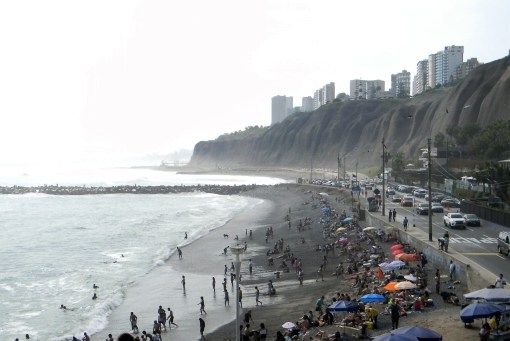
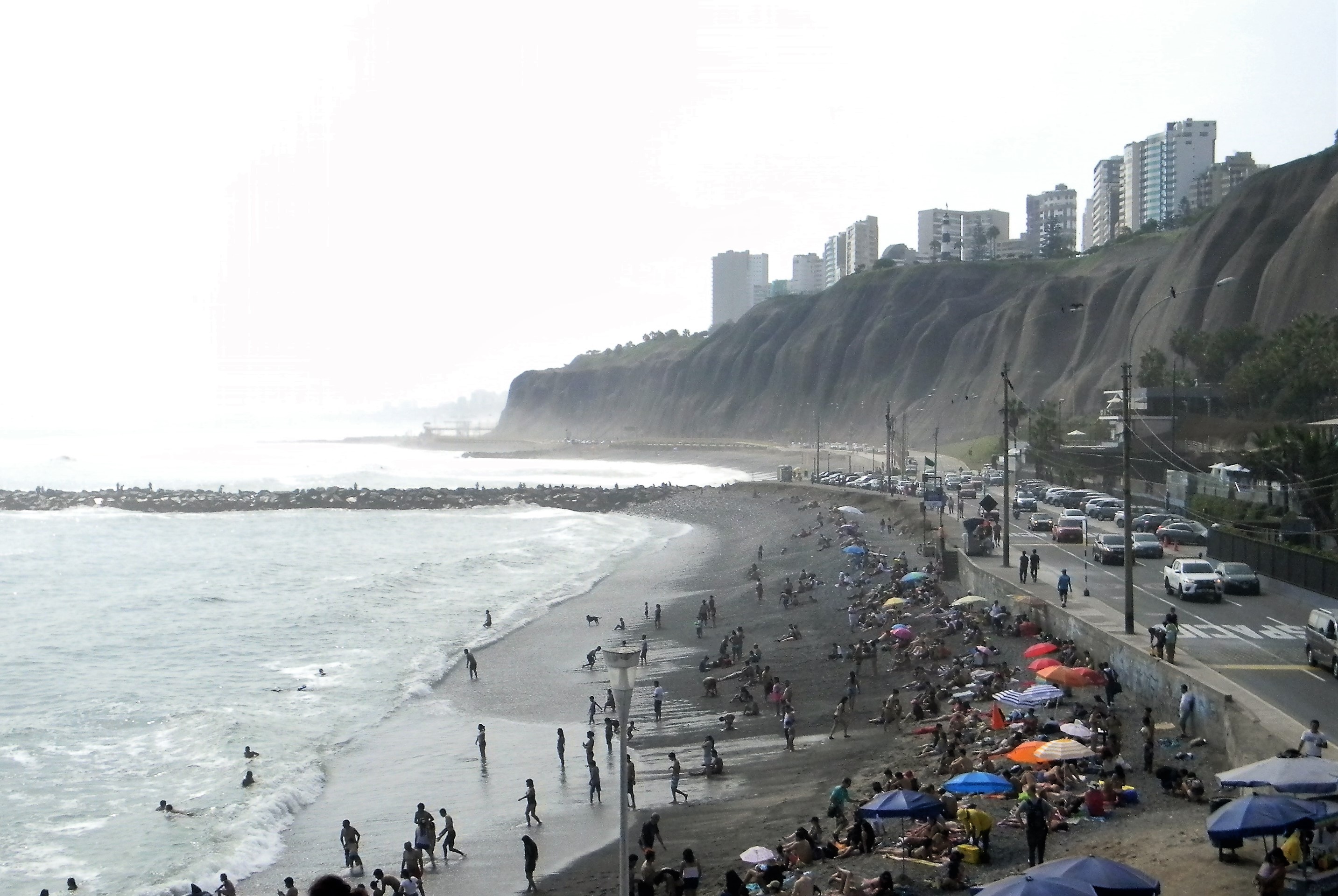
Having checked out Lima on Google, we thought it best to stay on the southern edge in a district called Miraflores. Again, no mistake there, for as we drove along the Pacific boulevard the hang gliders were sailing down over the cliff and the surfers were braving the gravelly beach by the score. We checked into the Radisson, where we got an upgrade to a superior room that overlooked the ocean and after a quick change of clothes and a brief look at Google maps, wandered out into the late Peruvian afternoon to J.F. Kennedy Park.

Peru is not Southeast Asia. Crowds, by Asian standards, were not a problem, and at least in the areas we travelled plenty of locals spoke sufficient English for our needs. We never felt threatened or were ever in any danger of getting lost or even separated from each other. After the organized chaos of Southeast Asia, travelling in Peru was a breeze.
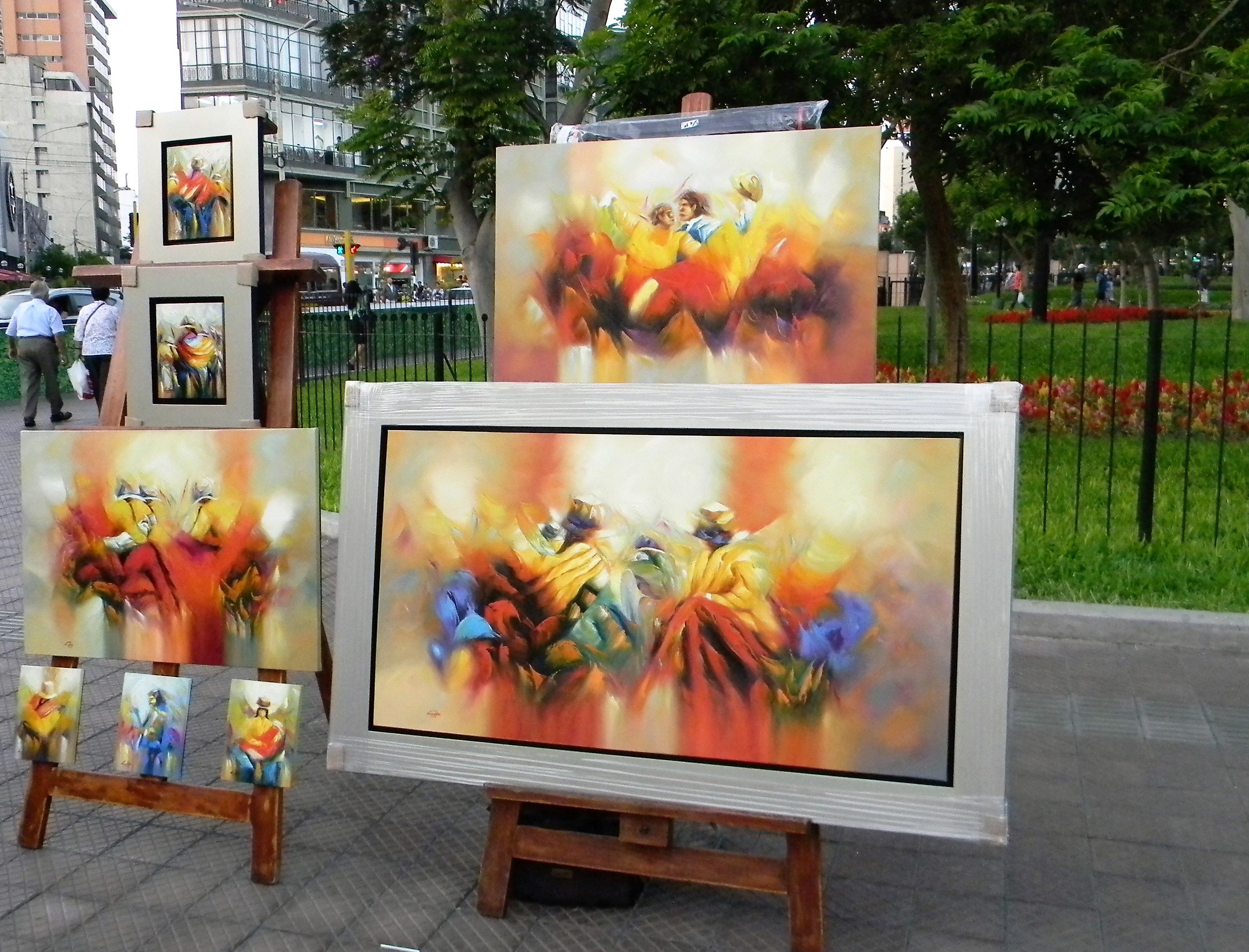
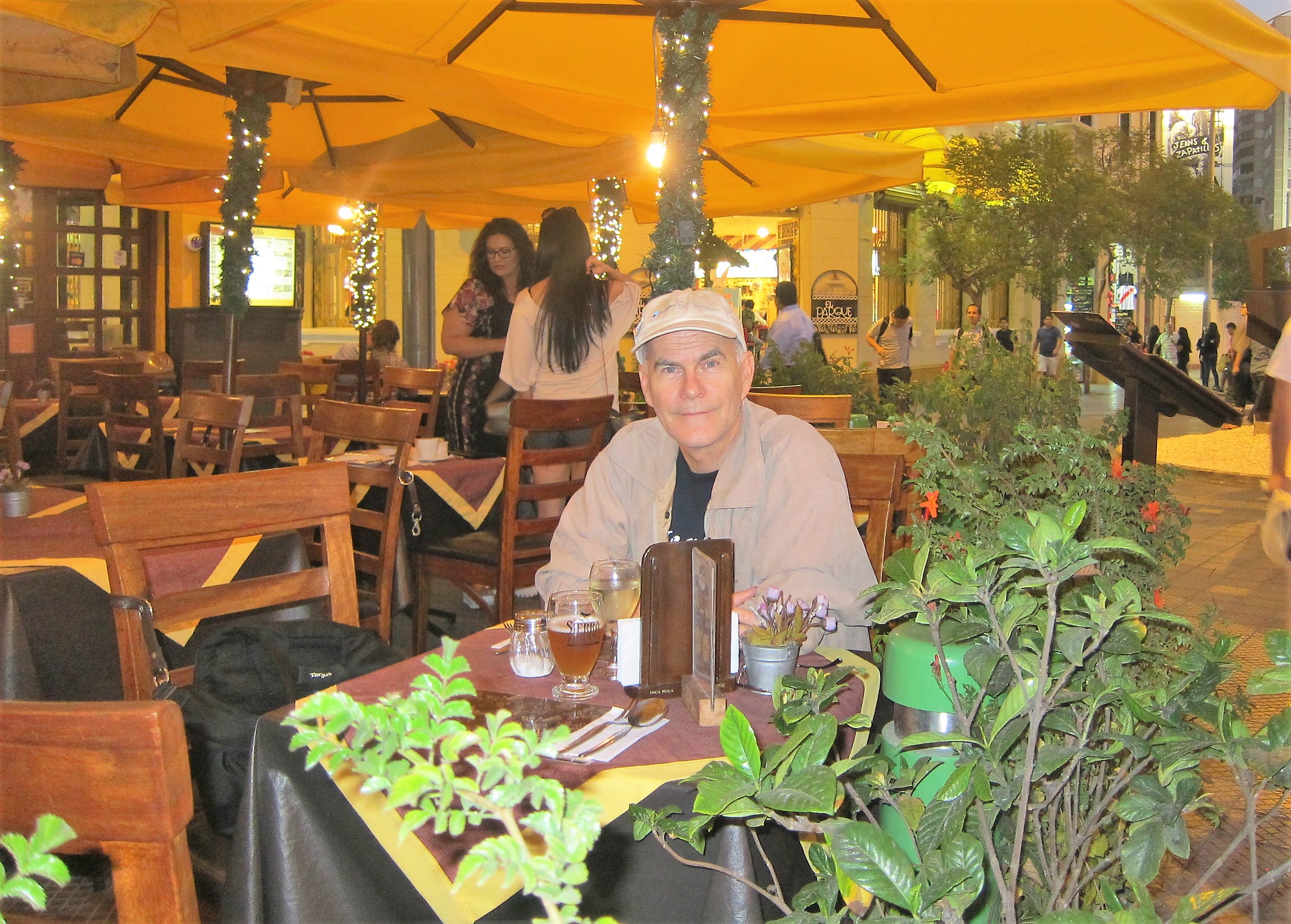
Kennedy Park was filled with vendors with their leather and pottery crafts. The local art was amazingly bold and unique, with strong colours and dynamic designs. Bordering the park were a number of outdoor cafés where we stopped for dinner so we could watch the crowds.

A pleasant stroll brought us back to the hotel to cash in a voucher for free drinks, then off to sleep in a most comfortable bed. This trip to Peru, much delayed and postponed, was starting out on a very positive note indeed. Why, we asked ourselves, have we waited for so long to travel in this part of the world!
May 21, 2018
Posted by Steve and Pam Wise under
Current News,
Family
Leave a Comment


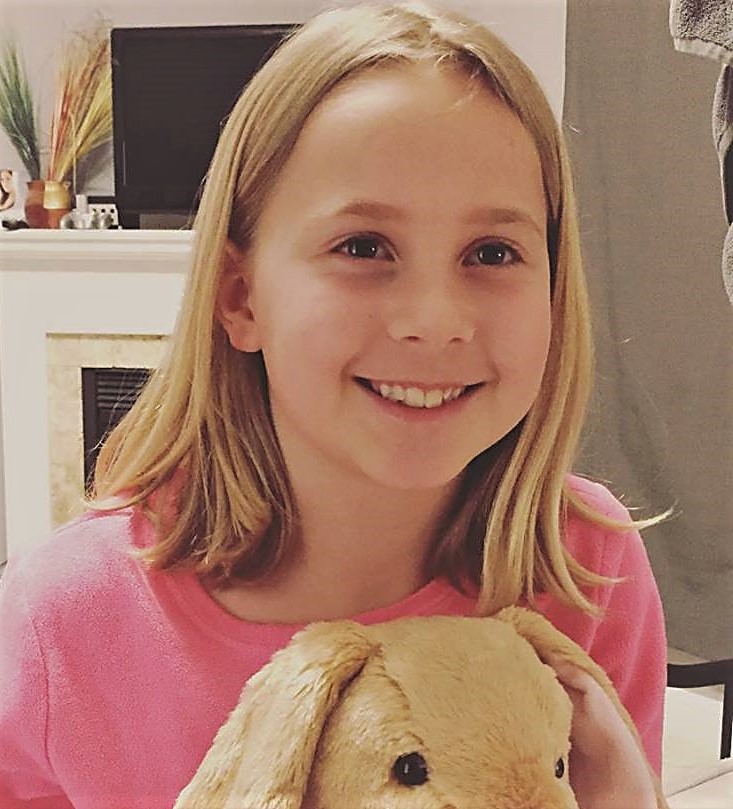
Our dear sweet Abi, we love you so very much that it is impossible to say all the things we would love to tell you as you turn ten. You have brought such special happiness into our hearts and our family. You are unique and beautiful and touch our hearts in ways that only you can.

May 21, 2018
Posted by Steve and Pam Wise under
Current News
Leave a Comment

Stephen Hawking passed away on March 14 of this year, a bright, shining star in the firmament of the brilliant. Like all truly intelligent scientists – Newton, Einstein, Darwin – Hawking left plenty of room for God in his thinking. Only the drooling Neanderthals of the intelligentsia, the Richard Dawkins and the Stephen Frys of this world who haven’t thought deeply about anything save breakfast are committed atheists. All those who are truly intelligent recognize the limits of scientific observation and theory and understand fully that beyond the ‘event horizons’ of the universe lies nothing but speculation.
Hawking certainly knew this, and at one pivotal moment in his landmark A Brief History of Time acknowledges that all of his speculation is merely an attempt to rationalize what is known about the universe into a coherent theory that is not dependent on the presence of God. He goes further. He acknowledges that the existence of God is a much better explanation for what is known and observed than anything he puts forward. Such intellectual open-mindedness is the hallmark of genius.
 Hawking was equally frank about the dangers posed by the development of artificial intelligence or AI. He once remarked that, “Computers can, in theory, emulate human intelligence, and exceed it. Success in creating effective AI, could be the biggest event in the history of our civilization. Or the worst. We just don’t know. So we cannot know if we will be infinitely helped by AI, or ignored by it and side-lined, or conceivably destroyed by it.”
Hawking was himself the beneficiary of the intelligent machines he warned us about. Unable to speak for the last thirty years, Hawking was entirely dependent on machines to move or even speak. Nothing, however, was able to limit his capacity to think. He was the director of research at the Centre for Theoretical Cosmology at the University of Cambridge at the time of his death and pushed the boundaries of what we know about the universe.
But perhaps his greatest gift to mankind was his indomitable spirit. Diagnosed with ALS at 21, Hawking was given two years to live. He lived another 55 and altered perceptions not only of the physical universe, but of the remarkable human capacity for endurance in the face of an overwhelming disability. He will be missed.
May 20, 2018
Posted by Steve and Pam Wise under
Current News
Leave a Comment

There is something about getting to forty years of marriage that has the quiet confidence of accomplishment. No, it doesn’t do away with the arguments and disagreements over the years, but it does put them in perspective. Marital arguments are immediate and intense. They are a psychological train wreck that leave both with bad feelings and thoughts about the other. One can’t help but ask, ‘Why are we still arguing about these things after all these years?’ But reaching forty years together takes the focus off the ‘arguing about these things’ and puts the emphasis on the ‘all these years.’ It happens so slowly and subtly. Each day is infinitesimally small, and the passage of the days just go incrementally by. Then you get to forty years and suddenly you recognize that together you have accomplished something remarkable.

As a Christian I know in my heart of hearts that this is not something we have done. We came into this marriage hurting and broken people, both of us. Everyone has baggage; the self-aware merely feel it more keenly. Without the other who knows what would have happened to us. In my case my own natal family is a salutary example of the person I might have become. Perhaps worse. On occasion I have felt that Pam has nagged me far more than I have been comfortable with and perhaps even on occasion far more than I deserved. However, she has been my moral compass far more often than she has been a stumbling block. When I consider where the Lord might be leading us, I always stop to consider how the Lord is speaking to her and it helps to guide my way.
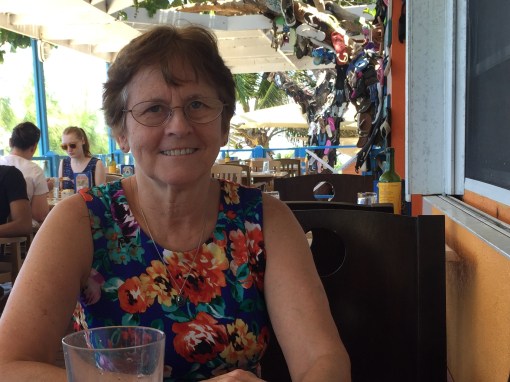
But these are just the details, the individual trees in the forest of our relationship. That forest began as a small grove of shared experience that now encompasses forty years of our lives. The branches of these experiences intertwine through the lives of all those we have known and touched, and all those who have entered our lives over the years. These shared experiences enrich our lives and deepen the connections between us. We have done far more than endure; we have grown deeper and more connected to all we have known. We have learned the lessons of love.
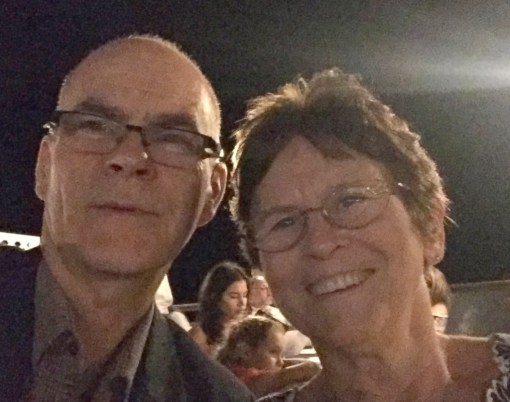
The modern notion of living together until you are no longer interested in the other troubles me. Not because I am a judgmental prude. Far from it. Rather I have seen how a marital commitment – in the presence of God, family and friends – provides the shelter under which the frail shoots of a nascent love can become a forest of blessing and refuge in a word that is filled with rancor and strife. So many people misunderstand just how considerate and caring, how reassuring and comforting that marital commitment can be. For us, at forty years and counting, it has been an immeasurable blessing.

May 20, 2018
Posted by Steve and Pam Wise under
Family
Leave a Comment

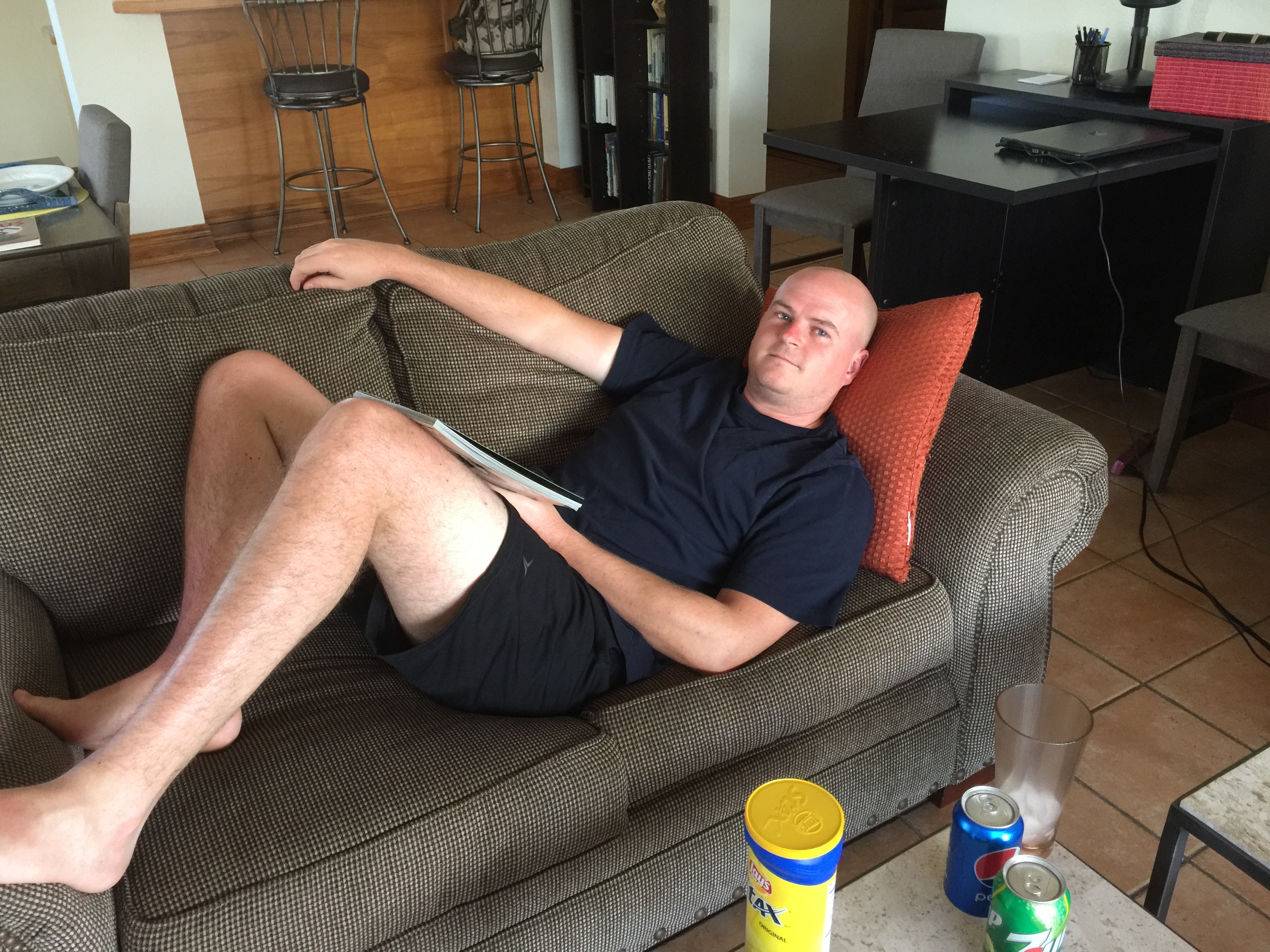
Dave didn’t manage to join us for Christmas but was able to sneak in a five day visit between projects, and before the start of the new construction season. Dave comes without pomp and circumstance, no massive preparations and no demands. His job is wonderful but demanding and stretching him in terms of catching up with the Engineering theory that he studies ten years ago. The company offers him great opportunities to update and to pursue some new certifications so he has been studying diligently for upcoming exams in March.

Dave is pretty ease to have around. He is happy to spend time with us or happy to go out and meet up with some random people to chat for an evening.He knows the island well and takes the old car and a pile of books to explore the various beaches; Barkers being his favourite of this visit.

Feb 11/18
« Previous Page — Next Page »

















 Home Thoughts From Abroad