Two years ago I went to Chiang Mai, Thailand and attended the Community Health Education Training of Trainers 1.  The CHE approach to community development was a concept that I had first heard of  in Cambodia and it fascinated me.  At that point, I took the training specifically to learn more about the strategy and the extensive library of educational materials that have been developed with the needs of the oral learner in mind.

Although several individuals in Malaysia have completed TOT1 and a number of organizations have begun using the CHE priniciples, that approach is fairly new here.

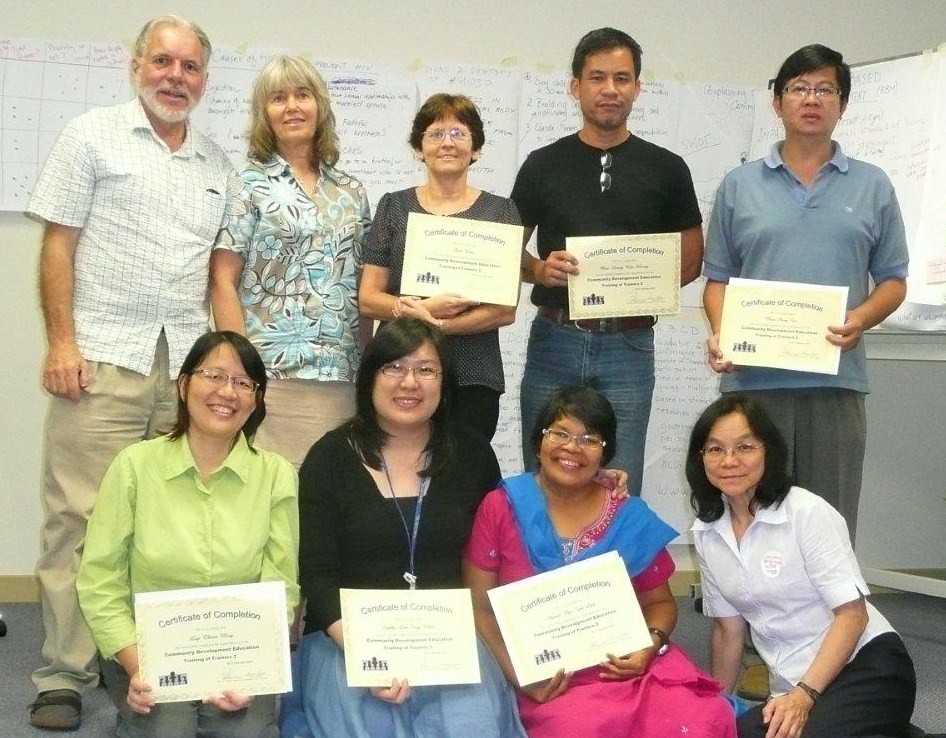
This past weekend I and five others were able to complete  TOT2.  It is normally done over five days but we did twelve hours each on Friday and Saturday and finished up with four hours on Sunday afternoon.  I thoroughly enjoyed the training and the opportunity to meet some very fine, committed Malaysians and hear about the projects they are involved with.  Programs represented are reaching out to street people, addicts, single parents, immigrants, youth and the aboriginal people of Malaysia with some very unique strategies.

With six of us now trained in Malaysia, we are hoping to be able to begin doing TOT1 sessions for local organizations and I  look forward to the opportunity to develop some new relationships in Malaysia.  This coming weekend I will go back to Thailand to attend the CHE SE Asia Consultation where each country will present on their own CHE projects, a great opportunity to meet some new people and to build some relationships for Project Hannah.

Before these Olympics started, the sporting braintrust in Canada addressed the issue of Canadian niceness. We are so nice, went the thinking, that we are reluctant to take first, often allowing our native courtesy get the better of us in sporting events, happily settling for second, or even better, fourth, so as not to spoil the day for others.

The new philosophy was going to be ‘Own the Podium,’ or in others words be proud of ourselves and our accomplishments, and don’t take a backseat. Obviously this has long been our attitude in our premier sport, hockey (or ice-hockey as the rest of the world sees it, although with all due respect to our winter deficient neighbours in the global community, that wussy thing you play with the curved sticks is for what Arnold Schwartzenager would call ‘girlie-men’). We don’t mind kicking butt there, and fully expect to win gold in both men’s and women’s hockey.

That new spirit can be seen all over Vancouver, from moguls to speed-skating. Our newest gold comes in the skeleton, Canada’s Jon Montgomery going flat out not just to place, but to win his event, doing so by the slimmest of margins. But slim margins are what the Olympics are all about, and I for one am happy to see this new Canadian attitude. It may not play well in the foreign media – England has been having a hissy fit, although now that they have won a medal themselves they may been in a little better mood – but it better fits with my image of Canada.

Traveling and living overseas gives you a whole new appreciation for your home country. There are some beautiful places in the world, but there are no better countries than the True North, Strong and Free. Wilfred Laurier once predicted that the 20th century belonged to Canada. He may have only been out by a hundred years. Our resources, both natural and human, place us in the forefront of nations. Our history – one of the most peaceful and compassionate nations on earth – and our geography give us huge natural advantage. Why shouldn’t we be proud of who we are as a people? Four gold? Come on Canada, let’s make it ten!

We have been watching a lot of the Olympics this time around, and it has been great to see. From the outstanding opening ceremonies (kd lang had us about in tears; what an electrifying rendition of Leonard Cohen’s Halleluyah) to the unheard of 18 to zero blowout of Slovakia by the women’s hockey team, it has been quite a show. I don’t know how it looks from home, but from over here it is a wonderful showcase of Canadian talent and character: we look pretty good in the eyes of other nations.

But it was the men’s moguls, and especially Alexandre Bilodeau’s gold medal run that had us cheering. Before he came down the hill Canadians were sitting one and two. Then Dale Begg-Smith, the reigning world champion came down and took first. The irony is that Begg-Smith is in fact Canadian, and this was his home hill. Recruited by Australia, who has a very agressive Olympic program, he was competing for Australia. Now we are sitting two and three. American Bryon Wilson was next up and his run was good enough for second spot. Now we are sitting 3 and 4 with two skiiers left to go.

Next up was Bilodeau, who tore down the hill in an astonishing speed, nailing two awesome jumps in perfect form, and clearly taking the lead. The gold was one competitor away from being ours for the first time on home soil, an historic accomplishment. Only one competitor, A French skiier remained, and he made a mess of his attempt, giving us the gold. In typical Canadian fashion, Bilodeau’s first gesture was not to roar out his victory, or even turn to the adulation of the crowd, but to slap the French competitor on the shoulder for his effort. I read later that Bilodeau left a promising career path to the NHL to remain close to his cerebral palsied brother. How utterly Canadian.

There are things more important than gold medals: character, compassion, care for others; these things count in a life; they count in our reputation among the countries of the world. I am very happy that we have finally won an well-deserved gold medal. But I am even happier about the way we won it.

Forty-two pages, 12,490 words. That’s how long Pam’s proposal was when it went ‘out the door’ at 7 pm last night. During the time it took to write those 42 pages, three months have gone by, along with three trips to Cambodia, a dozen conference calls to major stake holders, a hundred hours of research, and countless discussions and revisions. The document calls for the creation of an entire new team within the TWR office in Cambodia to deal with HIV/AIDs and the associated health and social issues. If approved it will provide funding for this team for three years.

My small role in all this work has been to edit the grammar and syntax and do some fact checking in some of the various UN documents that had to be referenced. Along the way Pam and I have both had to learn some new skills and extend others. I always tell my students that if what they hand in is the best they can do, then it isn’t good enough. The best you can do implies that you haven’t learned anything in the process of what you were doing. Instead you should aim to do more than you thought you were capable of. The doing of it should produce not just a new project, but new understanding, new skills. That is what this project has done for both of us.

To say that I am proud of Pam would be to belittle her. Being proud of her would imply that I already had the skills that she has just attained. That is not the case. She is doing things that I simply cannot do. She has a skillset that I will never have. It would be more honest to say that I am proud of myself for being part of the person she is becoming, for not getting in her way, for seeking to be what support I can. This proposal is something that I could never have written, and I am pleased to have had even a small part in its creation. I trust the Lord will bless its way through the many stages it must now go through before it can be funded.

I am also pleased with how this first part of the term has gone for me. I am teaching ENG 4U this term. This will be the fourth new English curriculum I have had to master since I got here. Each new curriculum has its own challenges, and of course there are no lessons in my computer to call up; they all have to be written from scratch. I have over two thousand documents – lesson, articles, slide shows – that I have written since I got here, and the number grows every day. I tell myself that there is going to come a point when everything I have to teach will all be written down and I will just have to call it up from some file. But I know that this is just a little white lie I comfort myself with from time to time. When that day comes, I will truly be ready to retire; for when there is nothing new to learn, there is nothing new to teach.

This week is the Chinese New Year break, an appropriate time for both of us to take a few days rest from what has been a very busy stretch for both of us. We plan on spending our days reading and watching the Olympics and maybe getting caught up on our sleep. We wish you all a Gong Xi Fa Cai and a prosperous and happy year of the tiger.

“Copenhagen was a disaster. That much is agreed. But the truth about what actually happened is in danger of being lost amid the spin and inevitable mutual recriminations. The truth is this: China wrecked the talks, intentionally humiliated Barack Obama, and insisted on an awful “deal” so western leaders would walk away carrying the blame.” So opined Mark Lynas, a journalist and environmental activist, writing in the Guardian. But Copenhagen was just the tip of the melting iceberg, to borrow a figure of speech. It has been followed by further embarrassing revelations that the predicted disappearance of Himalayan glaciers was based on contrived data.

Is all of this news necessarily a bad thing? I do not think so, and in fact I would argue that Copenhagen’s failure may turn out to be a blessing in disguise. It may in fact save the world from misdirecting billions of dollars that could be better spent on developing alternative energy sources. The current controversy goes deeper than a few errant emails or some hastily published reports that were not properly reviewed, but whether or not the evidence actually supports the thesis proposed. Some of the most solid (literally!) evidence does not.

These temperatures on display are taken from ice-core samples. They are not subject to the speculations of computer modelling, but are hard empirical data. Ice-core samples may not be the whole picture, but they are far more reliable than tree-rings, and go further back in time. Here is the famous ‘hockey stick’ graph (published first by Michael Mann, currently under investigation at Penn State for his part in the infamous CRU email fiasco) that was featured in Al Gore’s movie and slide show An Inconvenient Truth:

Certainly from this one graph it looks as if global warming is happening, doesn’t it? And for many people 1400 AD looks like an impressive starting point to consider. But 1400 AD is yesterday in terms of human history, and further look back reveals something quite different:

If we go back to 800 AD we can see clearly that the ‘hockey stick’ has been cherry picked to avoid what is called the Medieval Warming Period, a time in which Greenland lived up to its name and wine was cultivated in England. From this graph the present warming trend looks relatively insignificant, a full degree colder even at present from the highs of 1050 AD. However, the next graph is even more telling:

From this graph we can see that in 1200 BC, round about the time Athens was putting the boots to Troy, the world was much warmer than it is at present. Not only Greece, but Babylon, Egypt, China, India and Israel were all establishing or had established vibrant and growing cultures. It was certainly not a catastrophe, or anything near it, in fact it was a time of cultural flowering. Note too from this graph that the temperatures of the last 1,000 years, even including the last 30 years of warming – which incidentally have only produced a 0.3 degree rise in ice-core temperatures – are trending down, not up. We are still one degree colder than 1050 AD and 2 1/2 degrees colder than 1200 BC. Does this trend hold up the further back we go?
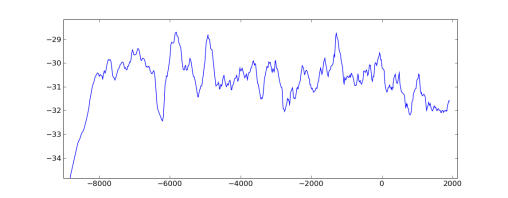
Yes, it does. Looking at the last 10,000 years, the temperature has been pretty consistently warmer than it is at present, and the ‘alarming’ rise in present temperatures disappears into insignificance. Even the rapid rise in temperatures can be seen as a normal pattern of development in the earth’s fluctuating temperature, and quite clearly not a result of anything that we are doing. But the truly sobering graph is the one that shows the last 50,000 years.

From this graph it is pointedly clear that the last 10,000 years on the planet, a period roughly coinciding with the earliest records of civilization on earth, are a rare and perhaps fleeting moment of warmth in an earth that had been chillingly void of heat for millennia. Readers will take from this what they may, but I think it is clear that the current flap over the doctoring of data over Global Warming may be seen in retrospect as a step away from a serious miscalculation of climate trends. No one shivering in Europe’s worst winter storms in decades is thinking of global warming at the moment, I assure you!
Canadian James Cameron gave up engineering in Ontario to drive a truck in L.A. so he could have a chance to flog his scripts and become a screen writer. That must have been a huge gamble. But nothing compared to the professional and financial risk he took by putting all of his eggs in a basket called Avatar and launching it into the ether.

Already the most successful movie maker in history – his previous blockbuster Titanic earned him $115 million – he staked it all and a whole lot more on Avatar, which cost $300 million to make. In the process he invented the cameras that allowed him to shoot in 2D and 3D simultaneously, technology that he is now in a position to lease out to others.

But Avatar is not all about technology. Like any good artisan, Cameron’s control over the process is so thorough that he doesn’t have to dwell on it or impress you with it. Throughout the entire film there was really only one object that was thrown “at” the audience (a gas canister). The rest of the 3D stuff is so organic and natural you almost don’t know that it is there. Cameron says of his own work, “My approach to 3-D is in a way quite conservative. We’re making a two-and-a-half-hour-plus film and I don’t want to assault the eye every five seconds. I want it to be comfortable. I want you to forget after a few minutes that you are really watching 3-D and just have it operate at a subliminal, subconscious level. That’s the key to great 3-D and it makes the audience feel like real participants in what’s going on.”

What is going on is hugely enjoyable. Cameron has a beautiful imagination, and he allows it free reign in this entrancing movie. I don’t think I have so willingly and wholeheartedly entered into a fantasy world since Dorothy landed in Oz, which incidentally is Cameron’s favourite movie. Yes, Avatar is derivative in that it relies on so much of what has gone before; we have seen the monster-men machines in Matrix and the mythological beasts in Narnia. But Cameron has taken all of these elements and woven them seamlessly into his vision of an alien world. You cannot escape the impression that with this film movie-making is evolving to a new level. This will be undoubtedly be the benchmark for all future blockbusters. Mr. Cameron, you are no longer in Kansas, or even Kapuskasing anymore!

The first two years here in Malaysia went by in a kind of blur. There was so much to learn, so many new projects and courses to get started, so much to see, so many new people to meet and cultures to understand. We are grateful to the folks at TWR Canada who have so supportive of Pam’s work here. But there was a lot to learn about her responsibilities, traveling, how to access reimbursement for expenses. Steve is still teaching new courses for which new lessons have to be prepared.

In addition there was a lot back in Canada that we had to learn to manage from afar. We are grateful to Sarah and Milan who look after our wee apartment, our friends who still drop by our website from time to time and especially our family who have been rock solid while we have been out galivanting around Asia. If we can ever get Canada Revenue sorted out we will consider ourselves to be well and truly adjusted to life on the other side of the planet.

In all that uproar, there was never much time for television. We would watch a show maybe once or twice a week, but we never subscribed to cable, and never saw Western news except when we were staying at a hotel. That changed this week when we got cable. I guess that is a measure of increased confidence in our ability to manage our responsibilities here that we feel that we finally have time to actually watch television in the evening.

This morning I watched the Toronto Maple Leafs and Vancouver Canucks play. What a treat. Especially as Toronto had an outstanding first period and were leading three-zip when I last looked. I even got to see Coach’s Corner. I can’t tell you how comforting it is to see a period of hockey when you haven’t watched a game in nearly three years.

The Olympics are coming up in just two weeks. It will be Chinese New Year here in Asia and we have a week off school. We can’t afford to go anywhere as we are still paying off our little jaunt to the Land of Oz, so we plan on seeing a lot of telly that week and soaking in all that gorgeous Canadian landscape. Go Canucks!

Having alluded to the problems in Haiti being caused by the French in the last post, I thought I might clarify what I meant. After all, France is not alone in laying a heavy hand upon the territories it controlled. As with all colonial powers, some good came of their rule in South-East Asia. The cities they helped to build, Phnom Penh and Saigon for example, are much better designed than the logistical nightmares of Kuala Lumpur and Dhaka mapped out by the British.

But administratively the French were a disaster. While Britain left behind an educated and efficient civil service in every colony they vacated, the French did next to nothing in this part of the world. Notoriously after 80 years of rule in Cambodia they paid for the education of just four nationals, and that only to the high school level. Cambodia was ripe for a Pol Pot, even before the Americans carpet-bombed the country.

But Haiti has suffered an even worse fate. Arriving too late to the island of Hispaniola to claim the rainy side occupied by the Spanish, the French settled on the dry side and immediately began stripping the forest for sugar plantations which they stocked with African slaves. In a nice touch of historical irony it was the slaves who kicked the French out of Haiti in the only successful slave revolt in the Caribbean. But they paid a high price for their independence, France exacting a tax that the poor Haitians only paid off shortly after WWII. Their independence also cost them markets, as many countries, in order to punish Haiti for its uppitiness, refused to do business with the country.

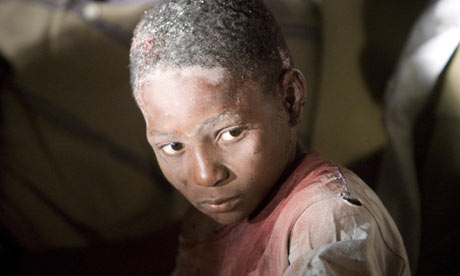
Decades of rule by a succession of kleptomaniacs further reduced what had once been the richest colony in the Americas to the depths of poverty. A series of natural disasters did the rest. Hillsides, no longer anchored by trees, slide into the populated valleys with depressing regularity. Hurricanes batter villages that are already on the edge of existence and earthquakes shatter the insubstantial buildings. A knowledge of Haiti’s troubled history will not provide medical aid for those who need it. But perhaps understanding will keep others from blaming the victims of centuries of injustice for the dilemma they now find themselves in.

Haiti’s recent disaster is but the latest in a long string of disasters to strike that unfortunate country. Although heartened by the generous response by much of the world, many others are busy blaming the victims for selling their souls to the devil, the French for raping the country of its resources, and global warming for an increase in natural disasters generally, and hurricanes and earthquakes in particular. Living in a part of the world that has suffered much at the hands of the French, my inclinations lean in their direction. Poor people are not going to build earthquake-proof buildings. But just to clarify the issue for those who see the perfidious hand of global warming at work again, allow me to reproduce the following article:

The United Nations climate science panel faces new controversy for wrongly linking global warming to an increase in the number and severity of natural disasters such as hurricanes and floods. It based the claims on an unpublished report that had not been subjected to routine scientific scrutiny — and ignored warnings from scientific advisers that the evidence supporting the link too weak. The report’s own authors later withdrew the claim because they felt the evidence was not strong enough.

The claim by the Intergovernmental Panel on Climate Change (IPCC), that global warming is already affecting the severity and frequency of global disasters, has since become embedded in political and public debate. It was central to discussions at last month’s Copenhagen climate summit, including a demand by developing countries for compensation of $100 billion from the rich nations blamed for creating the most emissions.

The new controversy goes back to the IPCC’s 2007 report in which a separate section warned that the world had “suffered rapidly rising costs due to extreme weather-related events since the 1970s”. It suggested a part of this increase was due to global warming and cited the unpublished report. The Sunday Times has since found that the scientific paper on which the IPCC based its claim had not been peer reviewed, nor published, at the time the climate body issued its report. When the paper was eventually published, in 2008, it had a new caveat. It said: “We find insufficient evidence to claim a statistical relationship between global temperature increase and catastrophe losses.”

Despite this change the IPCC did not issue a clarification ahead of the Copenhagen climate summit last month. It has also emerged that at least two scientific reviewers who checked drafts of the IPCC report urged greater caution in proposing a link between climate change and disaster impacts — but were ignored. The claim will now be re-examined and could be withdrawn.

The complete article can be found at:
http://www.timesonline.co.uk/tol/news/environment/article7000063.ece

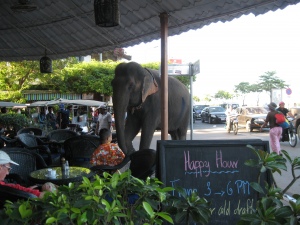
Sambo, the only elephant on Phnom Penh’s streets, has become a symbol of the city and this week she celebrates her 50th birthday. She has lived and worked in the city for over thirty years. When Steve and I are in Phnom Penh together, one of our favourite things to do is to go down to the riverfront, sit at an outdoor restaurant and watch the world go by. Most days you can see Sambo along the quay walking to work at the National Assembly, NagaWorld, Sisowath Quay, Wat Phnom and then back home again.

Sambo was  born in 1960 in Kampong Speu province into an elephant family that roamed freely through the rolling green hills and forests of Cambodia.  When she was eight she was captured and taken to a village where she became the special companion of a young boy named Sorn, who named his new friend Sambo. She lived and worked in the village for ten years before she was captured by troops loyal to the Khmer Rouge.  Although the four other elephants from Sorn’s village were killed for food, Sambo survived and was sent off to work in the mountains.  Many wild elephants avoided the slaughter and heavy workloads that were a result of the civil war by escaping across the borders into Laos, Thailand and Vietnam.

After the the defeat of the Khmer Rouge, Sorn and Sambo’s paths crossed once again when he discovered her working in the rice paddies for another village. Sorn gained Sambo’s freedom by purchasing a buffalo for the family, which was more helpful in their rice fields.  With Sorn’s village destroyed by war, the two friends, man and animal, headed together to Phnom Penh to find work. 

There were four other elephants working in the city at that time, but due to the demands of the work these patient animals are required to do and the lack of proper care from their human custodians, these others all died from exhaustion.  Sambo has survived because of the protection of her long time friend Sorn, who can still be seen walking beside her along the quay.  Many tourists continue to enjoy rides around Wat Phnom on this city’s most famous resident who will on occasion wander into local sidewalk cafes looking for peanuts.