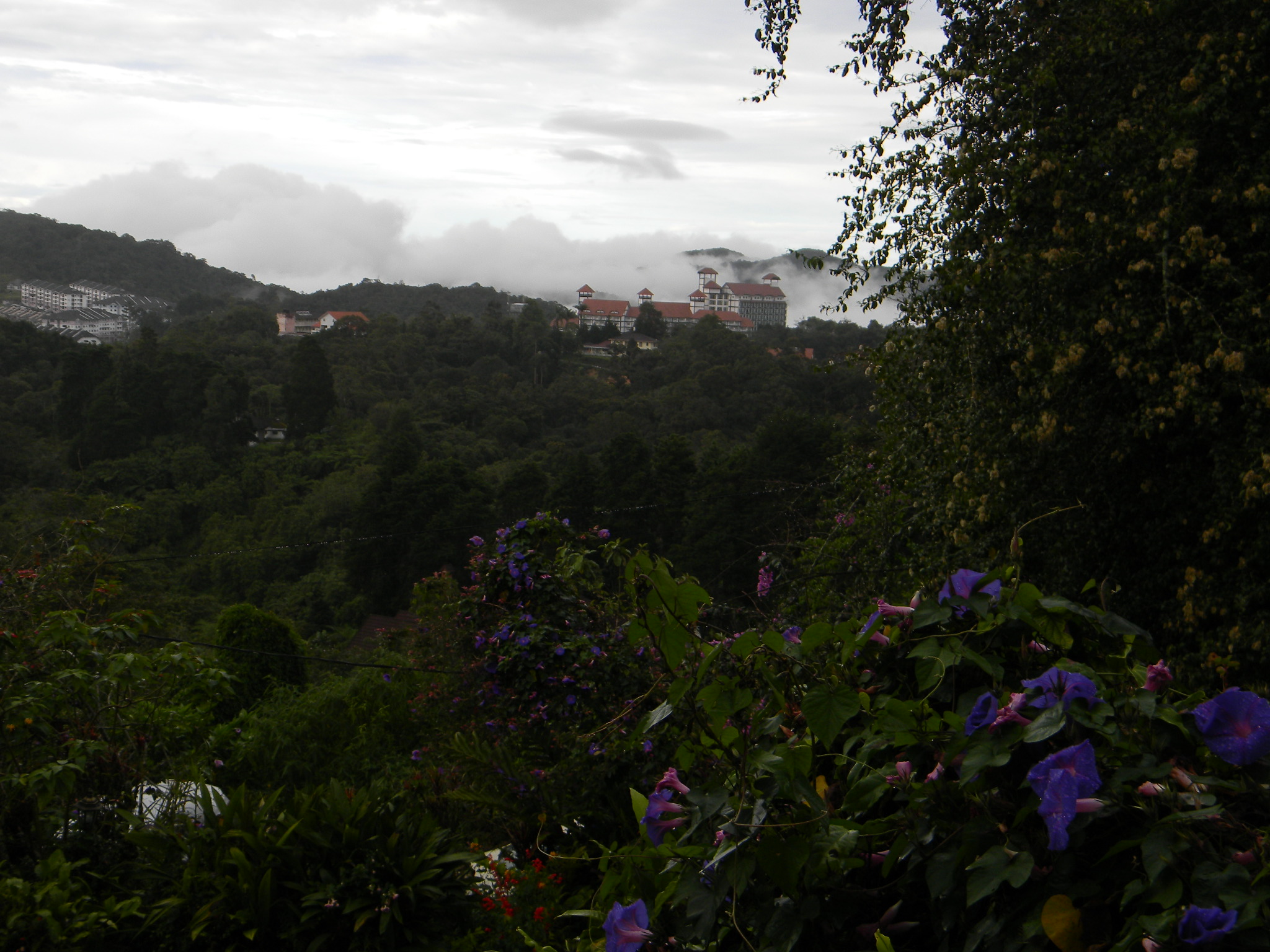
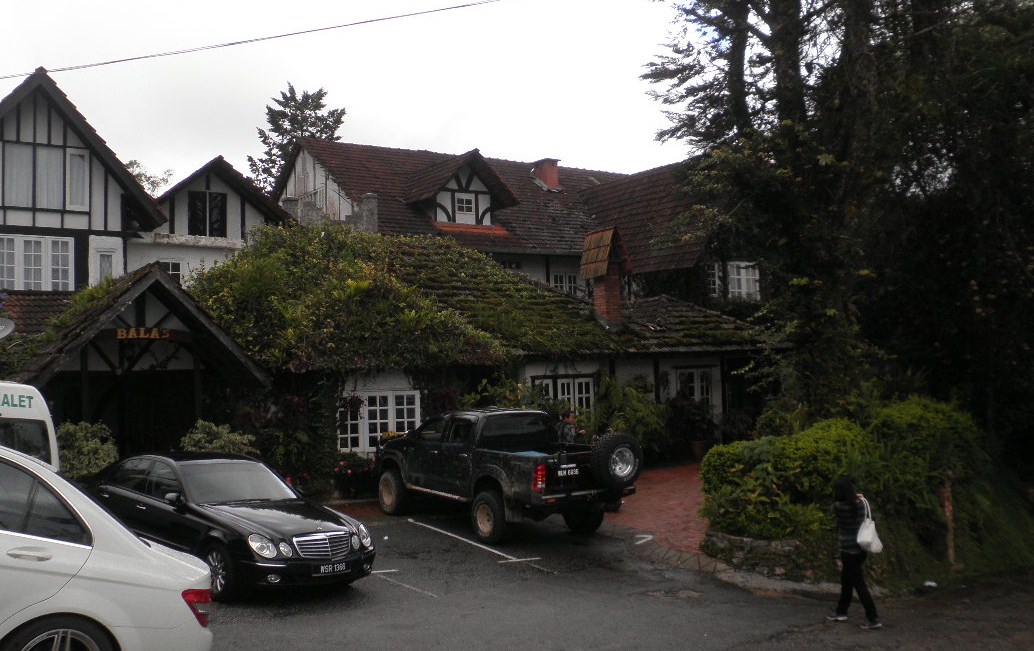
That fact that we have a car now allows us a bit more freedom to explore the wonders of our adopted country. This was a long weekend and although Steve still has a lot to do to wrap up the semester, we were able to get away for an overnight excursion to the Cameron Highlands. We stayed at Bala’s Chalet which is one of the oldest colonial buildings in the Highlands. Built during the pre-war era it has been preserved in its original structure. It originally opened as a boarding school in 1934 for European expatriate children and its owner and headmistress, Miss Griffith Jones O.B.E. passed on her love for nature by preserving the school’s surroundings in its natural habitat.

It’s present owner, a local gentleman, bought the property after the school closed down and turned it into a guesthouse and has carefully preserved the original Tudor concept. The peace and tranquillity combined with the natural surroundings in the cool Cameron Highlands climate make it a great place to escape for a weekend. The rooms are maintained in the style of the original decor and furnishings so are very quaint.

Although the hotel was quite full, the chalets are built at various levels up the side of the hill and there are multiple little nooks and crannies, balconies and little gardens to sit quietly in. Following a lovely Indian dinner, which the hotel is famous for, we had the conservatory to ourselves for the entire evening. Our friends, Peter and Joan are wonderful travel companions and we thoroughly enjoyed our time together.

The view from our window was breathtaking and it was a marvel just to explore the gardens and the amazing flowers that grow everywhere, including on the tile roofs. Although we were only there one night, we came away feeling very refreshed and ready to face the challenges of the month ahead.

Driving in Malaysia is not for the faint hearted. Practically everybody in Kuala Lumpur has a car, so very few people walk, cycle or ride public transport. The expats who work here always get incredulous stares when we suggest a stroll to the nearest mall, or offer to walk home after an evening with friends. As a consequence the roads are absolutely packed. Combine that with a road system that looks like a cross between a plate of spaghetti and the race circuit at LeMans and you have a driving nightmare. Even the locals here will admit that drivers in KL are notoriously aggressive.

Cars don’t drive in lanes towards a common destination; they hurtle towards each other, changing lanes and directions seemingly on a whim, with no forethought that there might be other traffic in the lane they have just decide to move into. And the speed! I am a fairly fast driver, as my many tickets and family anecdotes will attest, but to travel at 170 klics through heavy traffic is not fast driving, it is recklessness!

I was chatting to a colleague who rented a car to take some visitors to the east coast for the weekend, asking him how he liked seeing the highlands of Malaysia, and if he enjoyed the drive. “Not at all,” he replied, “we were scared out of our minds.” He recounted a horrific accident they had seen on the way; several cars completely demolished and little chance that anyone survived. He noted that the road was completely free and dry for miles in both directions, yet somehow these drivers had managed to hit each and several others. We shared ideas on the causes of this cultural phenomenon.

He suggested that it was a function of their culture and religion. The screws are turned pretty tight in this Muslim country with not much room for individual expression or freedom. All Malays are Muslim by legal fiat on the day of their birth and the only practical way to leave their faith is to leave the country. Their faith allows them few diversions or escapes, so he saw their excessive and erratic behavior on the road as a kind of “acting out” that their religion does not allow through alcohol, dance or nightclubbing. Another teacher thought they used their faith as a kind of ‘magic talisman’ to keep them from personal injury, and so felt immune to consequences as long as their karma was intact. He also suggested that the recent acquisition of wealth in a country that was not used to being able to afford a car might have something to do with it. Western countries that have had motor vehicles for a hundred years treat them as less of a novelty and more of a responsibility.

Another colleague suggested that it was the frustration of having to drive on such congested streets all the time that led drivers to go flat out the moment they saw a bare stretch of road. Another colleague thought it was the lack of driver education in a country where a 500 ringgit bribe could get you a driving license with no questions asked. Still another thought it had to do with a sense of community responsibility. In a culture where family is sacrosanct, those outside the family have little value. He thought this might translate into homicidal behavior behind the wheel.

This last one does not explain why parents are often seen hurtling down the road at breakneck speeds with their child standing in their lap with their tiny hands on the steering wheel. Perhaps it has to do with the inability to predict outcomes, something I see all the time. A man will stop his car on the side of the road and leave the traffic side door wide open. City planners will build three levels of flyover rather than plan out in advance how to manage the traffic at that intersection. Renovations are being conducted on our condo using the “trial and error” method. In a culture that has stressed rote learning and memorization from infancy, the cognitive skills involved in predicting outcomes of current behaviours are simply not taught or practiced. The fact that this shows up in their driving is not surprising. However, all of this cognitive speculation is of no avail if you are caught in a pack of semi-homicidal drivers all careening down the highway under the influence of their own personal demons without a thought for the consequences. Then it is simply terrifying!

Located about 45 minutes drive north of Siem Reap, Rohal is home for about 250 families who are mostly dependent on the rice harvests for their living. TWR has been broadcasting into this area for a number of years and has many regular listeners of Happy Children’s Garden, It’s Yours, Women of Hope, Stories from the Potter, The Word Today and Through the Bible.

When finances are available, the TWR Cambodia team attempts to make monthly visits to the commune to have fellowship with the listeners and teach some practical health and moral values lessons. Today, I was able to join them and to meet with a lovely group of people. We travelled with Tie Henge, a young Pastor’s son who leads this cell group church of very dedicated Christians. This little church has a village Pastor who is learning to lead the work.

While the TWR ladies taught a lesson on family planning to the adults, Kimsong lead the youth in a discussion on critical thinking. He used a lesson that Steve developed, using the hand to demonstrate the steps necessary to ensure they make the best life decisions. The little kids were only too happy to do an impromptu concert of the songs that they love to sing. With the lessons done and some noodles to munch on, an elderly gentleman got out his “tror sao”, a traditional sort of two stringed violin. A lady brought out a hymn book for some time of singing and chatting and laughter, all favourite pass times for Cambodians.

It was all very much like a regular cell group back home except for the incredible challenges these people live with every day. The village is very poor, cows and chickens roam between the groups sitting on the ground, the only source of water is a contaminated pond, the children are not in school because there is no teacher available and health care is totally absent.

It is still difficult for me to understand how so many people are able to rejoice in God’s goodness and express such faith and gratitude in His provision, in the face of the reality of their everyday struggles. These are our brothers and sisters in Christ, a challenge to my own attitude and the people that we are looking to serve through our project in Cambodia and it is a joy to have met them.


The beauty of the surroundings of Batu in East Java, Indonesia, where I have been this last week, was matched only by the sweet and gracious Indonesians that I met there.  It was such a privilege to attend the South East Asia Leadership (SEAL) meetings at which the leadership for this region was officially transferred into the capable hands of Freddy, my new ‘boss’ who has led an amazing TWR team in Indonesia for many years.  Andrew, will spend the next few months looking at the work in South Asia to establish a plan for his leadership of that region.

I always enjoy the opportunity to hear each of the country leaders present the work that their individual teams have accomplished over the past year.  These are very small teams with limited resources who face obstacles of poverty, communication, limitations in transportation and health systems, geographical barriers and religious and government restrictions; yet the extent of their outreach is awesome.  It is certainly not for financial gain or personal glory that they labour so hard in such difficult conditions, but the recognition of lives changed forever which is the fuel that keeps them going in spite of all the challenges.

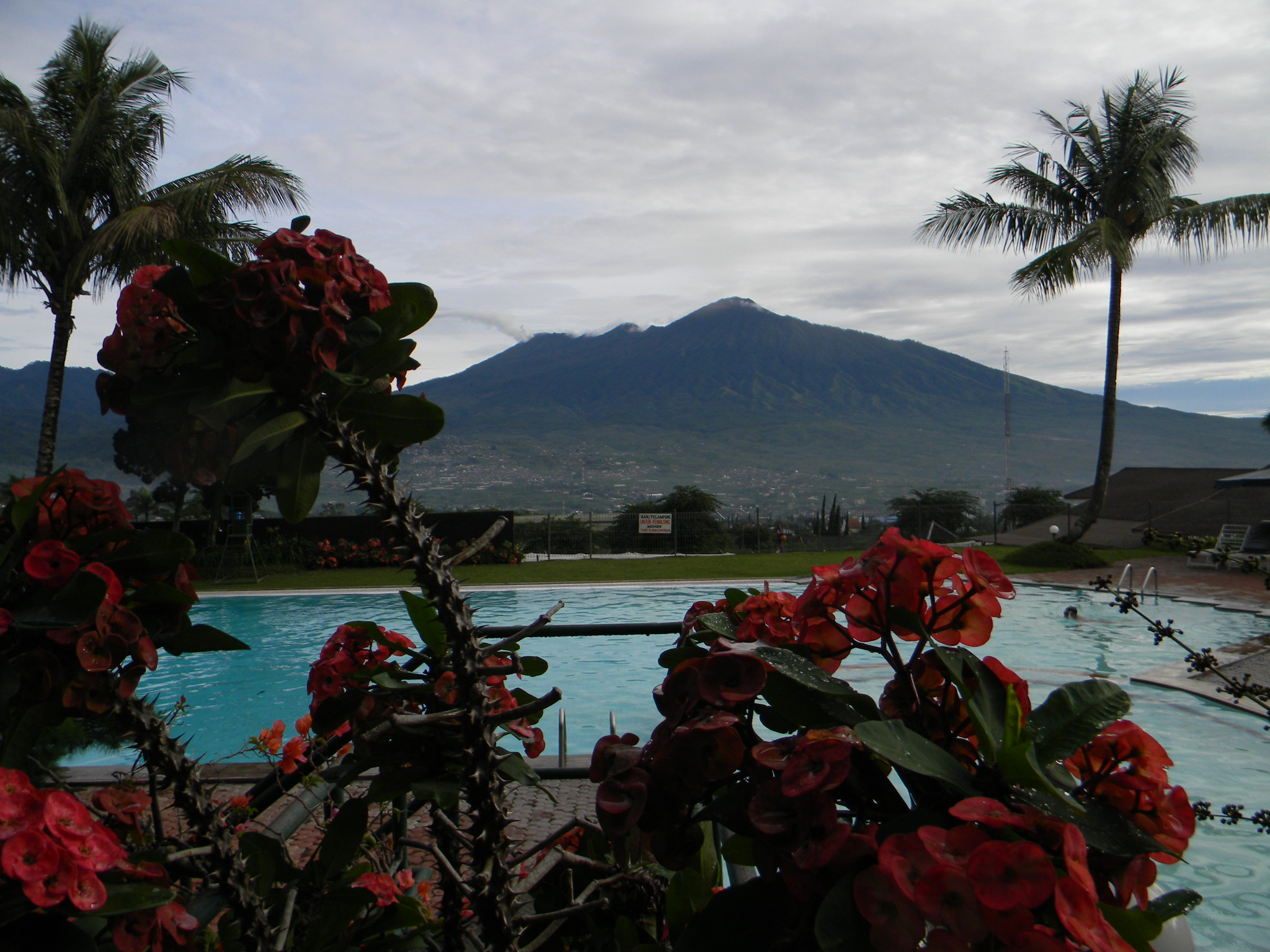
The hotel where we stayed was perched on the side of a mountain overlooking lovely scenery and the temperature was refreshingly cool after the steamy heat of Malaysia.  It is the rainy season in this part of the world, so we drove up the mountain in a torrential downpour against a river of water flowing down the road carrying with it all sorts of debris.  Due to the rain and fog we were unable to see any scenery the first night but I awoke at five the following morning to bright sunshine and a gorgeous view of the clouds drifting in front of the mountain.

With two full days of meetings we had no opportunity to explore the area but saw enough to know we need to go back and learn much more about Indonesia.  On the way back to the airport in Surabaya, we did get a quick tour of the city and a trip over to Madura Island to check out the batik market.  The Javanese food is spicy and delicious and I ate way more than my fair share this week.

The discussions were rewarding and engaging, and there is practically no end to the work that lies ahead. But we did have some time for leisure and even wrapped up the conference with a rousing table tennis tournament. After losing badly to some very serious contenders, I learned that table tennis is taken very seriously in these parts. But the comraderie and competetion also helped to build morale and team spirit among colleagues who don’t often get to meet and encourage one another. I look forward to working with both Freddy and Andrew as they begin their new roles and I undertake new challenges for the coming year. I promise I will keep you posted.

I have said it before and I will say it again that one of the most precious gifts that God has given to the Carter family was delivered twenty five years ago today when my brother Randy, married Sylvia.

Congratulations on this milestone in your lives, your hard work and persistance and commitment to God, each other and your family that has kept you on this path even through the rough times. Thank you both so much for your support and encouragement to us over the years and especially while we have been overseas.

We look forward to seeing what God has in store for you both and for Jesse, Jenelle and Jeremy in the years ahead.

Clarity in thought and expression is such a rarity that one is inclined to be astonished when it is encountered. Unfortunately there are so few classes of people among whom it can be found. Atheists are notoriously obsessed with the painfully obvious, so what they write is either boring or obnoxious; Hindus and Moslems are obsessed with exalted expressions of the obscure and obtuse, so many words and so little of any value; Catholics are obsessed with endless speculations of the symbolically arcane: fascinating but often beside the point. Which is why if you want clarity you need to seek out the ruthlessly logical writings of Dietrich Bonheoffer or C.S. Lewis. However, a notable and worthy exception is C.K. Chesterton, the delightfully acerbic Catholic writer and contemporary of H.G. Wells, Bertrand Russell and G.B. Shaw, all of whom he skewers on the end of his pointed and germane wit for their fatuous philosophical meanderings through the issues of early twentieth century thought. One of those issues was Eugenics, which all three of these three famous Fabians espoused as the saving principle of modernity.

Eugenics was the wayward child of Social Darwinism, and enthusiasts like Wells, Russell and Shaw proposed that by genetic engineering humanity would be perfected. Under their guidance Britain was well on the way to formalizing these principles through the force of law – such as the ‘feeble-minded law,’ known officially as the Mental Deficiency Act of 1913, drafted in part by then Home Secretary, Winston Churchill, “In order to realize the opportunities for racial betterment, and to secure the social and moral improvement which will inevitably ensue.” In the United States in Buck v. Bell, (274 U.S. 200, 1927), the United States Supreme Court upheld a statute instituting compulsory sterilization of the unfit, including the mentally retarded, “for the protection and health of the state.”

One of the first acts of the new German Reich in 1933 was to pass a Eugenic Sterilisation Law, ordering doctors to sterilise anyone suspected of suffering from hereditary diseases. “We want to prevent the poisoning of the entire bloodstream of the race” to quote Goering’s legal assistant. By 1939 some 250,000 ‘degenerates’ had been forcibly sterilised, over half of whom were diagnosed as ‘feebleminded.’ The Nazi regime took what it regarded as the logical next step in 1939, when it decreed euthanasia for all severely disabled or mentally ill people in German asylums. Any Jew in these asylums automatically qualified, irrespective of degree of handicap, and about 70,000 people were murdered. Essayist Russell Sparkes notes that, “it can thus be said, without exaggeration, that eugenics was one policy which paved the way for the ‘Final Solution’ of European Jewry.” Chesterton labelled the ‘progressive’ eugenists of his day ‘anarchists,’ and thought that they were dangerously deluded and that following them would lead to a dangerously unstable world. It turns out that Chesterton was absolutely right, but 60 million people had to die before the world realized how right he was.

Taking a leaf from Chesterton, I would have to say that what is happening on Wall Street today is unfettered anarchy, and its notions are likewise dangerously deluded. I don’t mean what is happening on the street itself. On the contrary, I find the actions of the protesters perfectly rational. They have no meaningful employment and are blamed for being unemployed; they have no resources, yet pay a burden in taxes which is quite disproportionate to their income; they have no hope or future and are protesting against those whom they feel, with some justification, have stolen it from them. Nor are they anarchists who oppose them with batons and tear gas. The police are merely carrying out the orders given to them by those who pay their wages. If they did not do so they would lose their jobs, or at least their chances for promotion. Their behaviour is perfectly rational as well. There are undoubtedly some bullies among the police. You cannot have a form of employment that includes the lawful right to carry guns and physically manhandle criminals without attracting those who enjoy that kind of license to abuse others. But they cannot be called anarchists, since they operate within a certain framework that permits a tolerable amount of abuse.

No, the anarchists are those who inhabit the offices on Wall Street: the bankers and investors who wear Armani suits and drive luxurious vehicles. They are the true anarchists. Why so? Because they fit the definition. An anarchist is one who has no clear notion of what he is doing, has no goal or agenda other than simply to destroy what exists. He does not oppose any specific thing or group, he opposes everything and everybody. He is not a rebel, since a rebel wants to overthrow the existing order and establish a new order based on new principles. The anarchist wants to overthrown all order and establish nothing in its place. Within that absence of structure and authority the anarchist deludes himself into thinking that he will be totally free to act according to his own selfish desires with no one to hold him accountable for anything that he does. He is Chaos incarnate.

That is who we find in the offices of Wall Street. That is what defines the Koch brothers, who will raise and spend nearly a billion dollars to defeat Obama and the Democrats in the coming American election. They and their ilk are not seeking to defend the American principles of entrepreneurship. They are not seeking to redefine regulations regarding the expansion of capitalism. They want all of that swept away. They want a world where there are no limits on their accumulation of wealth; they want to remove all fiscal restraints, including reasonable taxation, which paves the roads their Mercedes and Beemers drive; they want to remove all fiscal regulations, which prevent the systematic abuse of financial instruments; they want to remove the restraint of government in its entirety, or at least bring it to a grinding, immovable halt thereby destroying the social contract and even the foundations of American society itself. By so doing they will destroy the very goose which has laid for them a trillion golden eggs with their corporate logos stamped all over them. At which point they will depart with their billions to more favourable climes to destroy another country in their wake. They are destructive, dangerous economic anarchists, and there is no end to their delusional greed.

All of this I in a measure understand. In my youth I spent four dissolute years probing the seedy underbelly of Western society, and never saw the bottom of self-indulgent, anarchistic evil. It does not surprise me to find it on Wall Street or Main Street. It is the calling card of the Enemy of Mankind, the very stench of his sulphurous armpit (Decency forbids me to say worse). What surprises me; what alarms and dismays me is the number of Christians who ought to know their scripture better than they do aligning themselves with the destructive insanity that motivates Wall Street and its toxic greed. Have you not read the scripture that says, “It is easier for a camel to pass through the eye of a needle than for a rich man to enter the kingdom of heaven?” (Matt. 19:24). Have you not read “Let the brother of low degree rejoice in that he is exalted: but the rich in that he is made low: because as the flower of the grass he shall pass away. For the sun is no sooner risen with a burning heat, but it withers the grass…so also shall the rich man fade away in his ways” (James 1:9-11); or that “whatsoever my eyes desired I kept not from them, I withheld not my heart from any joy; for my heart rejoiced in all my labour, and this was the portion of my labour. Then I looked on all the works that my hands had wrought, and on the labour that I had laboured to do: and behold, all was vanity and vexation of spirit, and there was no profit under the sun” (Ecc. 1:10-11).

For those that will dispute with me on textual interpretation, I do not defend these verses, though they speak plainly enough to me. So consider instead the narrative of Christ: how as Creator of the universe He came to earth as a lowly, impoverished baby, helpless and despised; how at His death he owned nothing but His tunic; how He gave the riches of heaven away for free for those who asked; who identified with the prostitutes, Galileans, fishermen and tax collectors of His time. If Christ walked the streets of New York today it would be as the hands and feet of compassion and charity to those who live on the street, asking only that they be given a chance to earn a decent living for their families. He would not be drinking champagne with the residents of the banks and investment houses; He would be driving them, like the money-changers of old, out of the temple. How is it possible for you to have missed this fundamental point of scripture and side with such anarchist agents of destruction?

Forgive me if I have overstepped the bounds of decorum here, for I do not wish to offend those whom I love. Perhaps I have steeped my reason for too long in the intoxicating waters of Chesterton and Lewis. I do not have their insight and wisdom, nor the fearless tenor of their prose. But mark my words; for although I am no prophet I have studied and seen much in my sixty plus years. If those anarchists who inhabit the towers of Wall Street cannot be reigned in, America will not survive the devastation that their destruction of the economy will bring. The Dust Bowl of the Dirty Thirties will seem as a summer holiday in the ruin of America they intend. Have nothing to do with their evil deeds. Rather condemn them as ungodly anarchists seeking nothing but their own selfish, satanic greed, and do not worship the Golden Calf they exalt as their god.

For an opposing view, kindly see http://jonandnic.wordpress.com/2011/10/27/occupy-your-job/
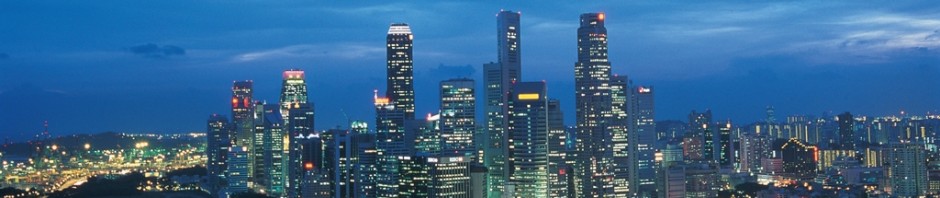
The pace at which I live is about to get crazy again and I hope I am not getting too old to keep it up. I took a very quick trip to Singapore this past week, leaving at 5:45 on Thursday morning and returning at 7:00 p.m. on Friday. I went directly to the office from the airport. Fortunately I have the art of packing lightly down to a science: one small flight bag. I had a wonderful time catching up on the work of the team there who a doing a marvelous job with few resources. I had a chance to renew some familiar acquaintances, meet some of the new staff and do some planning for the future, including a trip to Batu in Indonesia.

After work I made a quick trip to check into my hotel, which turned out to be quite modest, but in a very convenient part of town, and then took a pleasant walk to Clarke’s Quay to meet up with my friends and co-workers Dr Su Min and Dr Sing Yu. You cannot tell from their names, as is usual in Chinese culture, but they are a married couple; both retired doctors. They treated me to a wonderful dinner at a Chinese restaurant, authentic, and extemely complex, not at all like the ones in Canada. I had Peking Duck for the first time which was definitely an eating experience.  


First, the entire duck was presented to us for viewing and approval and then whisked away. Shortly thereafter, the skin was served, sliced very thinly, wrapped in steamed pancakes accompanied by spring onions and a sweet bean sauce. Yummy! Then the waiter asked how we would like the remainder prepared, as there are several choices at this point. We then chose to have the remainder chopped and served as a spicy, garlic-y stir fry. With accompanying vegetables it really was surprisingly lovely, not to mention, costly! Thankfully my hosts insisted on treating me to the meal.

Friday, I was back at the office for a meeting with our Canadian friend and co-worker, McDaniel, and got caught up on their news and plans. The happy circumstance of it being another friend Eddie’s birthday provided a good opportunity to fellowship over lunch at a local Japanese restaurant. More food! So much for that diet! It was a great surprise to see my dear friend Mel – whose wedding to a Mexican-American pastor  was one of those happy/sad occassions where you think that you are losing a friend – walk in and announce that she will be returning to Singapore for a year and take up her previous position with Media Resource Group! I have missed working with her since she married and went off to the States two years ago.

I hopped the incredibly efficient Singapore transit to the airport with plans in place to join the SE Asia team for two days of planning meetings in early November. By the time I boarded the plane I was rejoicing in the privilege of serving in this work but also burdened by a number of areas of concern for others. Bill and Sharon – who are our key facilitators for the Cambodia training scheduled in November – are dealing with the fact that Sharon’s dad is gravely ill in Canada so will probably need to head home, depriving the teaching team of their most valuable facilitators. We are also concerned with the fact that while the news has been focused on Thailand’s problems, Cambodia is still struggling with severe flooding resulting in a loss of much of the rice crop and the livelihood of many of our listeners there. We have also heard some of the details of the severe consequences some of our friends in Malaysia are dealing with as a result of their faith commitment. I cannot go into more detail on a public forum like this, but I would ask for you prayers for them, as they are facing life-changing persecution.

This is a time of major transition for the Asia team headquartered in Singapore who face many decisions as they seek to establish a new leadership structure. We would appreciate your prayer for these situations, knowing full well that God is in control and that His work will go forward and it is our privilege to be a part of it. I will be very busy during the entire month of November in travel to both Cambodia and Indonesia, and ask also for your prayers for Steve and I as we manage our marriage commitments in the light of all that the Lord calls us to do for Him.

When we want to get away for a weekend there are dozens of choices in this part of the world; from Bali to Bangkok, Langkawi to Koh Samui, Phuket to Redang. All of them are beautiful, and all of them are reasonably priced if you know where to stay and can get there in an hour on Air Asia. But where do you go for an overnight getaway? Obviously there is downtown KL, but that is pretty pricy when we live in the suburbs and can go there anytime we want. Besides, it doesn’t seem like a getaway to us unless there is water in the picture.

There is a little beach resort called Port Dickson just south of the city that always looked promising, but we had never been able to find a hotel along that strip that was both nice and affordable; that is until we got a car and could do some serious investigating. Last month our investigations turned up a place called Avillion, and last night we stayed there and had a fabulous time.

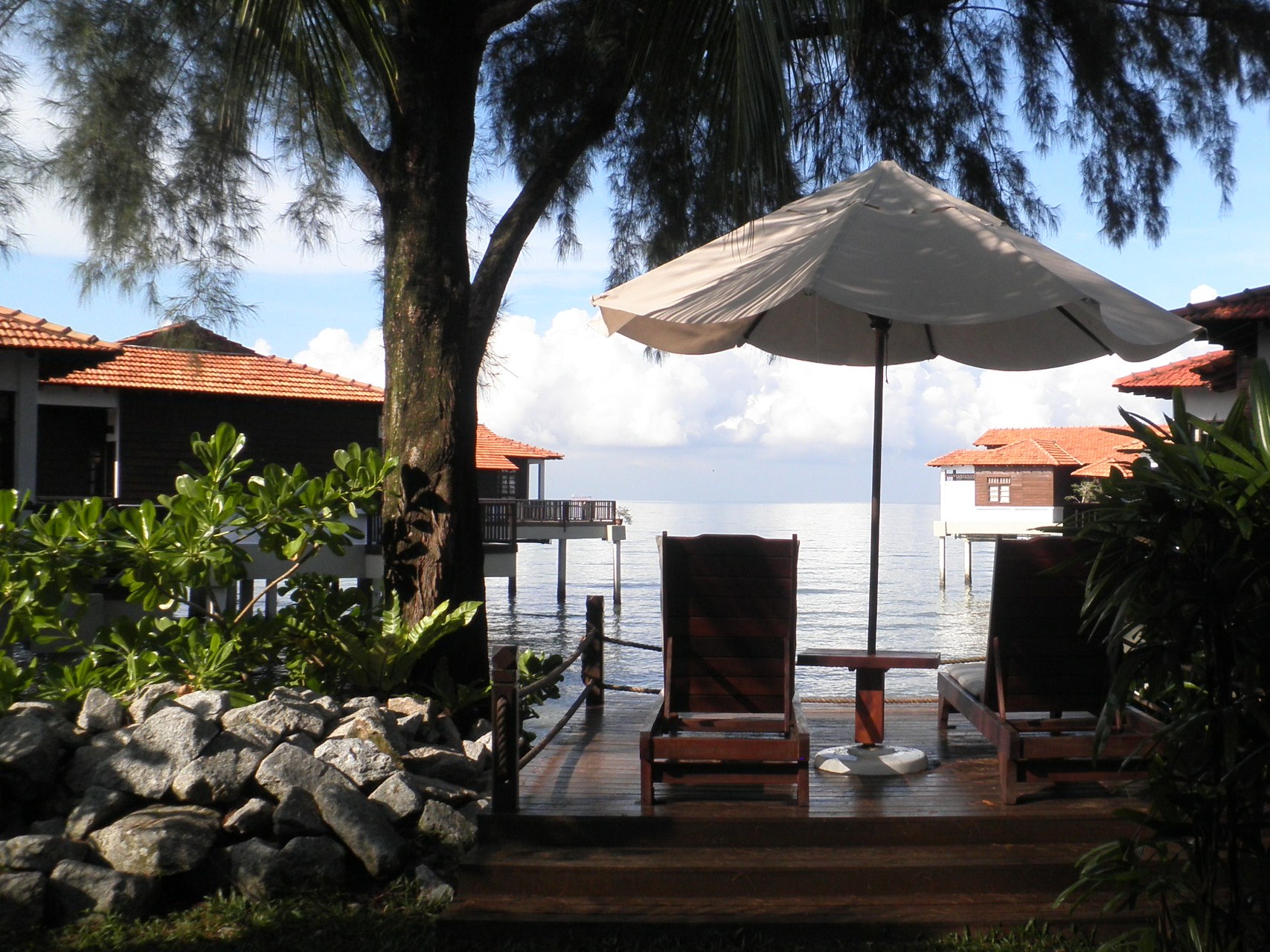
There are no rooms at this resort, only chalets. You can get a garden chalet, or a beach chalet, or a premium beach chalet. If you book through Agoda, the most expensive room is only $100 U.S. For that you get complete privacy, with your own deck and lounge chairs, a canopy bed, another daybed in a bay window with an unrestricted view of the ocean, a soaker tub with Jacuzzi jets, a fabulous shower that is open to the stars, two swimming pools, one for adults only, several bars overlooking the ocean, several restaurants with views as well, and an all you can eat breakfast buffet. All of this will cost you a hundred bucks. We spent a little more and got lunch at the spa restaurant overlooking the ocean and a candlelight dinner of stuffed chicken and grilled trout with tiramisu and chocolate for dessert. The dinner music – double bass, guitar, two excellent female singers who knew Patsy Cline, Bread, Abba and Anne Murray – was free.

Everything was spotless; the amenities, from the huge towels at the pool to the 54 inch television in the room, were first class. The staff were invariably helpful and polite, which is not unusual in Asia, but sweet all the same. The grounds, with their luxuriant gardens artfully lit in the evening along cobbled walkways, were refreshing and relaxing. However, the real bonus for us was that this place is only an hour’s drive from where we live. We are already planning our next visit.

In his 2012 Budget Speech, Malaysian Prime Minister Najib designated next year as National Innovation Year and allocated RM100 million for several strategic initiatives. This announcement raises one underlying issue – does Malaysia offer a nurturing environment for innovators? An examination of Steve Job’s life highlights several factors that contributed to his innovative successes but militate against nurturing a Malaysian wannabe.

First are laidback parents. Obsessed with ensuring their children’s education, many Malaysian parents are unlikely to allow their offspring to drop out of university or to study arcane subjects. In 1972, Jobs enrolled in Reed College in Portland, Oregon but left after one semester because he didn’t see the value of depleting the savings of his adoptive working-class parents on tuition fees. However, the biological son of a Syrian father and an American mother continued attending classes that interested him, including one in calligraphy. “If I had never dropped in on that single [calligraphy] course in college, the [Macintosh] would have never had multiple typefaces or proportionately spaced fonts,” Jobs told an interviewer.

Second is Malaysia’s corporate set-up. Would a college dropout habitually garbed in faded blue jeans and sneakers like Jobs be considered a “fit and proper” person to become a CEO of a public listed company? Even in the US, Jobs’ unconventional behaviour contributed to setbacks in his career. Partly because new computer models like Lisa failed and early Macintosh sales were disappointing, Apple directors stripped Jobs of his operational role. Jobs offered another reason for his ouster. “I don’t wear the right kind of pants to run this company,” Jobs told some Apple employees before leaving in 1985 the company he had co-founded with Steven Wozniak. Eleven years later, failure to develop the next-generation operating systems prompted Apple’s then CEO Gilbert Amelio to acquire Job’s NeXT for US$430 million (RM1.36 billion) and to invite the latter to return as an adviser. In July 1997, Jobs organised a board coup that ousted Amelio. He was later named Apple’s interim CEO, prompting jokes that Jobs was the iCEO. Could such a sequence of events happen in Malaysia?

Third is Malaysian society which venerates both success and conformism. Getting fired from Apple, however, inspired Jobs’ subsequent burst of innovation. “I didn’t see it then, but it turned out that getting fired from Apple was the best thing that could have ever happened to me. The heaviness of being successful was replaced by the lightness of being a beginner again less sure about everything. It freed me to enter one of the most creative periods of my life,” Jobs said in his commencement speech to Stanford University in 2005. In 1986, Jobs bought Pixar, a computer graphics studio, for US$10 million (RM31.7 million). Successful computer-animated films like Toy Story and A Bug’s Life enabled Pixar to be sold to Disney for US$7.4 billion (RM23.5 billion) in stock in a deal that made Jobs a billionaire. On his return to Apple, Jobs rolled out a string of innovative products – iMac, iPod, iPhone and iPad – that were mega successes as well as game changers in the personal computers, music and mobile telecommunications industries.

In Malaysia, whenever an individual espouses an unconventional view of an historical event, expresses a different opinion on the role of the monarchy or composes a song that adopts a satirical attitude towards the national anthem, many are quick to suggest the individual should be charged for criminal defamation, prosecuted for sedition or stripped of his citizenship. But innovators like Steve Jobs are rebels, not conformists. In an interview, Jobs singled out taking a drug like LSD as one of the most important things he had done in his life. When Jobs assembled a group of young, talented engineers in his Macintosh team, he called them “pirates” while the rest of the company was nicknamed “the Navy”. Jobs realised only those who dare to defy societal norms and break perceptions of what is do-able will be truly innovative.

In his Stanford commencement address, Jobs said a 1960s counterculture book titled The Whole Earth Catalog which deeply influenced him as a young man ends with this phrase “Stay hungry, stay foolish”. “I have always wished that for myself,” he added. Would parents, corporate chieftains and political leaders in this country allow such individuals to flourish? An environment that cherishes its non-conformists – rather than government support and the millions of dollars in funding – is the key to ensuring Malaysia will one day produce its own Steven Jobs.

Posted in the Malaysian daily The Sun 17 October 2011  by Tan Siok Choo

The late sixties and early seventies were a heady and exciting time for Canadian artists. In music Guess Who’s “American Woman” outsold The Beatles. Joni Mitchell, Leonard Cohen and Neil Young were blazing a song writing trail across American music and Canadian performers featured prominently in bands such as Blood, Sweat and Tears, Steppenwolf and The Band. In art Alex Colville and Ken Danby were gaining international attention for their explorations in high realism, and in film Allan King’s Warrendale in 1967 and Don Shebib’s Going Down the Road in 1970 demonstrated that there was a market for quality Canadian film. In 1971 Shebib followed his early success with Rip-Off, a largely forgettable film that was notable only for launching the film review career of my brother, Wyndham Wise.

Forty years ago, on Oct 21, 1971, Wyn published his first film review of this film. Other reviews followed, principally on Canadian film, and Wyn began to gain something of a reputation as an expert on Canadian film. He continued to develop that expertise as Toronto reporter for Cinema Canada, and had the distinction of being its last writer, as the magazine folded in 1989. He then parlayed his experience into the launch of his own magazine, Take One in 1992, which during its fourteen year tenure, was widely regarded as the leading magazine on Canadian cinema1. At the beginning of the new century Wyn wrote and published through U. Of T. Press2 Take One’s Essential Guide to Canadian Film, still considered the gold standard reference for Canadian film. CBC books in its review wrote of Wyn’s book that it was “impressive for its breadth of coverage, refreshing in its opinionated informality,” and went on to note that it was a “comprehensive and lively look at Canadian film culture at the start of the twenty-first century”3. In 1997 Wyn founded the Toronto Film Critics Association, and launched Canadian Screenwriter for the Writers Guild of Canada in 1998. From 2008–11 he was the editor of Canadian Cinematographer. He is credited with the genesis of Hot Docs, a yearly celebration of documentary film that takes place in Toronto. He is a contributing editor to Northern Stars4, and continues to write about and promote Canadian film.

Canadian artists have had a notoriously difficult time making inroads into a largely American market. Some Canadian film makers, like Norman Jewison, Ivan Reitman, David Cronenberg and James Cameron have become tremendously successful, but often at the expense of ignoring Canadian themes, rather than in celebration of them. Those who write about Canadian film have an even harder time getting the public attention in this Hollywood dominated industry. I salute my brother for his tenacity and integrity in continuing to promote and critique this important artistic exploration of our national psyche for the last forty years. Congratulations, bro!

1http://en.wikipedia.org/wiki/Take_One

2http://www.utppublishing.com/Take-One-s-Essential-Guide-to-Canadian-Film.html

3http://www.cbc.ca/books/reviews/2001/08/take-one’s-essential-guide-to-canadian-cinema.html

4http://www.northernstars.ca/Wise/01110210740_review.html