???????????????????????????????

This past week we had the opportunity to demonstrate for three very amazing young medical students most of the challenges that one is likely to encounter in the process of conducting rural community development training and research. We were training in a government health center which is a forty minute tuk-tuk ride from Siem Reap, guaranteeing that before the day even started we were hot, sweaty and filthy. Our co-facilitators had minimal English but then the training was done in Khmer. We however, did not have a great understanding of what was actually happening.

We had no part in the planning for the training and were working with great facilitators but although we had met once before we had not worked together.  Their organization has a very different approach to CHE and do not use the style of facilitation that we normally do.  This was a bit of a problem since the medical students were hoping to see a typical TOT1 as part of the research they were there to carry out. Thanks to Dr Su Min’s creativity, our TWR staff’s willingness to step in and the gracious attitude of our facilitators they did see a few typical lessons and even managed to help facilitate a few. Amit got to see how something that looks pretty straightforward on paper can actually be quite challenging to facilitate.

Group

It goes without saying that there was no air conditioning.  It was blistering hot and the electricity was spotty so often the ceiling vans were not even working. At one point we moved outside where there was a bit of breeze. The participants came from varied backgrounds and education levels; villagers, RHAC trainers and nurses from the government clinic, making the training even more challenging. Lots of distractions as children wandered in to see there moms, patients strolled by with their IVs held above their head and patients arrived by all sorts of transport.

Fortunately, we did have the assistance of Kimsong from TWR to assist with the translation for the research Focus Group Discussions and surveys, so hopefully the students will be able to get the information they need for their report. A fourth medical student was unable to come as she couldn’t get excused from a classroom based course on conducting research in a community setting. I hope that she learned as much as Ravi, Amit and Wesley did.


???????????????????????????????

4b3859d1-2a5e-4ee5-a184-e8ad2d469f0cwallpaper

Godot

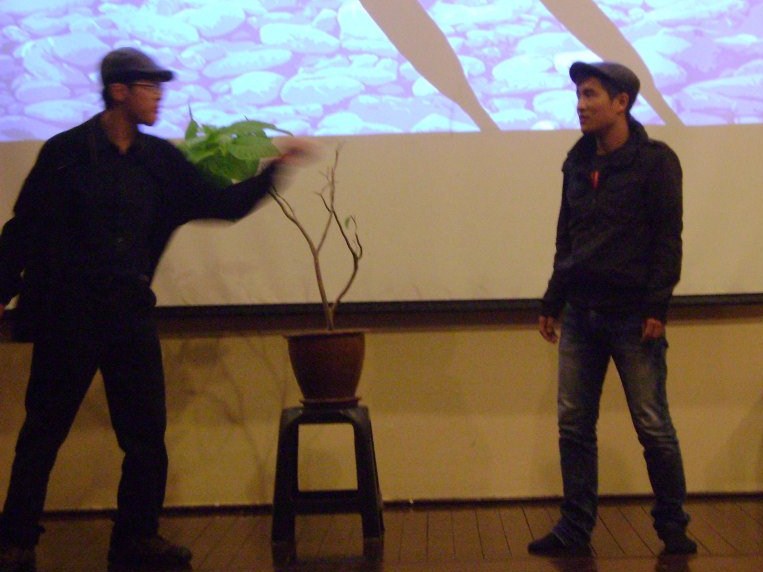
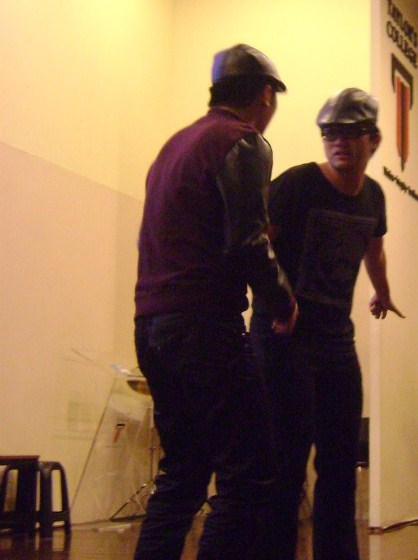
Each semester the students at the Canadian Pre-University program where I teach put on a Drama Festival over on the main campus. This year my three classes did Act II of Samuel Beckett’s Waiting for Godot, a play that was written shortly after the devastation of the Second World War that envisions a future landscape where billions have died in some global catastrophe leaving only a few survivors to make sense out of what little of their life remains.

Jon and Beck

The play consists of two principal characters, Vladimir and Estragon who meet two other people during the course of the play who are just as destitute and confused about what has happened to their world as they are. They spend the entire play waiting for someone or something to enter their lives and give them meaning, entertaining themselves with pointless exercises and engaging in conversations that range from the meaningless, to the poetic, and even deeply philosophical. Despite its depressing theme, the play is touched by traces of warmth and compassion, with liberal doses of dark, ironic humour.

Period 2

Last year when my classes were larger I divided the second act into twelve parts and had my twenty five students each take a portion. I tried re-dividing the play this year for my smaller classes, but the divisions I had arrived at last year would not yield easily; it seems as if I had stumbled across pretty close the ideal separation of roles. So I asked my stronger students to take on two portions of the play, and as in typical in Asia, they did so without grumbling or complaining, bless their hearts!

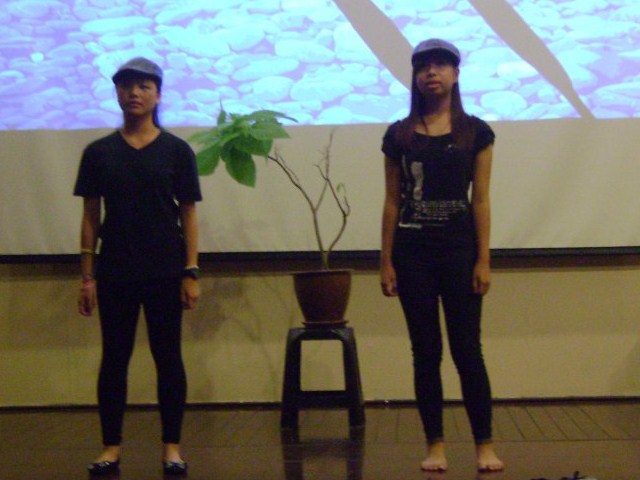
Sum Yee, Ashleigh and Jessica

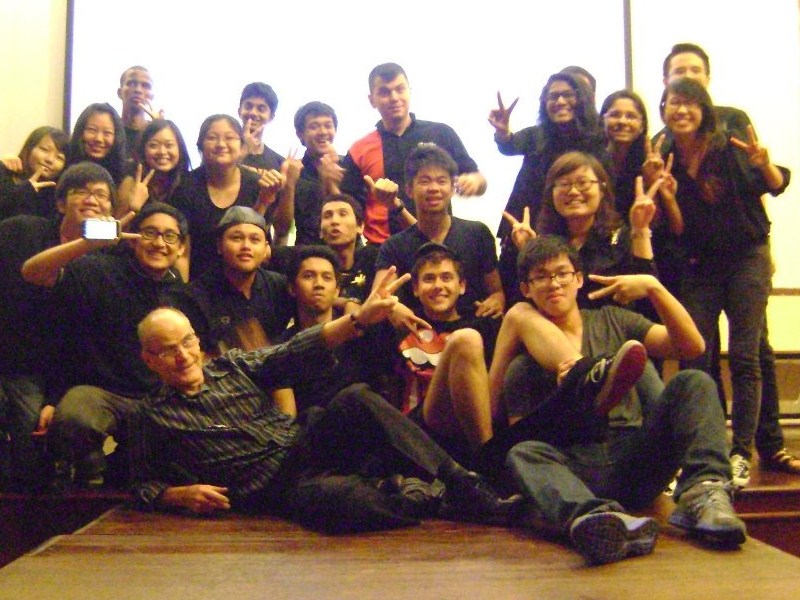
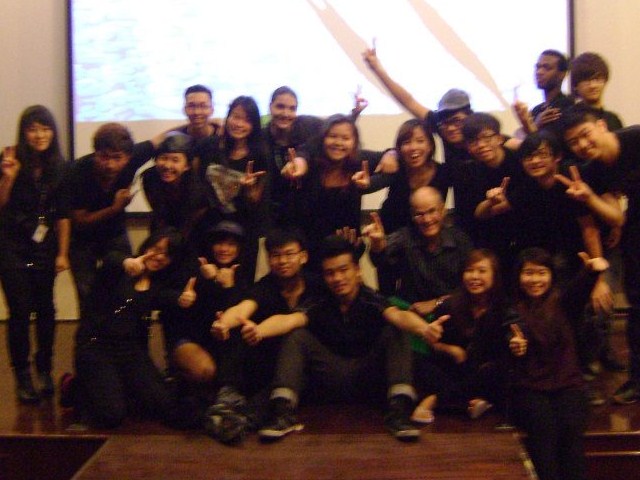
Last night we staged our productions in the largest lecture theatre on the main campus, one that has a proper stage and tiered seating. Despite several weeks of advertising, promoting, and rehearsals, I confess I was disappointed with the audience turnout. The theatre was considerably less than half full despite my best efforts. However, that does not detract from the performances, which were enthusiastic, well-memorized, and well-executed. I sat in the wings ready to prompt, but frankly had little work to do all night and instead was able to see some really fine performances by students who clearly enjoyed the experience. It is a great joy to me as a teacher to see my students take on a class project like this. They got to feel like they had taken part in something larger than themselves and contributed to its success.

Joie and Calxin

Many of these students come from schools where they have been punished for speaking in class. If they ask questions they are made to feel stupid or rebellious. To be placed in English in a small group where they are encouraged to talk to each other is a scary and difficult thing at first. To put their faulty language and awkward accents on stage in front of their peers is overwhelmingly intimidating. Yet once they have done so there is an exhilarating feeling almost of liberation from the shackles of years of classroom restrictions.

Period 1a

To see the students I am teaching tackle something that a year ago would have been unthinkable, and not only to succeed at it but to enjoy the experience and share it with others, that to me is the most rewarding part of being a teacher. Congratulations to ALL who did the best that they could to take on this challenge last night. I admire your spirit!

Ming Wey and Theng Loo2

I am sitting here trying to deal with fact that we have not updated this blog for almost two weeks and I am not sure what to do about it. Recognizing that our stress levels were off the chart, we sat down two evenings ago and made a list of the things that are weighing on our minds so that at least we would know why our guts are in a permanent knot, if that helps.

Steve, on his second course is an old hand at this Master’s thing and there is not much he enjoys more that writing a good research paper and is, of course maintaining his 100%. Nevertheless he is frantically trying to finish out this school year well, and preparing for all three of his classes to present Waiting for Godot at the Drama Fest the first week in May. In the midst of that, all of his students are preparing their final ISU’s for the semester and needing an incredible amount of support. Add to this the almost daily requests for him to take on tasks to support the other staff and students and that is why he is not blogging.

I, on the other hand am frantically trying to come to grips with writing a research paper for a most unhelpful professor and wondering what made me think that I wanted to spend four hours trying to get the punctuation marks in the correct place for a Turabian style citation. Meanwhile, I am attempting to plan for a week long training session in Cambodia amidst a huge number of obstacles that will undoubtedly impact this project over the long term. Praying that somehow my passport will be returned by the Malaysian government in time for that to happen.

We are wrapping up our sixth year here and planning for all of the details of our trip home like buying and insuring a vehicle, and looking after all of the financial staff that always need to be dealt with. Given that Steve will only have four days in Ontario we need to basically schedule them by the hour. We are missing our kids and grandkids and so looking forward to seeing them but already know how hard it will be to say good-bye again and this time to a new little grandbaby. Part of the preparation for going home always involves getting the apartment ready for Steve to manage on his own which means repairs and air con maintenance which is always a battle here. The brightest spot in my day is when I get to suck up thousands of little ants with my vacuum in some kind revenge for them having taken over the entire 27 storey complex.

However the real problem with the blog is that much of what we are dealing with right now is “unbloggable” either due to its sensitive nature or because it is news that just can’t be shared yet because details are still being worked out. We have been busy with meetings and even a trip as part of the planning process and are hoping to be able to share that soon. But… in the meantime there just is not much to blog.

Pam and I are both pretty busy on our Master’s at the moment. Much is going on, but not much time to write about it. Here is a recent essay on the book I have just finished.

Paul Gordon Hiebert (1932-2007) was born in India to second generation Mennonite Brethren missionaries, and passed away in at the age of 74. Dr. Hiebert combined rigorous anthropological and theological scholarship with a passion for God’s global missionary work and was a vigorous researcher who authored twelve books, of which Transforming Worldview is his most widely admired.

Hiebert’s thesis grows from the understanding that “when we seek to win people to Christ, we look for some evidence of conversion” in behavior. However, he notes: “people could adapt their behavior to get jobs, win status, and gain power without abandoning their old beliefs.” He reasons that, “transforming explicit beliefs is not enough to plant churches that are faithful to the gospel,” and posits that, “conversion may include a change in beliefs and behavior, but if the worldview is not transformed, in the long run the gospel is subverted and the result is a syncretistic Christo-paganism, which has the form of Christianity but not its essence.” Hiebert argues that transforming world view must be the central task of the church in the twenty-first century.

Hiebert supports his contention by first looking at the concept and characteristics of worldview. He defines worldview as, “the assumptions people make about the nature of reality which they use to order their lives.” This includes myth and other meta-narratives that cultures use to explain eternal truths that lie outside the bounds of empirical measurement and analysis. Such worldviews are resistant to change as they help to shape and integrate entire cultures. Hiebert then examines how worldviews are contested, citing the work of Michel Foucault, Lewis Mumford and Neil Postman.

Hiebert then directs his attention to an examination of spiritual systems, noting that, “Satan seeks to blind people by keeping them bound by false ideologies,” and that “concern for this life rather than eternity has led to a stress on physical comfort and material abundance.” Later chapters explore other impediments, such as “the myth of evolution” and “the myth of redemptive violence,” which Hiebert sees as rampant in Western ideology, brilliantly tracing its roots to gnostic dualism.

Hiebert then traces the decline of modernism, noting that over the past one hundred years, “this presumably enlightened century has loosed more rivers of blood and piled up more mountains of corpses than any century in history” and that as far as the present age is concerned, “the vision of utopia provided by modernity has been lost.” In its place post-modernity holds out a fractured view of humanity that focuses on individual, rather than community values, and has little room for the grand meta-narratives of religion.

Hiebert’s scope is breathtaking. In this relatively short book, Hiebert exposes all the shortcomings of the missionary enterprise of the past 500 years. For our current missionary understanding, this book is foundational. The man is fearless, wise and insightful. He spares neither secular empiricism, nor theological/missiological syncretism. I particularly appreciated his analysis of the intellectual paucity of scientific reductionism, whose superficial understanding of the complexities of reality is matched only by its didactic arrogance.

My own exploration of culture since my conversion, largely as a result of the writings of C.S. Lewis, has been limited to Neil Postman, Noam Chomsky, Herbert Marcuse, Edward T. Hall and John Pilger, secular writers who alone it seemed were willing to take on the intellectual hegemony that has characterized the last fifty years of thought in the West. Christian writers seem largely concerned with padding their pews and their wallets and were little inclined to gore their own gilded ox. Reading Hiebert was like watching Muhammed Ali thoughtfully and remorselessly reducing his opponent to physical incoherence. A very impressive work.

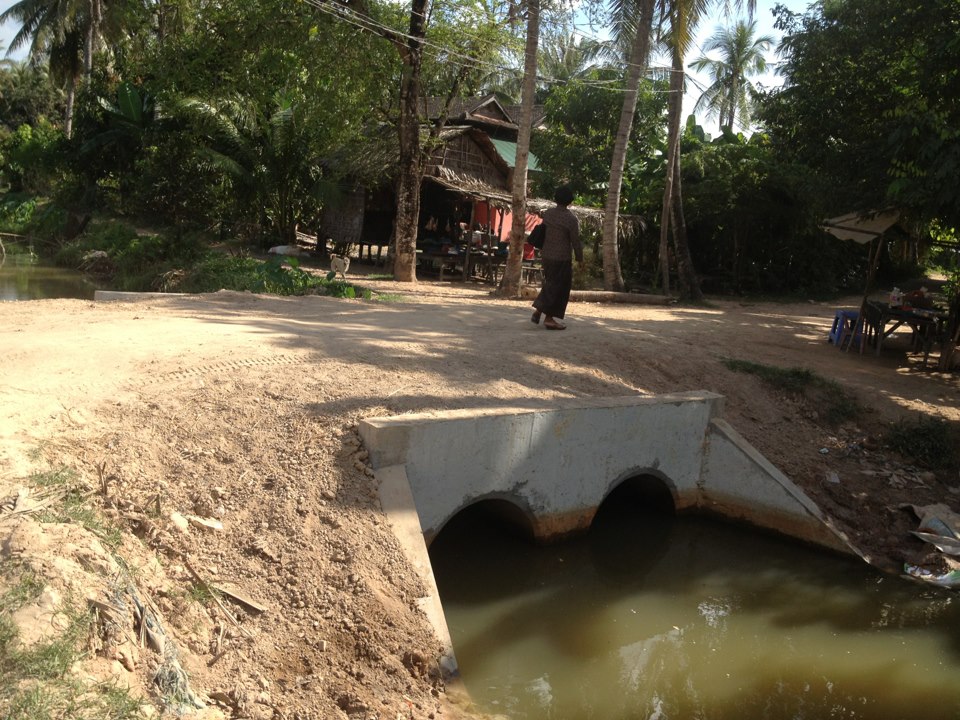
One of the chief goals of CHE is to help people move from dependence on outside resources, to understand their own potential and give them the tools they need to articulate their own needs and goals and to develop a plan to move forward.  I would like to share an excerpt from this months’ health initiative report in Cambodia that demonstrates how this works.  Road access to villages is essential for villagers to have access to outside services, work, schools, and markets and is often viewed as the responsibility of others such as government or ngos and often does not happen.

These three villages are not yet part of a formal CHE project but have participated in a few CHE lessons facilitated by our TWR staff.  They each were able to identify the need for a road as a key issue and to come up with a strategy to meet their own need.

prey khmengIn  Prey Khmeng village outsiders had previuosly built a road wwithout full knowledge of the area and when the rainy season came, it was washed away and no one ever came repair it.  The villager leadership developed a plan to gather the money together to repair it and lift it above the flood levels and now use it happily. It brings a sense of ownership to them and pride in their work.

beung knarThis a road in Beung Knar village which used to have many big holes and it was terrible to get into this village. Now it is so nice to travel here because those holes were filled and people there travel joyfully. There was no help from the government, but the people there were able to save the money and fix their own road and now know how to keep it under repair so their village will no longer be isolated.

knart

In Knart, the villagers collected some of there own money to repair the road but also learned that they could access money that they were entitled to through a government assistance program. It is amazing to see that they have started to identify their needs and take ownership for repairing and taking care of their own community.

As people are dependent on outside help, over time they begin to see themselves as incapable and somehow deficient and helpless, leading to all sorts of problems including illness, alcohol abuse and violence. Building and maintaining a road in your own village may not seem like a big thing to us but to these people it is a first step in regaining their self respect, some joy in their own accomplishments and a hope for the future.

IMG_2457

March Break used to be the time that my colleagues in Ontario would take off for the Caribbean for a break from the stress of teaching and a way to shake off the winter blues. We could never afford that ourselves, but I certainly sympathized with the sentiment and would often envy them the leisure time. Teachers over here are no different, and all this week I have been hearing about Australia and China and other neat places my colleagues have gone without many stories of my own to tell.

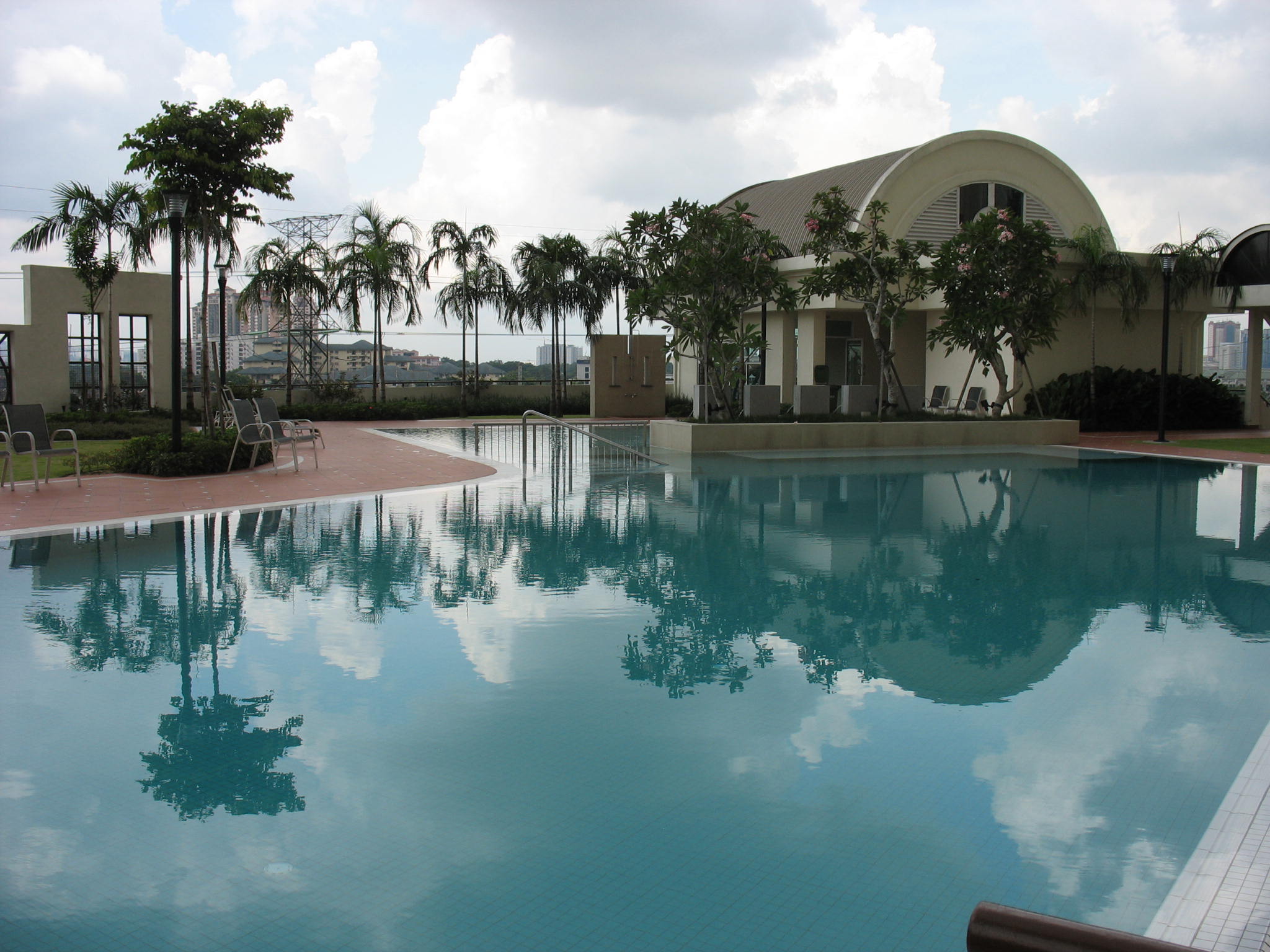
We are not exactly broke anymore, but we did have a pretty spectacular visit to New Zealand over Christmas and Pam has just got back from an almost uninterrupted month of travel around Southeast Asia. So this March Break we could think of nothing we would rather do than grab our towels and bathing suits and head on down to the pool with a coffee and a good book. So that is what we did all week.

The weather was pretty cooperative and most days we had the pool to ourselves. We swam and sat and chatted and then swam some more until it was too hot to sit outside, and then we took the elevator back to our apartment where we read and sat and chatted and then read some more. Pretty boring week, right?

Well I didn’t think so. I thought it was darn near the nicest holiday I had ever had! The alternating exercise and relaxation was exactly what this old body needed and it was good to get caught up with my partner’s life beyond the mandatory, ‘How was your day?’ We were able to finalize our flights home and get ourselves prepared for a change in our ministry focus in the coming year. All that and we were able to sleep in our beds at night. All in all a nice little holiday.

58006db3-2ff7-45e8-948e-d596de2474bawallpaper

Wedding (52)

We hope you have a wonderful day and look forward to sharing this amazing year ahead with you and Liz.

You are an awesome addition to our family and we know you are going to make a great Dad for our new little grandson.

Boy486131_10152653107295398_2052011437_n

Can’t wait to meet this little guy.

Online Master'sA little older, a little balder, a little pudgier, but still game to learn. This is me at 63 working on my first course in my Master’s in Intercultural Studies, an endeavor that perhaps optimistically will be finished in four years and a bit. If I’m still around, I’ll be 68 when I’m done. Seems like a bit of a pointless exercise, right?

However, I consider education to be one of life’s greatest joys and privileges. If you reckon that about five percent of the world’s population has a university degree, it is a rare privilege as well. This may sound intuitively false in Canada, a country recently hailed by the UN to be the first in world history to have a majority of its citizens with a post-secondary education. But if you consider the billions in Africa, Asia, and the Middle East with barely any education, it makes our little pocket of the world the exception, rather than the rule.

So what am I going to do with this Master’s, presuming that I survive till then? Well if I consider both my family’s genetic s and world trends in longevity, I am likely to be around into my nineties. Seen in that light, not to get further education now that I can finally afford it would be foolish. Who knows what opportunities the Lord may bring my way for service in the years remaining? I certainly don’t!

But I do know this: whatever the Lord has for me He is going to need me to be better equipped than I am at present. I have gone a long way on a three-year B.A. and a year of teacher’s college. Pam has gone even further on her R.N. For us to go further, we both need to be better educated. Neither of us can think of anything we would rather spend our time, effort, and resources on that to prepare for the road ahead, no matter how long, no matter how short.