Bario2

In 1928 Charles Hudson Southwell, a recent graduate of both the University of Melbourne and Melbourne Bible Institute, sailed north to establish the Borneo Evangelical Mission. Like his famous namesake, Hudson had intended to go to China, but was challenged at MBI to go to the remote jungle instead. Establishing a mission in the Limbang District of northern Sarawak, close to the border with Sabah, Hudson quickly learned both the Malay and Iban languages. Returning to Australia to marry his childhood sweetheart Winsome, the two returned to Sarawak and settled into a ministry among the Murut people, who were eager to know about ‘Tuhan Isa,’ (Lord Jesus) who is mentioned in a favourable light in the Qur’an. Unfortunately their success among the Murut attracted the attention of the British overlords of that territory who preferred to keep missionary activity to a minimum and on occasion banned them entirely as it interfered with British territorial ambitions in the region.

Taking a strategic furlough in Australia, the Southwells returned quietly to Borneo in 1936 to the Miri area and began working among the Iban with equal success. By then American missionary John Willfinger had rendered the New Testament in the Iban language (one of the many ways that Christian missionaries have strengthened and preserved indigenous people groups has been to commit their oral language to written form) and the Southwells found that Christ’s parables rendered in their own language spoke to the Iban in a powerful way. The war loosened British hold on the territory, and staying in Borneo during the conflict the Southwells were able to renew their work with the Murut who themselves became evangelists to their neighbours. Driven further inland by the Japanese who had now landed in Sabah to the north, Willfinger – a brilliant scholar and gifted linguist who was now working on the Murut New Testament – and the Southwells continued to evangelise indigenous tribes as they fled, among them the Kelabit people of the highlands near the border with what was then Dutch Indonesia.

The Japanese, like the British before them, understood the dangers posed by an educated and empowered tribal population and targeted both Willfinger and the Southwells for immediate arrest. When they surrendered – rather than further endanger the local tribes people – John Willfinger was summarily executed and the Southwells and fellow missionary Frank Davidson were incarcerated in an internment camp where Davidson died of disease. Hudson’s previous education as a chemist allowed him to identify and use local leaves and berries for both food and medicine, and he and Winsome survived. In March of 1945 American parachute troops, led by Major Tom Harrisson, landed in the Kelabit Highlands, and organizing and arming the Kelabit people led them in a guerrilla campaign against the Japanese that left no escape from advancing American and Australian troops now attacking the coastal regions.

Following the war, Harrisson returned to Bario and began working among the Kelabit people, to whom he felt he owed much of his wartime success. He was opposed to the evangelical efforts of the Southwells and sought to restrict their influence. But the Kelabit themselves were in awe of the changes they saw among the Murut and many Kelabit turned to Christ in the years after the war. In the early 60s Sabah and Sarawak joined the new Malaysian Federation, raising the ire of the Indonesians who considered the provinces part of their territory. The resulting ‘Confrontation’ with Indonesia caused many Kelabit from the surrounding villages to flee into Bario where there was a Malaysian army base. This increased Bario’s population and importance which after the conflict led to the construction of first a primary and later a middle school to serve the children of the area.

The Southwells continued to minister in the Highlands until the 1980s, working among the Kelabit, Kayan and Kenyah people. Hudson developed a Kayan-English dictionary to preserve this indigenous language and established a Community Development Project far up the Baram River at Long Lama that provided technical training to improve local living conditions. A ‘moving of the Holy Spirit’ in Bario in 1973 led to the Christian conversion of the entire village and the construction of a local church. An emphasis on Christian morality and an understanding of the importance of education has led to the Kelabit being among the most well-educated people groups in Malaysia. Former Malaysian Airlines executive director and current minister in Prime Minister Najib’s inner circle Dato Sri Idris Jala is Kelabit, as are a number of Malaysian CEOs and Christian evangelical leaders.

Some research material from: With Pythons & Head-Hunters in Borneo (2009) by Brian Row McNamee. Xlibris.
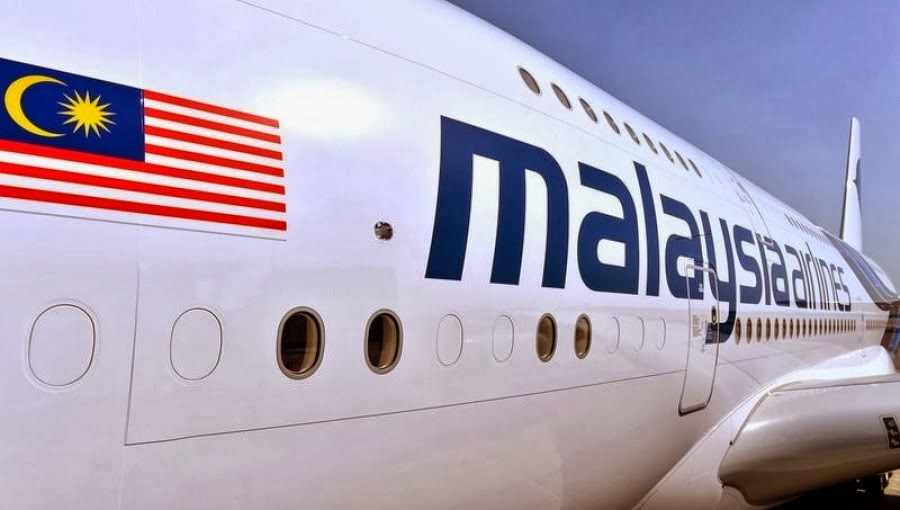
Pesawat MAS Dari Kuala Lumpur Ke Beijing Terputus Hubungan Dengan Menara Kawalan

Anwar Ibrahim was former Prime Minister Mohamed Mahathir’s Finance Minister and the man most widely credited with the Malaysian economic miracle that took this country to a solid Second World status, where it has unfortunately been stalled for the last dozen years. Once Time magazine’s Asian Man of the Year, Ibrahim is not only Malaysia’s most able economic and political force, he is the ruling Barisan Nasional party’s greatest threat. So potent do the ruling elite consider him, that they have found it necessary to pursue him through the courts for a dozen years, perverting the justice system of an entire nation to see him jailed for hysterically contrived offenses.

Offended by all this decidedly less than First World behaviour, the significant Chinese minority – amounting to some thirty percent of the population – have abandoned the BN in droves pushing them to the edge of the political wasteland in the last election. Only skillful gerrymandering of electoral districts saved them from certain defeat. Rather than be chastened by such wholesale rejection, the BN has retrenched and renewed their legal assault on Anwar, resulting an unprecedented appeal against the Supreme Court decision that exonerated him from the latest charade of charges. Significantly he was hauled off the jail – again! – one day before MAS flight MH370 went missing. The two, it seems, are not unrelated in the surreal world of Asian politics.

As offended as are the Chinese by the corruption and incompetence of the BN party, there is another group that are equally if not more offended: devout Muslims, who see the venality and blatant corruption of the current government – all neatly wrapped in a veneer of official Islamic prose – as a grave offense to the purity of their beliefs. Such a man was Captain Zaharie Ahmad Shah, a pilot of impeccable credentials and considerable experience who is said to have attended the mosque five times a day for prayers. This is almost certainly Muslim hyperbole, but even taking that back a peg and allowing that the man prayed five times a day puts him among the devout elite in this still predominantly liberal Muslim country. And devout Muslims regard the ruling party in this country about as highly as devout Christians regarded that hypocritical scoundrel Ronald Reagan. But I digress.

Among Captain Zaharie Ahmad Shah’s many interests – including his helpful videos on air conditioner repair and a state of the art flight simulator in his house where he plotted out his route that fateful night – was a deep interest in the plight of Malaysia’s embattled Opposition Leader Anwar Ibrahim. He attended the trial throughout, which in itself is a political statement in a country that takes an interest in what its citizens are interested in. Surely Captain Zaharie Ahmad Shah knew which way the political winds were blowing in this trial, which might have been a factor in formulating a plan. A by-election was on the horizon; one that the ruling BN could not afford to lose. Anwar was contesting the seat; BN’s defeat was inevitable. Anwar had to be removed from contention. Nothing as insignificant as a fair trial would stand in the way; the judge had already been bought. Five hours before he boarded flight MH370, Captain Zaharie Ahmad Shah sat in a Malaysian courtroom and heard Anwar Ibrahim sentenced to a further five years on trumped up charges that no one in the country believes are true.

What will be the outcome of what is now being called a “pilot hijacking?” What was the purpose? The purpose is being played out each night on the television sets of this nation, as Captain Zaharie Ahmad Shah knew it would. A whole succession of Malaysian bigwigs, including the prime minister himself, has been parading in front of the international media making absolute fools of themselves contradicting whatever the last guy said and falling all over themselves in their incompetence which has roused the just wrath of China, Vietnam, Indonesia, and everyone else who has had the misfortune to have to deal with them. The Malaysian military knew within minutes that the plane had changed course. Rather than admit this, the Malaysia government had surrounding nations spend millions looking for where the plane was not. The Malaysian police knew within hours that the pilot – who had moved his entire family out of his house the day before the flight to protect them from arrest and media scrutiny – was the one responsible, yet they waited a week for others to point out the obvious.

All of this and much, much more will be the outcome of this sorry affair. Nor will it be the last embarrassment this government faces. As long as there is trouble in Europe and a war in the Middle East, Malaysia will be spared the kind of scrutiny which it by nature abhors. But this is an enduring mystery, and the devout and canny Captain Zaharie Ahmad Shah  has done more to highlight the shortcomings of this incompetent and corrupt government than a planeload of Anwar Ibrahims. Welcome to your nightmare, Barisan Nasional. The world is watching.

Ever since we lived in Bangladesh in ’86-87, we have loved the sights and sounds of the monsoon rains which create a virtual wall of water that marches across the landscape refreshing and cleaning the air. It is a sound that we will never forget. We were even looking forward to sharing that with Greg and Liz while they were here in January. Unfortunately, not only did it fail to rain the entire time they were here, but it has not really rained since then either and we are feeling the effects of it big time.

It has been incredibly hot, humid and still, making it oppresseive to even venture out. The government began rationing water in some parts of our province in early February and some areas have gone days at a time without water, playing havoc with small businesses like food stalls and laundries. This week we were warned that we our water rationing would begin, two days on and two days off so we have full containers all around the apartment. Although we have been careful with our water useage, we have actually not yet been cut off.

However, what has been far worse is the air quality. The Air Pollution Indexes have reached as high as 365 ppm is some surrounding areas when anthing above 100 is considered hazardous. This week the air is positively smokey and it burns your eyes and throat to be outside.  We even recieved an advisory notice from the Canadian High Commission here in KL; I guess that is how the Canadian government justifies withholding 25% of my meager pension at source, This morning we were delighted to wake up to sunshine and clear skies and treated ourselves to an hour or so at the pool. This evening we had the first taste of rain and now we sit enjoying some cool evening breezes once again.

IMG_1673

IMG_1675f

Sochi 2014 Winter Olympics has been over for almost a week now and we miss them.
OLY HKW Canada United States 20140220

It is clearly not that we are or aspire to be athletes or have a major fascination with sports in general. What the Olympics provide for us is a connection to home and our home country. Astro, our cable provider had two channels dedicated to the games which allowed for pretty decent coverage and we spent as much time as we could afford glued to the TV.

The sportsmanship of our fellow Canadians and of course the medals they that won, gave us a great sense of pride in our country and lets face it, a fair bit of homesickness. What reminds you more of friends and family that a good rousing hockey game?
We even had the opportunity to join with about thirty five other Canadian expats at a bar to watch the Men’s gold medal game. It was awesome but I did feel a little sorry for the small contingent of Sweden fans in the audience.

IMG_1660

IMG_1662

IMG_1658

???????????????????????????????

Much effort has gone into the pilot Wholistic Community Development pilot project in Siem Reap province in Cambodia and the goal is that the impact is not only well documented but back up by academic research. This past May a group of medical students from Singapore did the first phase of the research with a study on the impact of the initial Moral Values training on the ngo staff and community leadership. They also began a baselines survey in two target areas.

This past weekend, I was in Siem Reap with a Singaporean researcher to organize and trainer for a follow-up survey of about 120 homes. The community leaders are very keen to get the work done and have an amazing knowledge of their own communities. We had a good time training five very capable teachers in the content, process and skills needed to carry out confidential interviews.

As it is very difficult to monitor and document behavior change, the students will use alcohol consumption and the resulting issues such as family violence and unsafe sexual activities as proxy indicators of change. Alcohol is a major issue for these communities, and accounts for a significant financial burden not only in terms of money spent on booze but also in decreased productivity, school dropouts, ill health and relational problems. With the data collected in these surveys, Singaporean medical students will return in May to work with the community leaders to design and implement a community wide alcohol reduction program.

We stopped by a very small village alcohol supplier, which didn’t look like much from the street but was shockingly well stocked.
???????????????????????????????

???????????????????????????????

On Sunday I braved the roads and made the six and half hour bus trip to Phnom Penh. When your Khmer friends tell you that the road is under construction they mean it: all 350 km of it. I had three great days in the TWR Cambodia office working with the staff on a report that was needed by the end of the month. It was fun to connect with them again and get caught up with their lives. I benefitted from a farewell for one of the staff for which the guys graciously did a fabulous BBQ.

???????????????????????????????

feet

DSCN5484

Well, they are gone. It seems they only just arrived and they are gone already. ‘They’ being of course our daughter Liz, son-in-law Greg and wee babe Russell, who at five months has already begun to be a world traveler, having been to Paris, Malaysia and Amsterdam.

IMG_1612

Christmas is always a difficult time for us. All the expats go home so there are precious few people to socialize with and all the people you really want to be with are impossibly far away opening presents, going out to movies and eating dinners with family and friends. Lord help my envious spirit!

DSCN5527

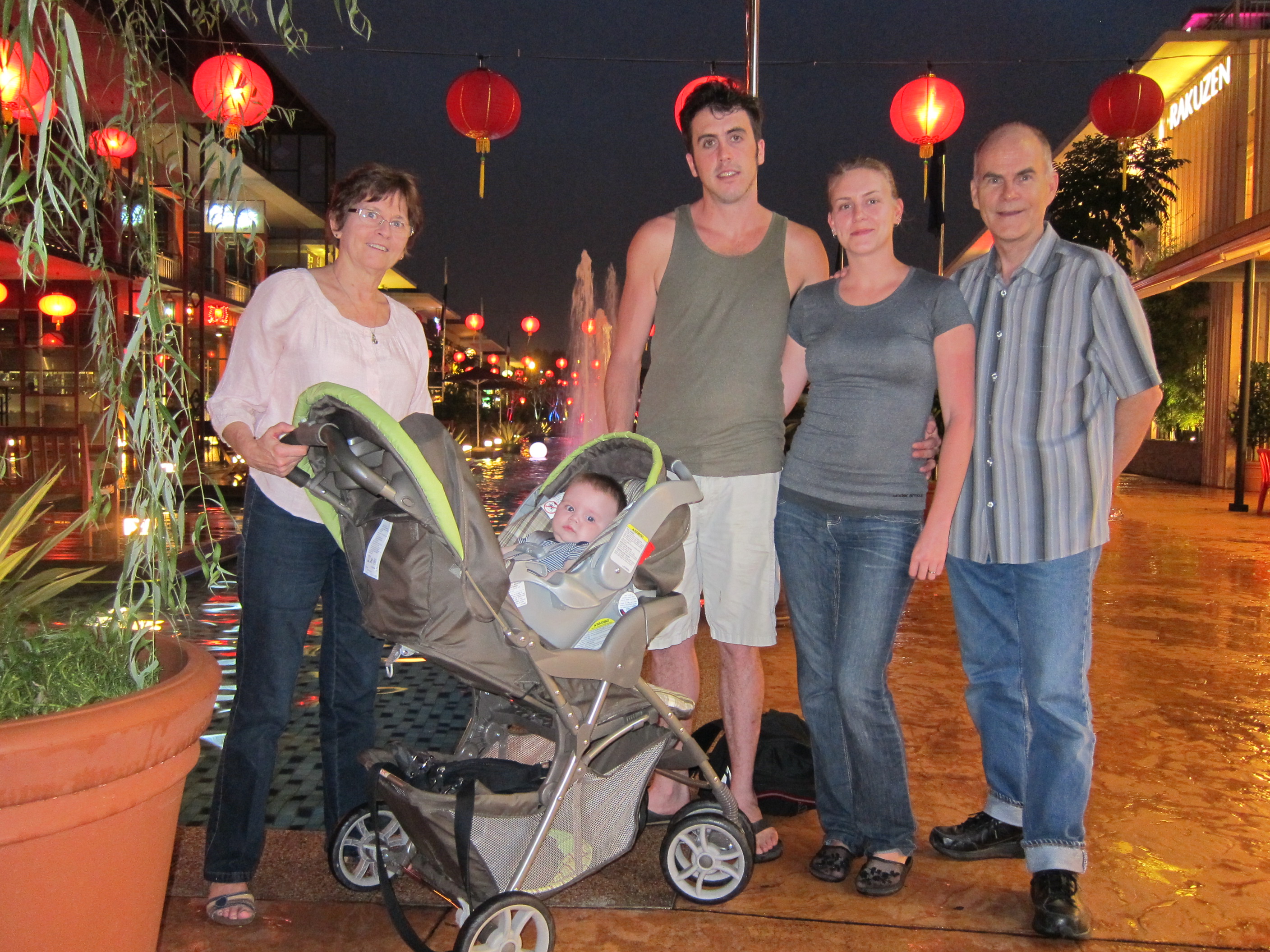
So when our youngest ‘child,’ now a grown woman with a husband and child of her own, decided to make the long (24 hours, door to door) trek to Malaysia to visit us, we were more than just grateful; we were ecstatic!

DSCN5567

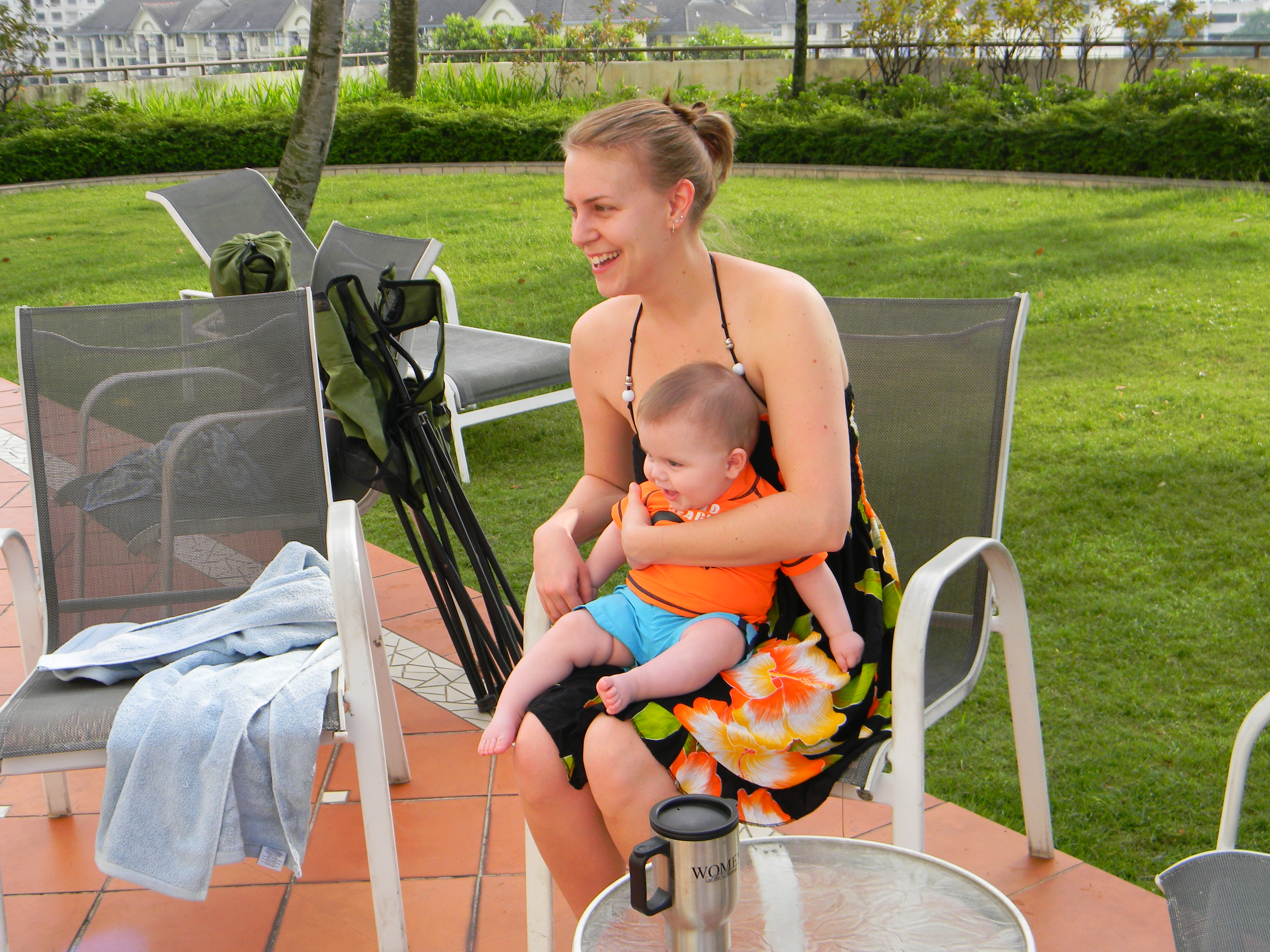
We were fortunate in that close friends Jim and Karen were willing to allow us the use of their apartment while they were in Canada, so Greg and Liz had plenty of room to relax and a place they could call their own while they were here. Pam had rented and bought a few things to make life a little easier for Russell, such as a baby walker – now unfortunately banned back home, much to every child’s loss of mobility and joy of exploration – and a pool float which got a lot of use. Liz and Greg brought their own stroller/car seat which was invaluable.

IMG_1550

Suitably equipped we went everywhere that we were collectively inclined to go. We drove out to Genting and took the longest cable car in Asia across the ancient tropical rainforest and tended Russell while Liz and Greg climbed up to see the Batu Caves at Thaipusan. We saw our local supermall/theme park, Sunway Pyramid, strolled through the lovely KLCC park, designed by famed Brazilian landscape artist Roberto Marx, and ‘window shopped’ in Pasar Seni and Jalan Petaling. But mostly we hung out at our own elevated pool where we got a nice breeze to cool us down while watching Russell work out the logistics of forward motion.

IMG_1598

While Liz and Greg checked out the sights in Singapore and the sands of Langkawi, Pam and I – well c’mon, mostly Pam! – entertained our grandson with more local walks and occasional splashes in the pool. It was great to get to see Pam with a baby in her arms again. She was a wondrous mother when our kids were little and I remember being very much in awe of her understanding and care for our kids. It was nice to be reminded of that again after so many years!

IMG_1529

After a final meal at the Oasis where Greg and I got in a couple of games of pool and Pam and I got to dance, it was time for Liz and Greg to go back to Calgary and more familiar surroundings and weather, and for us to get back to our regularly scheduled lives. We made a final run to the airport to see them off and drove back home in complete silence just thinking through all the joys of the last two weeks. It was a glorious visit and very much appreciated.

IMG_1571

What is it about Phil Everly’s death that has such a grip on me?

It is not just that I am getting old and all the people I grew up listening to are dying. It is more like a way of life is passing. I know this will be hard to capture in this post-modern age, but there was a time when Western culture wasn’t fractured. Could you imagine the tsunami that the Beatles caused happening today? It would be impossible. It was impossible even for the Beatles themselves towards the end of their career, because what I am referring to had already passed by the end of that decade.

But there was a time shortly after the war and lasting for perhaps twenty years at most, when Western culture was unified. We all listened to the same music, read the same books. When Catch 22 came out in ’61 we were all reading it. You’d ride on the subways with people reading the book, listening to them laugh out loud. It was like everyone was in on the joke. We all knew what they were laughing at. West Side Story came out the same year. Everyone was humming along. There were no country music stations or alternative rock stations. We all listened to the same music.

There was a good deal of schlock back then, for sure. Not everything was good. There was a veritable deluge of ‘Bobbys’ for a couple of years and most of them died deservedly quick musical deaths. But there was a brief spell, from maybe 1955 to 1965 where there were incredibly good songs by gifted musicians, and The Everly Brothers were among the best. Elvis was king, of course, and there were as many as two or three dozen solo, quartet and group artists that could compete on any one song. But no other group were anything like Phil and Don.

To my mind they had not only the best sound – pure, sweet, full of soulful longing – but they were the best ambassadors of that age; sweet boys who really seemed to care for the music they were making, with the most delicate harmonies that matched meaning, cadence, intonation, phrasing, tonality and musical colouration in a way that none of us had ever heard. It was like there were two people with one soul, breathing perfectly in harmony.

If you think I am just being nostalgic, have a listen and especially a look at this video of their 1983 reunion concert at Albert Hall. I am happy to admit that the first half of the concert is a little ragged (although you may not be as much of a perfectionist as I am and not notice), but the last half is a close to musical brilliance as you are ever likely to hear this side of glory. Watch how carefully Phil pays attention to every phrase that Don sings, matching and soaring above in absolute harmonic perfection. I read one comment on this YouTube page likening Phil to a human Stradivarius. That’s a pretty good metaphor for his technique. That sound didn’t just happen; they were singing harmony on their father’s radio show when Phil was six.

This sweet sound and thoughtful care for one another characterized the age in which I grew up. We wanted to have a little fun, to be sure, but we were good kids, and we seemed to share a culture of caring for one another. Something happened to fracture that. Perhaps the cracks were already evident and I didn’t notice. We had gangs, or there would have been no West Side Story that sought to portray them. There were even drugs back then, but so marginalized as to be almost insignificant. There was the threat of polio, but that was being beaten back. There was even the threat of nuclear war. But leaders of courage and integrity were facing the threat. I suppose that came to end in on Nov 22, 1963, although perhaps we didn’t know it at the time. Somehow with Kennedy’s death we were aware that dark forces were at work in our world to shatter our innocence and thrust us into the fractured and cynical age which we now struggle to make sense of.

With Phil’s death I am confronted by the sweetness of a world that is long lost and largely unknown by most of those reading this blog. My memories of its loss are bittersweet. I long for those days, as one might long for a glimpse of heaven. It was a kinder world: gentle, melodic and sweet. I will never see it again in this life. And neither will you. Here is a taste of what it sounded like:

Lunch
Although Steve is technically on break as the college is closed for the holiday season, the university is still going strong and the project doesn’t move forward unless Steve is there, so we have been staying close to home. However, this past weekend Steve had a work based commitment down in the south outside of Johor Bahru.  Since it is a four to five hour drive we decided to make the trip count by spending the weekend there.

We stayed at the Pulia Springs Resort which is a little down at the heels but has some lovely architecture and is located on a gorgeous golf course. It was nice to walk in the quiet, coolness of the evening and spend some time with a book in hand enjoying the greenery and sound of the birds. Subang Jaya is noisy all the time and you forget how restful the quietness is.

On Saturday we drove about forty kilometers out to Ulu Tiram to connect with a potential partner for the university. Kampung Temasek, The School Of Doing, aims to provide experiences that allow people to experience the kampung days of their youth.  The curriculum is geared at equipping future leaders “with the 5Cs of Courage, Curiosity, Creativity, Compassion and Collaboration,” as they explore nature and sustainable technologies. They have a great ten acre site, adjacent to the river Sungei Tiram. Groups are encouraged to go there to work with local facilitators and experiment on any sustainable project from gardening to renewable energy.

After a very nice home grown lunch and some stimulating conversation with Singaporean, Professor Tay Kheng Soon and members of the Buckminister Fuller Club, we headed out to the east coast for the afternoon. It being monsoon season the winds were high and the waves, pretty wild but we relaxed in a hammock, with our books on our laps and watched the waves crash on the shore.

???????????????????????????????

???????????????????????????????

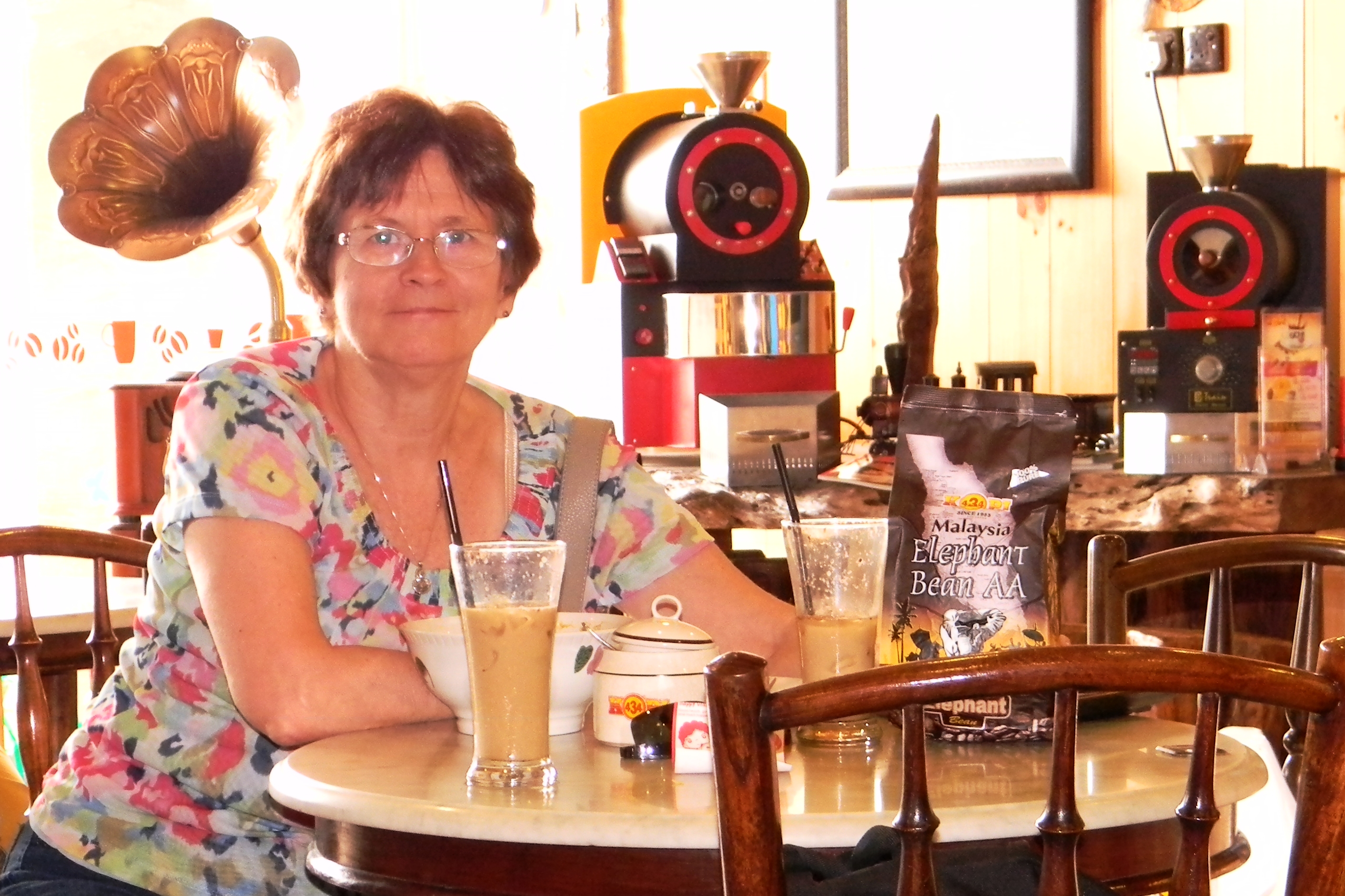
???????????????????????????????We broke up our drive home on Sunday with a short side trip to the west coast town of Muar. Grabbed lunch at the Elephant Café and stocked up on a couple of kilograms of our favourite Malaysian Elephant coffee. Still beat the rush hour traffic and got home in time for Steve to set up a three time zone, Wise Boys, Red Alert 2 online game with Jon, Ben and Dave. Steve is not much for online games but when your grandson turns seven it is time to learn so you can play with him.

Happy Birthday, Ben

7thbirthday

despair_by_saca

I read a blog posted by our dear friends Beth and Stephen Lauer, who serve the Lord in Phnom Penh, Cambodia. You can read the blog for yourself here: http://www.alifeoverseas.com/outlawed-grief-a-curse-disguised/ although I could easily summarize it for you if you like. It deals with the issue that all missionaries face: what to do with the fact that serving God in a foreign country means leaving behind all those whom you most love and care about. It also deals with the often airy dismissal by others of either “I could never do that; I love my family too much” (ie: you are a heartless jerk for going overseas) or “Well, God tells us to cast our burdens before Him” (ie: you are so unspiritual that you don’t know the fundamentals of the faith).

What should those of us who are so far away from our families do, especially at this most family oriented time of the year? Should we give way to grief and let our emotions out? Or should we rise above our emotions with heroic spirituality? Well here is what I think: Grief yes; despair no (which is why although I largely agree with the article, I disagree with the accompanying picture which seems more despairing than grieving). However, I do not think it is only those who feel called to serve the Lord in far off places that are told that their emotions are unchristian. It seems to me that we live in an anaesthetized world where ALL emotions are drowned in booze-sex-tv-iPads-entertainment-sports-drugs and EVERYONE is reluctant to face what they are truly feeling. I think Christians in the West simply adopt their culture’s approach to emotions and back-date their theology to fit in.

This attitude has far more in common with Stoicism than Christianity. Jesus wept, for heaven’s sake. Paul grieved for the care of his churches. Christianity encompasses all things human. It doesn’t discard or ignore emotions, else why did Christ put on a human body? Pam and I talk a lot about what we are giving up (family, mostly) to be here. I think it is both necessary and healthy. The Lord advises us to reckon on the cost (Luke 14:28) before undertaking a major endeavour. Prior to coming here in 2007 we discussed leaving Canada for 20 years, and always thought the cost too high; not for us, but for our children who not only had difficulty adjusting to our year in Germany, but even greater difficulty adjusting to life back in Canada. It was always our understanding that our children were given to us by God as our primary responsibility, and if serving God meant neglecting that, than we must not have understood the Lord correctly. We waited until they had all graduated from college/university before coming here. Not every missionary comes to the same conclusion, and it is certainly not our intention to criticize the decisions of others taken in faith and good conscience. But that was ours.

Now that we are here we still count the cost of our being here on our family. We reckon on it regularly, which may have something to do with the fact that although we grieve, we never despair. Our Lord is in this and He knows our hearts and our limits. He will not try us above what we can bear. That said, if any of our children needed us home, we would be there in a holy minute; I think they know that about us. Nothing is more important to us than our children. We do not place them above God, but we see our ministry to them as God given. We pray for them constantly, and ask God to bless and uphold them and our dear grandchildren. We do not have to live in their backyards to see the Lord working in their lives; our faith in God is greater than that.

Grief is the Lord’s way of putting us in touch with what is important to us; of allowing us to reflect and appreciate the contribution of another to our life’s journey, and express our love for them and our longing to be with them once again. For those who have died, it is a testimony – not given in vain by a sadistic evolutionary quirk, but given in hope by a loving almighty God – that we will see them again in glory. This is the Christian’s unique heritage; the assurance of an incarnate God who left the Father’s side to minister to our eternal need. If we are truly His, should we not be willing to do the same? And like Christ, should we not also express our deep longing and love for others?

IMG_1323

It is no secret that the Bible has some of the best stories in all of literature, and none so compelling as the story of Christmas. Forget the religious implications for a minute and just revel in the narrative. God looking down on the world He had created in love gone so far astray that even the people He had chosen out of all the peoples on the earth had begun to forget His name, and even His purpose. They had lost a kingdom that under Solomon had extended its influence to Egypt and Persia, through Arabia and Syria. Its writings and teachings so full of wisdom and sound good sense that they would influence all the world’s religions. Now they were reduced to a mere outpost of the most powerful empire the world had ever known, an empire that ruled not in wisdom and justice, but by the exercise of ruthless power.

Into this world, so troubled and torn, God Himself appeared in human form, not as a ruler to contest earthly power, but as a child of neither wealth nor power, born to a woman betrothed, but not yet wed to a man that was not the father of her child. Can you imagine a situation less promising? Yet from this Child arose the greatest moral teaching the world has ever heard. In His name great enterprises were established, scientific discoveries made, schools and hospitals were built, humanitarian aid flowed to the needy, slavery was abolished, not only in the Roman Empire scarcely two hundred years after Christians were accepted as Roman citizens, but again in the West after it had been reintroduced by Arab slavers.

In His name missionaries went out, not armed with swords and spears, but with knowledge and compassion, seeking to temper the worst excesses of mankind and bring healing and hope where there was poverty and despair. Just imagine what would have happened in India if Gandhi weren’t so taken with the teachings of Christ, or Black America if it wasn’t guided by the godly Rev. Martin Luther King, or South Africa if Mandela hadn’t been ruled by the Spirit of God, but the spirit of vengeance. If Christ hadn’t entered the world, what hope would there be in the world?

For this reason Christians everywhere celebrate the goodness of God in entering human history, not to judge, but to offer freedom from the oppression of wicked men. Wicked men like Herod, threatened by the arrival of Christ, sought to kill Him as a child. Men equally wicked still seek to kill Him, or at least remove Him from public love and consideration. To those we say ‘Merry Christmas,’ and offer to you the same advice that Gamaliel gave to the Sanhedrin (Acts 5) when Peter and John were hauled before them, “Keep away from these men and let them alone; for if this plan [the spread of Christianity] or this work [telling others the good news] is of men, it will come to nothing; but if it is of God, you cannot overthrow it.”

The teachings of Christ have not changed, but our understanding of them continues to mature and grow as new cultures and communities interact with its truths and reveal new insights. Christianity’s explosive growth in South America, Africa and Asia has deepened our understanding of the universality of its message. The faith has weathered the devastating wars of atheistic socialism, the upheavals of the sexual revolution and the destructive effects of unrestrained capitalist greed, and it has only become deeper and broader with each challenge. This little child born in Bethlehem packed an enormous punch. Isn’t it time you considered His claims to deity more seriously?