School


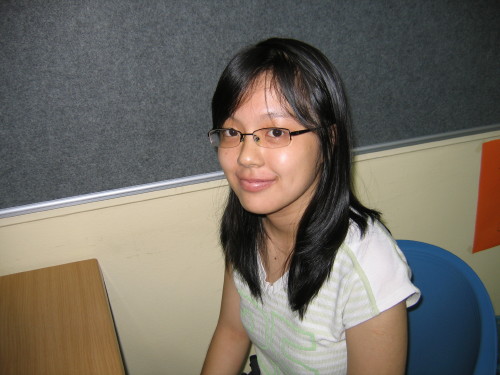
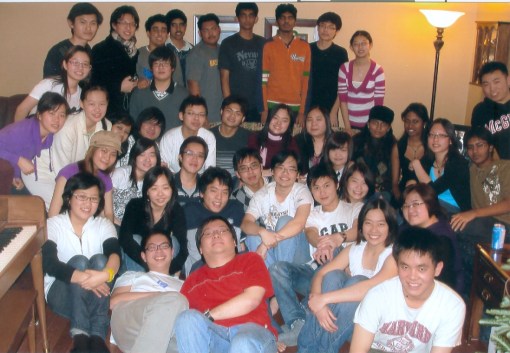
This has been my best term since coming to Taylor’s College back in July 2007. With one or two exceptions, the students this term were great; very motivated and hard-working with some exceptional writers and thinkers, three of whom are pictured here. The course work went very smoothly, unfolding at a good pace, neither rushed nor lethargic with plenty of time to develop the nuances of thought into character and motivation that I try to bring out. The final student presentations were finished early enough that I haven’t had to mark anything for two weeks, leaving me plenty of time to prepare my students for their final exam and giving me enough time to rest up for the final push of marking and reporting.

This is my fifth term here and my second time through ENG 3U, and I thoroughly enjoyed it. I find it hard to imagine that I once was anxious about teaching this course in Malaysia. Now I can scarcely imagine doing anything else. I have always loved writing and literature and never had enough scope at my previous teaching positions to develop the courses to the depth that I wanted. Here I can go as deep as I am able, and the students can not only keep up, they dig deeper into the material themselves and feed back their insights. It is very rewarding teaching.

For the next two weeks I will be invigilating exams and compiling marks. Not the most exciting tasks that teachers do, but necessary ones. Many of these students are here on government scholarships, and unless their marks are high enough they don’t get to go on to university in Canada. They have a lot riding on the line, and get understandably pretty anxious about their results. ENG 3U is not high on their list of priorities,as it is simply a prerequisite course for ENG 4U and will not count for entrance to university, but given their high level of drive for excellence, I know that they are going to try to score high regardless.

Norton CoverOn my desk in my little cubicle at Taylor’s College sits a battered two volume edition of the Norton Anthology of English Literature. I bought it used in 1973 in my second year at Guelph University, and it has been by my side ever since. It is a plain grey cover, unlike the Turner illustration on this picture. Its leaves are well paged, and its binding sags, but it is a dear friend and companion, and I would be loathe to lose it.

When I graduated from the University of Toronto with a B.Ed. in 1975 I intended to be a high school English teacher. But life is what happens while you are making other plans and I was desperate to get out Toronto and took the first job that offered me that chance. It happened to be a position teaching Industrial Arts in St. Thomas, Ontario. Shop had been my minor at OISE, something I took more for my own personal interest than any serious thought of teaching it, but it was a job, and I always figured that once I had a permanent contract, I could switch to high school, and my first love, English.

But I loved teaching Shop, and held onto it long after I could see the writing on the wall that it was on the way out. It gave me an opportunity to work with my kids, who loved coming in on the weekends and building things with their Dad. The facilities helped me renovate two houses, and the expertise stood me in good stead on the third. The kids I taught were always enthusiastic about the subject, and loved building skateboards, stools and baseball bats. I felt that what I did helped to keep them motivated about coming to school.

When the shops were closed there was a position in my school across the hall in Science. It seemed to be a good fit, and with a back door on the classroom and access to a conservation area where I could take my classes for samples, I enjoyed another good fifteen years of doing something I really enjoyed. The learning curve was steep, but by the end of my tenure I was teaching seminars on the technological aspects of the Science curriculum and driving computer driven robots across remote locations.

My present position as a high school English teacher is the third phase of my career, and finally I am getting to use that old Norton Anthology that I have been lugging around all these years. My lessons are invariable Power Point presentations and my writing projects are web based and interactive. But there at the core is this deep love for literature and the intricacies of human understanding that I am finally getting to explore and present, and I am enjoying every minute of it.

I am just so eternally grateful to God for seeing me through all the changes of my career that have given me such tremendous satisfaction and fulfillment. Each phase has had its purpose and its joys, and I still go to work excited about what I will learn, and how I can help my students to learn. And when I am unsure about a reference, there is my Norton beside me to help. That’s what old friends are for.

Locke's Teachers

I miss my colleagues back in St. Thomas. They were a good crowd, always happy to help with a great attitude towards kids. Yeah, there were some turkeys in the mix. We had a principal that never should have left Grade Three, where I’m sure she was a competent teacher at one time, and a vice-principal that spent her days auditioning for the role of either Jack or Roger in Lord of the Flies, depending on whether or not there was a full moon that night.

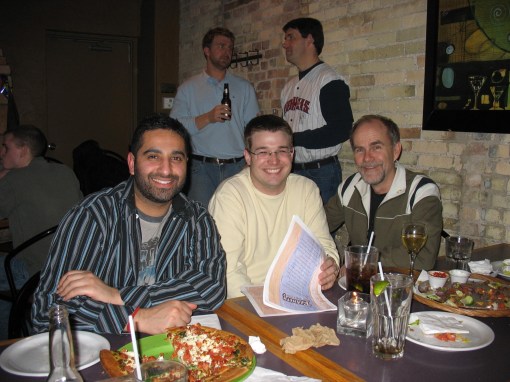
But your colleagues are where where you live in this profession, and they are solid then you are going to have a good year no matter what else is going on. I was fortunate to have some really great colleagues in the course of my career, four of whom are pictured here at my “retirement” -lol! They have been settling in to another year in Ontario, just as I am getting mid-terms out the door in Malaysia, and I wish them all the best.

So to all of my colleagues back in St. Thomas, thank you all so much for being such a great group of teachers. Your dedication and your friendliness have always been such an encouragement to me, and I have so many fond memories of all our years together. If you ever get a hankering to experience what teaching is like on the other side of the world and think you might like to take a year’s leave of absence to find out, I would bend over backwards to help you to land a teaching job in Malaysia. Just log on to the link below for information on the Queen’s Job Fair in Kingston Ontario and fill iin the forms on the site. I would be happy to give you a hearty recommendation!

http://educ.queensu.ca/careers/torf/eligibility.html

004

In the middle of exam week, when I’m trying to finish up my marks, get in a few days with Pam before she leaves for Thailand for a week, and get myself packed to come home, I volunteered to conduct a workshop at Taylor’s. I’m thinking twenty to thirty teachers in a classroom, with lots of desk space to spread things out and lots of hands on activities. Instead I get a hundred teachers in a lecture theatre. I found out the day before my English exam, and three days before the event the true nature of this ‘workshop’. The last two days I have been retooling what I thought I was going to do in a classroom into what will work for a larger venue and a much more restricted workspace.

In my usual ‘get prepared way over the top’ way I had about four hours worth of stuff ready, so I had no problem filling the two hours I was scheduled to speak. The audience consisted of Malaysian High School teachers from a number of disciplines, mostly the sciences. But I teach English, so that is what I taught. Poetry, to be precise. The topic of my talk was Interactive Learning, and over the years I have found poetry to be one of those parts of the curriculum that is most interactive. I did the usaul: poetic rhythm and Haiku, but in my research I came across Ghazal, an ancient Persian poetic form that is well suited to interactive learning. In Ghazal each member of the group write one couplet on a theme you assign, and all the member of the group put their couplets – or shers, as they are properly called – together to form a poem. The ones on the subject of money were very clever. The ones on lonliness were most touching.

My group was a little reluctant to get started. Those of you who know me know that I can be a bit formidable at first blush. But after a few minutes of me running up and down through the auditorium soliciting volunteers they soon loosened up, and by the end I had a hard time getting them out of there for lunch. We had a lot of fun together and we all learned something from the experience.

I sat for lunch with a very articulate and well educated group of them who worked in a school of four thousand students, with classrooms of forty students each. Their English was impeccable and they knew full well the challenges that they and their country faced to bring Malaysia into the first world. They earned my admiration for the enormous job they do, and my appreciation for a very rewarding teaching experience. For more information on Ghazal and great review of Haiku, go to:

http://www.cranberrydesigns.com/poetry/home.htm

English 4C_Per3

It is hard to believe that we have been here two years already. Where did the time go? I have just finished my fourth term, and I am in the process of marking the final exam and compiling the students’ marks. It has been another great year, filled with learning for both me and my students.

I just passed my sixtieth birthday, as I’m sure you are aware, and as a result I got a lot of nice cards and notes from others who wrote of my passion for this profession and my commitment to the kids I teach. For me it has always been a no-brainer: find what you are gifted in and like to do (the Lord is no fool; the two are connected), then pour your heart and soul into it.

Tomorrow I get to expand my expertise a little further, presenting teaching and learning in an interactive manner to a group of Malaysian secondary school teachers coming to Taylor’s for some in-service workshops. It has always been my goal to share what I have learned with my younger colleagues, and I am looking forward to the opportunity.

Pam continues to develop her expertise as well, leaving on Tuesday for Chiang Mai for a Project Hannah Consultation, where she will meet with Marli Spieker and discuss her new responsibilities for South-East Asia. A busy time for both of us as we also have to prepare to fly home in less than two weeks, but a rewarding time as well as we continue to have an impact on the world around us.

kindness

I have a student teacher with me for the month of April. Sheila is from Ottawa, and for her last practicum has opted to come to Malaysia to learn not only how to teach, but to find out what another culture is like. I think it is incredibly gutsy of her! Sheila is great, and I have enjoyed her can-do spirit and her rapport with the kids. But I have not always had good success with student teachers. There is something about this job that brings out the worst in people, and it is never more apparent than when they are starting out. steve-and-me_1

For some reason having a class full of naive and trusting children in front of them encourages otherwise rational adults to behave like young autocrats auditioning as storm troopers. They get the idea that ordering other human being around has something to do with learning. It doesn’t. Instead it has everything to do with your vanity and your desire to make other human beings miserable. You want to rule someone, and these poor kids are as close to it as you are likely to get. chan-and-evelyn_1

I remember when I first starting taking on student teachers I would be careful to emphasis lesson plans and proper preparation and the organization that pedagogy requires. Not anymore. Now I go right to the core message: you show me that you care for these kids or I won’t let you anywhere nearthe front of the classroom. I needn’t have worried with Sheila, who within a few days had everyone’s name down pat and was carrying on animated conversations before and after class. As a result she doesn’t need to correct any behaviour or exert any discipline during her lessons. The kids like her, and therefore they listen to what she has prepared for them to learn. jagdeep-and-jaipreet_1

I don’t know why so many in this profession have failed to learn the lesson that learning is based on relationships. Develop rapport, and everything else will fall into place. Kids want to know you care before they care about what you know. This doesn’t mean there won’t be some poor students in your class. A class is just a cross section of the culture you live in. The only difference is that  in a class you can set the tone: critical and controlling, or caring and compassionate. Would the first type kindly leave the profession I love and get a job a job as a security guard where you’ll be much happier and do far less damage! yi-ming_1

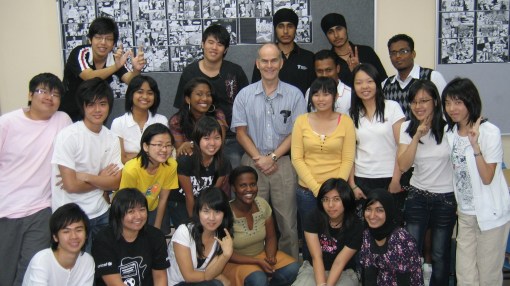
I have just a delightful group of students with me this term, some of whom are pictured on this post, others you can find in our Flickr sidebar. They come from as far away as Tanzania and the Punjab and English is for some of them their third or fourth language. So if they struggle with the intricacies of our grammar, that is only natural. They are invariably pleasant and polite and have a keen desire to make an impact on their world. As a teacher I get the opportunity to help them learn how to do that. What a huge responsibility. What a great privilege.

pic1

We miss our friends Bill and Kim who were here with us last year and went home in June. They are our age with kids our age and we shared a similar love for adventure and music. We also shared a similar faith, which is also nice.

Both Kim and Bill were principals in Canada, Bill retiring a few years ago and Kim retiring just days before they flew to Malaysia. Both of them brought a level of competence and caring to the school where I teach that made a lasting impact on this educational environment. I was here in time to seeing the last regime at the school, and it wasn’t a pretty picture: angry and disappointed teachers; a spirit of selfishness and insularity that resisted change and innovation; acrimony and discord throughout the program.

Bill and Kim would have none of that. Their cheerful competence and get-it-done attitude swept through this place like a cleansing breeze. Clean-up days and class trips were organized; extra sessions laid on for English training; even staff meetings became more positive and goal-oriented. They just had no room in their busy lives for negative nonsense, and it simply disappeared. The new crop of teachers never knew anything different and they simply kept pace. The result is that we now have a different attitude here that is Bill and Kim’s lasting contribution to this school.

Although they have gone back to Canada, Bill and Kim are still impacting this program. They started a support group in Canada for Malaysian students who graduated from this program and are now studying in Canada. Recently they rented a bus and invited the ones who were in the Toronto area out to their house for a get together. Forty-five of them showed up! Our friends Ken and Susan, who were also part of the sea change that happened here, did a similar thing in Montreal, hosting thirty-five of them.

We miss our friends from last year, but we are grateful for the impact for good that they have had on so many lives in Malaysia and back in Canada. It is amazing what two caring people can do, and we are fortunate to count them among our friends.

steve-marking

I love teaching. There is absolutely nothing in the world I would rather do. I love to learn and dig up new and interesting facts I can use to enrich my lessons. I love to learn new technologies and incorporate them into my lessons. I love the interchange of ideas among my colleagues from different disciplines. I love the interaction with the kids I teach and joy I get from seeing them grasp new concepts that will help them in their futures. I even love the rhythm of my job, the pressure of exams, the pleasure of the holidays. I love everything about my job. Except the marking.

I hate marking. It is boring and repetitive. I find it really hard to keep my mind on task, and I need the constant stimulus of caffeine and music to keep my mind awake. I think, “I have already taught this concept a dozen times, and they still don’t get it.” I think of all the other things I would rather be doing. I think of all the jobs that don’t require marking, or wasting entire weekends on essentially unpaid labour. There isn’t a single thing about marking that I like. Except that it is an essential part of teaching (see paragraph one).

What really galls, however, is the inequality between my marking load, and that of other disciplines. I was chatting to a business teacher who showed me a test generating program for business. He clicks a few categories – chapters and concepts covered, number of questions desired – and hits a button. The multiple choice test instantly appears on his screen. He hits print, and his test is written. He will photocopy it and give it to his students along with a form that the students use to select their choice of answer. He will turn in those forms to an exam office that will scan the form and give him a print out of student marks. His time on task? About two minutes.

I on the other hand will take two hours to write a test that is tailored to what I taught in English, and then spend about twenty to thirty hours marking it. (Oh, did I mention that he gets a four thousand dollar bonus for teaching an “essential” subject?) However, I still love teaching. I just hate marking. In fact I am writing this post just to avoid getting back to it. Guess my time is up.

Please forgive me if you are already tired of this subject. But I just received a comment from a friend of mine from an old post that does not deserve to be buried in the comment archives of last November. Gary is a well read and articulate thinker and his response deserves a post on this site. I do not agree with every thing he says, but as Voltaire famously said: “I will defend to the death his right to say it.” I consider myself fortunate to work in such an intellectually stimulating environment, I learn something new everyday. Here is Gary’s (unedited) comment:

I have just been made aware of this site and as I am a colleague of Steve’s on the other side of the debate I would like to enter in.

First, let me state that I have no firm conviction on the existence of a Creator, although I lean to atheism. There are questions which cannot be currently answered by science. Some cannot be answered because we have not had the time, or the resources or the theoretical understanding to deal with them or even to formulate them. Most of these will with time and effort yield, but the existence of a Creator is unlikely to, so we should be each free to come to our own conclusions: but certainly you cannot use science at this time to justify an answer either way.

Behe’s ideas fall into the realm of the miraculous (and I did read the book, Steve, when you lent it to me) although he is knowledgable enough in the science. His ideas are miraculous simply because they indicate that there are complex entities which cannot be explained in terms of simpler ones. The philosophy of science is that all problems are in principle explicable with time and effort, including biochemical ones. Thus a scientist is not likely to like Behe’s approach for philosophical reasons: it would close off so many avenues of research. That, of course, would not matter if Behe were right and some processes are irreducibly complex. But it is actually fairly simple to find explanations on the internet for the processes he sites. I give you here the website of Kenneth Miller (I am sure you will recognize the name, but you shouldn’t be deterred by him being a strong opponent of ID – he is after all a strong Catholic Christian as well). His explanation for a possible evolutionary development of the Clotting Cascade (which you like to cite) is clear and comprehensible: http://www.millerandlevine.com/km/evol/DI/clot/Clotting.html

Keep in mind that to refute the idea irreducible complexity all that is logically needed is a feasible pathway based in current knowledge of biochemistry and genetics: the exact pathway will never be known.

As to probabilities, the calculations as presented are not correct or applicable. The most unlikely event in the whole process is the original synthesis of a self-replicating molecule from precursors. However, in a large “soup” of small molecules, given the chemical bonding rules as we know them and chemical energetics sooner or later a molecule would be built – it wouldn’t require all the small molecules coming together simultaneously which would be improbable to the point of impossibility: rather, if the first “living” molecule required 26 precursors, call them A to Z for convenience, they might first link chemically in pairs, AB, CD, EF and so on and then in pairs again. None of these steps would be prohibitively improbable especially given the times involved. From there variation and differential reproduction take hold: this process never requires multiple elements to come together simultaneously – an existing gene, for that is what the living molecules are, is modified and acts as a template for some new protein. Evolution does not build each new protein or enzyme from the beginning, from 0, but adapts existing models, which is why the probability calculation often quoted is wrong (I know you like Hoyle who it seems introduced this calculation: a brilliant physicist but not so hot in biology). The only point in this process which is random or at least unpredictable is variation in an existing gene or chromosome, by reshuffling of component parts, or duplication of a gene, or mutation and these occur so frequently that cells have evolved sophisticated repair mechanisms

Jon Wise brings makes a point that scientists are desperate. I don’t think so, although science is under attack particularly in America, by more literalist Christians who would censor science where it disagrees with their beliefs. But scientists are interested in the question of origins, naturally, and would like naturalistic explanations. At this point there are several possible explanations for the nature of our universe, that is the setting of certain constants at values that are necessary for life, often referred to as the Anthropic Principle. Possibly these were set this way be God, possibly it is mere chance – the values could have been anything, but at the time of the Big Bang, they settled at just the right values, perhaps the universe is a multiverse, with possibly an infinite number of universes each subtly different, perhaps the universe will go through a potentially infinite number of cycles of Bang and Crunch, with each new cycle having a new, random set of values and we are of course living in one of the cycles in which it is possible for us to live, perhaps, as Lee Smolen of the Perimeter Institute, suggests, black holes within our universe act as progenitors for new universes each with subtly different characteristics. All scientists know that these ideas are not science, they are interesting speculation: no serious scientist would ever say “This is how it was or is” because there is no data. There is no real evidence for any of these hypotheses and likely never will be. Thus origins, the nature of God lie beyond us, and reason and science cannot help us without fact to work on.

My own feeling is somewhat like Jon’s. Science is a means of exploring the nature of God, however one conceives it. If there is a God, then all of Creation is a book for us to read; if not, we should continue to learn in any case.

Personally, I find evolution and quantum mechanics (especially) far more elegant than a set-piece creation. If God made it all in a particular way, and knows all, how boring that must be and pointless, since all the outcomes would already be known. On the other hand, in QM, uncertainty rules, the outcome of any interaction is fundamentally unpredicable, based on current knowledge, let alone all of them. How much more interesting it would be for God to look with curiousity and amazement at the handiwork as it developed.


 
It has been a real joy coming to Taylor’s and teaching here for the past year. I can’t tell you how much I have enjoyed getting to know you and interacting with you in class and reading your essays and emails. If I had known (past perfect, 3rd conditional) teaching in Malaysia would be this much fun, I would have (would + present perfect in the main clause) come long ago! (Once an English teacher…)

I just want to remind you that I would love to see your pictures. I don’t need to be in them. My wife has my camera back in Canada so I am relying on you. I pinched this photo from Yap’s blog. You can send by email to steve.wise@taylors.edu.my. If you have a weblog give me a link in my comments folder below so I can track back to your site.

I believe with all my heart that there is a God, and He cares for you. Furthermore, He has a plan for your life, and since He is loving and caring God, He means to bless and encourage you, and give you good things. I trust that I have been one of those good things for you. I haven’t always said nice things about you. Sometimes as a teacher you have to correct and direct your students, as well as praise them.

I hope that you have found that whether I have corrected or praised you, I have always had your best interests at heart. I would like to see you succeed at whatever it is that you attempt to do, and if I can be of any help to you in the future, you have only to ask. Good luck with your exams; study hard, and ask God to bless your efforts.

« Previous PageNext Page »