Ministry


A year or so ago, I met with a group of young Malaysians who were studying at Sabah Theological Seminary, ten of whom had gone to Cambodia to attend a CHE TOT1 facilitated by our TWR Cambodia staff. One young lady, Zahara, has now graduated and returned to her home village to await her assignment with the Anglican church. Zahara is an orang asli (native people)young lady with a passion to serve her own people and sees CHE as the ideal way to move her communities forward.

I decided to venture out on my own to meet up with Zahara and found myself a local bus heading north to Teluk Intan. We met up with no problem at the bus station and drove out to her village about a half hour away. This is the first time that I have been able to experience the close family connections, gracious hospitality and acceptance of the rural communities of Malaysia. We had to stop several times on our way in to Zahara’s house to meet, greet or share a drink with other village members. The community consists of two small villages just a few minutes walk apart, with a total of about fifty families. It is largely Christian, with four established churches but there are also a few Muslim families living peacefully amongst them.

Church

Dinner

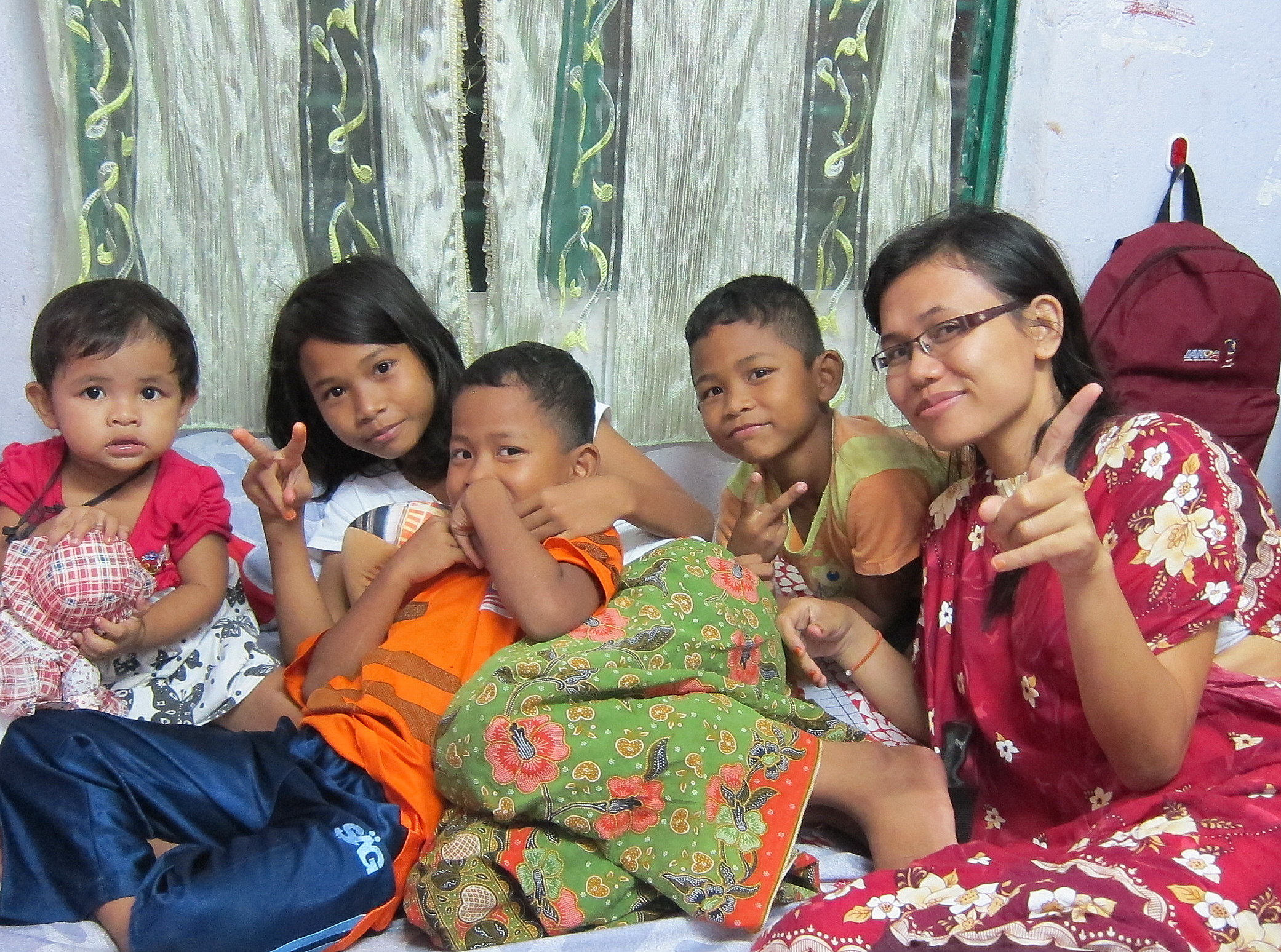
Since I was in the village, Zahara quickly arranged a church service for that evening and over thirty adults and many children arrived to hear me speak, which of course I was totally unprepared to do. With Zahara translating, I facilitated a CHE lesson called What is Good Health. As virtually always happens in this part of the world, at mess of food appeared for all to share after the service. I had the opportunity to meet and pray with a number of the women before we retired to Zahara’s home which she shares with her Mom, niece and nephew. Lots of family members, sisters, brothers, aunt, uncles and nieces and nephews and cute little kids dropped by to visit before bed.

Zandkids

In the morning we met with a village lady with a burden to reach the young people in the village who refused to attend church or even go to school so we did some planning on ways to engage the youth in the village. From there we went to the kindergarten and shared some CHE resources for children with the young lady who teaches around a dozen little cuties and her friend who works in the children’s ministry. I am so grateful for the thousands of CHE lessons that I have so often relied upon in sharing with others.

Girls

Zahara cooked us a very flavourful lunch, including some turtle, and by the time I left to catch my bus back to KL, I was sad to be leaving this close knit group of brothers and sisters. I am looking forward to hearing where Zahara’s placement will be and figuring out how we will work together. I also have standing invitations to bring Steve to meet the folks and stay any time. Oh and a wonderful group of friends to spend Christmas with.

Many communities in developing countries are trapped in a mindset of short term relief, feeling helpless or simply unaware of how they can improve their environments. They have grown dependent on outsiders coming in with short term, quick fix solutions for long term problems. Sustained, long term improvements will not happen until the community members themselves own the problems and the solutions.
ideas

Last week in Cambodia I had the joy of seeing our pilot project take some definitive steps toward local ownership and direction. Although my colleague and I, both outsiders, were there our TWR Cambodia staff are very capable trainers and it was great to see them facilitate the process even though I didn’t understand a word.
booklet

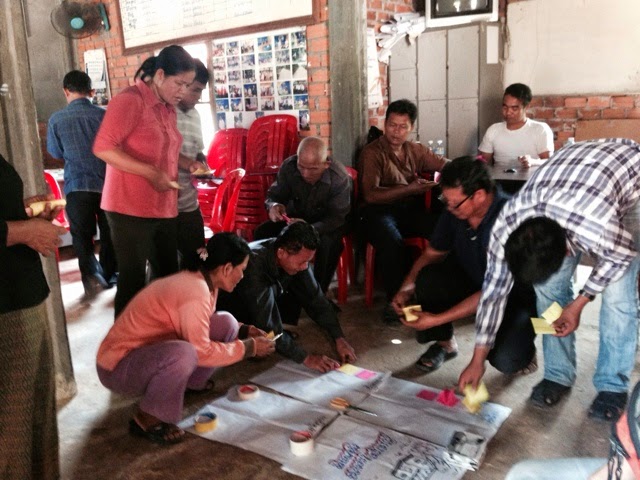
They led a group of commune leaders, village council members and local volunteers through an exercise designed to enable them to discuss what constitutes good health for their villages and families. However it was even better to see the community leaders come together to decide on their own criteria for defining a “healthy home”, create their own teaching booklet and take the initiative to arrange and pay for the printing of the booklets.

Practice

villagehouse
After the second day of training, we accompanied the young volunteer trainers to a village where they could practice teaching the lesson in a couple of the homes. These young ladies then taught the lesson to several of the other volunteers who had been absent for our lessons, and then observed as these young men taught the lesson themselves. This is multiplication.

IMG_2288
As the day wrapped up, we sat under a village home snacking on enormous pomelos that were growing on a tree in the center of the community. Trapped by a monsoon downpour, we enjoyed watching village life as children returned from school and families from the fields carrying wood and leading their cows home for the night. Within minutes a small lake had formed beside the house and the village boys were romping in the mud.

Rainbow

Not to waste a perfectly good opportunity to share with others, Kimsong spontaneously shared with the villagers the story of the rainbow.

DSCN5694

It was during a speech by Idris Jala – former resident of Bario and rising star in the Malaysian government – that Taylor’s Education Group president and CEO Dato Loy Teik Ngan heard a call to help with the problems of education in remote villages. Although the government had built schools and hostels in the remote interior, many of these were now facing the end of their useful life. Dato Loy harnessed the considerable resources of his educational interests in Malaysia to raise the funds necessary for a new hostel in Bario that would allow the school to continue to serve the needs of the children in the remote villages in this part of the world. An architect was engaged, a project manager hired, a cost analysis conducted, and a fund-raising campaign was conducted – all pro bono – to meet the need for a new hostel.

DSCN5732By the time I stepped into the role as Project Coordinator for Bario much of this preparation was already either done or well underway. However, now recognizing that Bario was but one piece in a larger picture, I was taken on as coordinator for all community projects, numbering more than three dozen with more developing all the time. These added responsibilities for the larger picture of CSR are the reason why it was not until last week that I finally got to Bario myself, in the company of Evan Horsnell, the project manager for the build. Evan is an Aussie who came to Kuala Lumpur to help sort out a project, met a Malaysian who he married, and has now settled down in the country. He is your typical Aussie, friendly and garrulous with a distinctly colourful past, and we regaled each other for hours on things that we did in our youth that we probably should never have gotten away with.

In order to get to Bario you have to first fly to Miri, a town funded largely by the oil that is drilled off the Borneo coast in Malaysian waters, and then on Bario in a Canadian-made de Havilland Twin Otter over terrain that rose rapidly to 3200 feet over virgin forest that held few villages and fewer roads. The single dirt track that runs to Bario takes two days and 14 hours when it is dry, and is impassable when it rains. We were met at the airport by Dora Tigan, the headmistress of the primary school where the hostel is being built and John Tarawe, the local counselor most responsible for moving the project forward. With limited time for social niceties, we drove straight to the site of the hostel where Evan and Shep Bala the local contractor, walked over the build and made an assessment of its progress. Evan wasted no time in checking over the build with his experienced eye.

DSCN5737I spent my time collecting the stories of the participants in the project, chief among them Dora Tigan, a resident of Bario who like many others had to leave the village to get an education, but has then returned to contribute to the ongoing development of the village as a local cultural heritage center for the Kelabit people. There are two schools in the village: a primary school and a middle school, both of which have hostels to house the children from the surrounding villages. There is a medical clinic and a coming electrical project which will see the village get a solar array to reduce their dependency on expensive diesel fuel which has to be trucked in from Miri, and the small hydro-electric plant which is often hampered by insufficient rainfall.

Like most things in life, the hostel situation in Bario is hard to categorize in a single weblog post. It is easy to see how a larger and better equipped hostel would help the community to meet the educational needs of the surrounding villages. It is also easy to see how the project could get bogged down without regular technical oversight. I sympathize with my Aussie friend’s frustration at the rate of progress and difficulties with materials. I also recognize the desire of most in the village – many of whom are sincere and devout Christians – to use the vehicle of education to serve the needs of their community. It is that need that drives my own interest to see this project through to its conclusion.

Bario2

In 1928 Charles Hudson Southwell, a recent graduate of both the University of Melbourne and Melbourne Bible Institute, sailed north to establish the Borneo Evangelical Mission. Like his famous namesake, Hudson had intended to go to China, but was challenged at MBI to go to the remote jungle instead. Establishing a mission in the Limbang District of northern Sarawak, close to the border with Sabah, Hudson quickly learned both the Malay and Iban languages. Returning to Australia to marry his childhood sweetheart Winsome, the two returned to Sarawak and settled into a ministry among the Murut people, who were eager to know about ‘Tuhan Isa,’ (Lord Jesus) who is mentioned in a favourable light in the Qur’an. Unfortunately their success among the Murut attracted the attention of the British overlords of that territory who preferred to keep missionary activity to a minimum and on occasion banned them entirely as it interfered with British territorial ambitions in the region.

Taking a strategic furlough in Australia, the Southwells returned quietly to Borneo in 1936 to the Miri area and began working among the Iban with equal success. By then American missionary John Willfinger had rendered the New Testament in the Iban language (one of the many ways that Christian missionaries have strengthened and preserved indigenous people groups has been to commit their oral language to written form) and the Southwells found that Christ’s parables rendered in their own language spoke to the Iban in a powerful way. The war loosened British hold on the territory, and staying in Borneo during the conflict the Southwells were able to renew their work with the Murut who themselves became evangelists to their neighbours. Driven further inland by the Japanese who had now landed in Sabah to the north, Willfinger – a brilliant scholar and gifted linguist who was now working on the Murut New Testament – and the Southwells continued to evangelise indigenous tribes as they fled, among them the Kelabit people of the highlands near the border with what was then Dutch Indonesia.

The Japanese, like the British before them, understood the dangers posed by an educated and empowered tribal population and targeted both Willfinger and the Southwells for immediate arrest. When they surrendered – rather than further endanger the local tribes people – John Willfinger was summarily executed and the Southwells and fellow missionary Frank Davidson were incarcerated in an internment camp where Davidson died of disease. Hudson’s previous education as a chemist allowed him to identify and use local leaves and berries for both food and medicine, and he and Winsome survived. In March of 1945 American parachute troops, led by Major Tom Harrisson, landed in the Kelabit Highlands, and organizing and arming the Kelabit people led them in a guerrilla campaign against the Japanese that left no escape from advancing American and Australian troops now attacking the coastal regions.

Following the war, Harrisson returned to Bario and began working among the Kelabit people, to whom he felt he owed much of his wartime success. He was opposed to the evangelical efforts of the Southwells and sought to restrict their influence. But the Kelabit themselves were in awe of the changes they saw among the Murut and many Kelabit turned to Christ in the years after the war. In the early 60s Sabah and Sarawak joined the new Malaysian Federation, raising the ire of the Indonesians who considered the provinces part of their territory. The resulting ‘Confrontation’ with Indonesia caused many Kelabit from the surrounding villages to flee into Bario where there was a Malaysian army base. This increased Bario’s population and importance which after the conflict led to the construction of first a primary and later a middle school to serve the children of the area.

The Southwells continued to minister in the Highlands until the 1980s, working among the Kelabit, Kayan and Kenyah people. Hudson developed a Kayan-English dictionary to preserve this indigenous language and established a Community Development Project far up the Baram River at Long Lama that provided technical training to improve local living conditions. A ‘moving of the Holy Spirit’ in Bario in 1973 led to the Christian conversion of the entire village and the construction of a local church. An emphasis on Christian morality and an understanding of the importance of education has led to the Kelabit being among the most well-educated people groups in Malaysia. Former Malaysian Airlines executive director and current minister in Prime Minister Najib’s inner circle Dato Sri Idris Jala is Kelabit, as are a number of Malaysian CEOs and Christian evangelical leaders.

Some research material from: With Pythons & Head-Hunters in Borneo (2009) by Brian Row McNamee. Xlibris.

???????????????????????????????

Much effort has gone into the pilot Wholistic Community Development pilot project in Siem Reap province in Cambodia and the goal is that the impact is not only well documented but back up by academic research. This past May a group of medical students from Singapore did the first phase of the research with a study on the impact of the initial Moral Values training on the ngo staff and community leadership. They also began a baselines survey in two target areas.

This past weekend, I was in Siem Reap with a Singaporean researcher to organize and trainer for a follow-up survey of about 120 homes. The community leaders are very keen to get the work done and have an amazing knowledge of their own communities. We had a good time training five very capable teachers in the content, process and skills needed to carry out confidential interviews.

As it is very difficult to monitor and document behavior change, the students will use alcohol consumption and the resulting issues such as family violence and unsafe sexual activities as proxy indicators of change. Alcohol is a major issue for these communities, and accounts for a significant financial burden not only in terms of money spent on booze but also in decreased productivity, school dropouts, ill health and relational problems. With the data collected in these surveys, Singaporean medical students will return in May to work with the community leaders to design and implement a community wide alcohol reduction program.

We stopped by a very small village alcohol supplier, which didn’t look like much from the street but was shockingly well stocked.
???????????????????????????????

???????????????????????????????

On Sunday I braved the roads and made the six and half hour bus trip to Phnom Penh. When your Khmer friends tell you that the road is under construction they mean it: all 350 km of it. I had three great days in the TWR Cambodia office working with the staff on a report that was needed by the end of the month. It was fun to connect with them again and get caught up with their lives. I benefitted from a farewell for one of the staff for which the guys graciously did a fabulous BBQ.

???????????????????????????????

feet

despair_by_saca

I read a blog posted by our dear friends Beth and Stephen Lauer, who serve the Lord in Phnom Penh, Cambodia. You can read the blog for yourself here: http://www.alifeoverseas.com/outlawed-grief-a-curse-disguised/ although I could easily summarize it for you if you like. It deals with the issue that all missionaries face: what to do with the fact that serving God in a foreign country means leaving behind all those whom you most love and care about. It also deals with the often airy dismissal by others of either “I could never do that; I love my family too much” (ie: you are a heartless jerk for going overseas) or “Well, God tells us to cast our burdens before Him” (ie: you are so unspiritual that you don’t know the fundamentals of the faith).

What should those of us who are so far away from our families do, especially at this most family oriented time of the year? Should we give way to grief and let our emotions out? Or should we rise above our emotions with heroic spirituality? Well here is what I think: Grief yes; despair no (which is why although I largely agree with the article, I disagree with the accompanying picture which seems more despairing than grieving). However, I do not think it is only those who feel called to serve the Lord in far off places that are told that their emotions are unchristian. It seems to me that we live in an anaesthetized world where ALL emotions are drowned in booze-sex-tv-iPads-entertainment-sports-drugs and EVERYONE is reluctant to face what they are truly feeling. I think Christians in the West simply adopt their culture’s approach to emotions and back-date their theology to fit in.

This attitude has far more in common with Stoicism than Christianity. Jesus wept, for heaven’s sake. Paul grieved for the care of his churches. Christianity encompasses all things human. It doesn’t discard or ignore emotions, else why did Christ put on a human body? Pam and I talk a lot about what we are giving up (family, mostly) to be here. I think it is both necessary and healthy. The Lord advises us to reckon on the cost (Luke 14:28) before undertaking a major endeavour. Prior to coming here in 2007 we discussed leaving Canada for 20 years, and always thought the cost too high; not for us, but for our children who not only had difficulty adjusting to our year in Germany, but even greater difficulty adjusting to life back in Canada. It was always our understanding that our children were given to us by God as our primary responsibility, and if serving God meant neglecting that, than we must not have understood the Lord correctly. We waited until they had all graduated from college/university before coming here. Not every missionary comes to the same conclusion, and it is certainly not our intention to criticize the decisions of others taken in faith and good conscience. But that was ours.

Now that we are here we still count the cost of our being here on our family. We reckon on it regularly, which may have something to do with the fact that although we grieve, we never despair. Our Lord is in this and He knows our hearts and our limits. He will not try us above what we can bear. That said, if any of our children needed us home, we would be there in a holy minute; I think they know that about us. Nothing is more important to us than our children. We do not place them above God, but we see our ministry to them as God given. We pray for them constantly, and ask God to bless and uphold them and our dear grandchildren. We do not have to live in their backyards to see the Lord working in their lives; our faith in God is greater than that.

Grief is the Lord’s way of putting us in touch with what is important to us; of allowing us to reflect and appreciate the contribution of another to our life’s journey, and express our love for them and our longing to be with them once again. For those who have died, it is a testimony – not given in vain by a sadistic evolutionary quirk, but given in hope by a loving almighty God – that we will see them again in glory. This is the Christian’s unique heritage; the assurance of an incarnate God who left the Father’s side to minister to our eternal need. If we are truly His, should we not be willing to do the same? And like Christ, should we not also express our deep longing and love for others?

IMG_1323

It is no secret that the Bible has some of the best stories in all of literature, and none so compelling as the story of Christmas. Forget the religious implications for a minute and just revel in the narrative. God looking down on the world He had created in love gone so far astray that even the people He had chosen out of all the peoples on the earth had begun to forget His name, and even His purpose. They had lost a kingdom that under Solomon had extended its influence to Egypt and Persia, through Arabia and Syria. Its writings and teachings so full of wisdom and sound good sense that they would influence all the world’s religions. Now they were reduced to a mere outpost of the most powerful empire the world had ever known, an empire that ruled not in wisdom and justice, but by the exercise of ruthless power.

Into this world, so troubled and torn, God Himself appeared in human form, not as a ruler to contest earthly power, but as a child of neither wealth nor power, born to a woman betrothed, but not yet wed to a man that was not the father of her child. Can you imagine a situation less promising? Yet from this Child arose the greatest moral teaching the world has ever heard. In His name great enterprises were established, scientific discoveries made, schools and hospitals were built, humanitarian aid flowed to the needy, slavery was abolished, not only in the Roman Empire scarcely two hundred years after Christians were accepted as Roman citizens, but again in the West after it had been reintroduced by Arab slavers.

In His name missionaries went out, not armed with swords and spears, but with knowledge and compassion, seeking to temper the worst excesses of mankind and bring healing and hope where there was poverty and despair. Just imagine what would have happened in India if Gandhi weren’t so taken with the teachings of Christ, or Black America if it wasn’t guided by the godly Rev. Martin Luther King, or South Africa if Mandela hadn’t been ruled by the Spirit of God, but the spirit of vengeance. If Christ hadn’t entered the world, what hope would there be in the world?

For this reason Christians everywhere celebrate the goodness of God in entering human history, not to judge, but to offer freedom from the oppression of wicked men. Wicked men like Herod, threatened by the arrival of Christ, sought to kill Him as a child. Men equally wicked still seek to kill Him, or at least remove Him from public love and consideration. To those we say ‘Merry Christmas,’ and offer to you the same advice that Gamaliel gave to the Sanhedrin (Acts 5) when Peter and John were hauled before them, “Keep away from these men and let them alone; for if this plan [the spread of Christianity] or this work [telling others the good news] is of men, it will come to nothing; but if it is of God, you cannot overthrow it.”

The teachings of Christ have not changed, but our understanding of them continues to mature and grow as new cultures and communities interact with its truths and reveal new insights. Christianity’s explosive growth in South America, Africa and Asia has deepened our understanding of the universality of its message. The faith has weathered the devastating wars of atheistic socialism, the upheavals of the sexual revolution and the destructive effects of unrestrained capitalist greed, and it has only become deeper and broader with each challenge. This little child born in Bethlehem packed an enormous punch. Isn’t it time you considered His claims to deity more seriously?

Steve: Thanks for joining me for lunch

Murthi: Let me pay this time

Steve: Sure; you’re such a rich guy, right. How’s the family? Siti wasn’t feeling well the last we spoke.

Murthi: Good. She’s fine. Pam?

Steve: Well it is a little tough for her at this time of year. Christmas is a time for family, you know

Murthi: Will you be going to church?

Steve: We always do. Why, do you want to come?

Murthi: We have our own Festival of Light, you know.

Steve: I do know. I love the little coloured rice things in the mall when Deepavali comes around.

Murthi: It is the celebration of good over evil

Steve: But it is just story, right? You don’t actually think it took place, do you?

Murthi: It is story, but it is story that tells a deeper truth. Much of Hinduism is like that

Steve: C’mon Murthi, you have a Master’s degree. Doesn’t the rational side of you want some historical fact to back up what you believe?

Murthi: Doesn’t all belief come down to a leap of faith? Isn’t that what your faith teaches you as well?

Steve: There is a lot of truth to that. There comes a time when you have to make a decision based on what you already know. We will never know everything about anything, so to that extent a leap of faith is necessary. But for rational beings there has to be reason as well as belief, otherwise it is just nice stories we tell ourselves

Murthi: Your faith is full of stories as much as mine is

Steve: But in my faith there are historical markers that can be verified in history. There was a Roman Empire, there was an Emperor called Augustus, there was a governor of Judea called Pontius Pilate, they did use crucifixion to execute political prisoners in order to subdue revolt; these are historical facts that can be verified by Roman history. There was no historical event where some giant threw handfuls of rocks that became the islands leading out to Sri Lanka so he could pursue his enemy. You don’t believe that any more than I do.

Murthi: And Christ fed five thousand people with just a loaf of bread?

Steve: Ah, now you are confusing reason with scientific reductionism.

Murthi: No, I am saying you cannot feed five thousand people with one loaf of bread.

Steve: Several loaves and a couple of fish, according to records. But yes, logically that is impossible. But logic and reason are not necessarily the same thing. Logic would tell you that according to the Second Law of Thermodynamics all closed systems move towards entropy: things wind down. Yet as we look around the world we see that this has clearly not been the case on earth. Systems have become more coherent, not less so. Clearly there are other dynamic forces at work. The same is true with the feeding of the five thousand. Logic would tell you that this is impossible. But reason would instruct us that there are other forces at work; in this case the presence of the One who made all matter in the first place. This event demonstrates His claim to be that Creator: able to make matter out of nothing.

Murthi: To my mind, just a story.

Steve: Then why were the people so impressed, if He had just told them a story? Why were they so insistent that He declare Himself to be King?

Murthi: They weren’t. That is just part of the story as well.

Steve: I suppose that line of reasoning holds for the crucifixion as well?

Murthi: People do not come back from the dead; not if they are truly dead. Therefore if Christ appeared again it follows that he was not truly dead in the first place

Steve: And therefore just a story.

Murthi: Just a story, like Lord Rama pursuing Ravana to Sri Lanka

Steve: Ok then explain this rationally: You take 11 guys with no formal education but well steeped in the school of hard knocks, subject them to some of the most rigorous theological training the world has ever heard and then get them to witness a total sham where some guy who up until now has never told you anything except the absolute truth, even when it was hard for you to hear, and now fakes his own death in one of the biggest frauds in history and on the basis of that you go out and devote the rest of your life through hardship, toil, floggings and death to spread his message? Have you any idea how illogical that sounds?

Murthi: I admit that is a stretch.

Steve: Peter, when he was arrested and condemned to be crucified ask to be hung upside down because he didn’t consider himself worthy of dying the same way that Christ did. He did that knowing that Christ faked his own death? The followers of Christ, many of who were alive at His death and witnessed His resurrection suffered the loss of all that they had, including their lives, and not one of them said, “Why am I doing this? The man was a fraud.”?

Murthi: Ok, you made your point.

Steve: And here is the point. No human has ever come back from the dead, just like no human has ever walked on water, or given sight to the blind, or cured leprosy with a touch, or fed five thousand people with a few loaves of bread. These things were not done in the remote reaches of unrecorded history, but took place in one of the mightiest empires the world has ever known in one of the most educated parts of that empire. People were circulating written portions of the gospel story within months of the events they record. We have thousands of written historical documents that record the same events. They were systematized and codified into books within a decade or two. Peter writes about these records and calls them scripture in his own letters as an older man and we know he was crucified in AD 64, barely thirty years after Christ died.

Murthi: Look Steve, I don’t want to argue with you

Steve: I don’t want to argue with you either, Murthi. But I do want to contest the view that everything that counts in this world can be counted. Some things are not subject to the laws of physics. My emotions aren’t, and even my thoughts aren’t. Why is it that I can dream a future for myself – a future where I spend the last part of my career teaching in a foreign land and even taking my Master’s when I am 65 – and by effort, by strength of will make that a reality? And I am just a human being. Why can’t God – however you conceive him to be – by the force of His will bring into being whatever He decides in his sovereign will to do? Once you accept the idea that there is a God, then why limit Him to just the things that any human could do? How would that be a witness of His God-ness?

Murthi: But why would God – who presumably made the laws of physics in the first place – want to violate those laws?

Steve: I can think of three reasons why. The first would be to declare that He is sovereign over those laws: He made the laws, the laws didn’t make Him, which is what you would get if God couldn’t overrule the laws of physics. Secondly, to demonstrate that there were larger truths than the laws of physics. People in the past used to know this a lot better than we know it now. There is no law that binds us together as friends. There is no law that makes you love your wife or your children. Some things exist outside of physical laws. All the really great truths of life lie outside empirical truth, not within it. Perhaps God ‘violating’ the laws of physics is just a way of alerting us to larger truths. Then finally what I just said earlier: if God didn’t overrule physical laws, how would he have witnessed that he was God? As Paul says in his letters, “If Christ is not raised form the dead then our faith is useless” (1Cor. 15:14); it is no more than just another set of moral principles

Murthi: Moral principles are all we have

Steve: If moral principles are all we have, my friend, then we are of all people to be most pitied. For it is a wicked world out there, ruled by wicked people who enjoy doing wicked things and rejoice that there are moral people like you and me to do them to because that makes their wickedness a whole lot easier to get away with. If we all carried guns and were prepared to shoot anyone who took advantage of us in the slightest, it would harder for wicked people to rule.

Murthi: It would be hard for anyone to rule

Steve: That’s my point. The wicked rule because moral men allow them to. Because to oppose them with them same force that gives them power would make us as wicked as them. That is why it is not enough to have moral principles to live by; there has to be a moral force in the universe opposing that wickedness, or we are all lost.

Murthi: There is a moral force; that moral force we call karma

Steve: You can call it karma if you like. But what you can’t do in my view is say that this is an impersonal force. To the Christian, the moral law is the expression of a personal God who has set the rules for mankind to follow and has every intention of having mankind adhere to those rules

Murthi: Which none of them ever do.

Steve: Which none of us ever do; which is why we need a Saviour. Look, I do not deny that there are good moral teachings in your faith tradition, or in Buddhism. There is even some moral teaching in the Koran, although it is pretty thin on the ground, if you ask me. But good moral teaching will not get you into the next world any more than it will get you through this one. If all moral teaching comes from God, and He is the Author of it, as Christians believe, and not subject to it, then that makes Him greater and more holy than the holiest moral law. Why would that God, infinite in holiness, want me – a good moral man and yet still crawling with sin and moral error – in His presence? Wouldn’t He be defiled just by my being there? This is the great conundrum of every faith, and only Christianity has an answer to this riddle. Christianity says that Christ paid the price for my moral error, and His sacrifice washes away my impurities. I take on the nature of Christ in some way that even I can’t fully understand, so that when God looks at me He sees the holy, risen Christ who died for me. Isn’t that a truth that the world is longing to hear?

Murthi: Let me pay this time

Steve: You can pay for my lunch, but you cannot pay for my sins, my friend.  Only Christ can do that. And just for the record, He can pay for yours as well.

dream-wall-1280-1024

I had a very nice letter from a student who is overseas studying for a degree and is delighted to be fulfilling a childhood dream. But she wonders if wanting something badly enough that you risk your heart being broken is worth the dreaming in the first place. This is my response:

Dear Student:

When I was young I had a dream. Oddly enough, for one so young, my dream was about getting married. The woman I married would be my equal in every way: equal in determination, equal in vision, equal in ability, equal in intelligence, equal in compassion. We would raise our children to see the world without race or gender barriers. We would understand that character was more important than wealth, and we would provide a launching pad for our children to explore the world and find happiness in it. Every woman I met I compared against this dream. I would not settle for anything less than that, but neither would I fail to investigate every possibility. I waited 15 years until I met the woman who came the closest to all I had envisioned. I pursued her for a year until she agreed to marry me. We raised three children who are all that we envisioned they would be.

Once we married and had three children, I became captured by another dream. This dream was to go for the Lord to those who were not as fortunate as we were in the West and to see if the Lord would have us serve him there. In 1986 we went to Bangladesh, and served the Lord for year. But He reminded me that my previous dream was as yet unfulfilled, and asked me to postpone this new dream until it was complete. When we returned we conceived another dream that would unite the dreams we had for our children with the dreams we had to serve the Lord. We would see our children through their education until they were safely launched on their lives, and then we would go back to Asia. We nurtured that dream for 20 years, taking short and longer missionary assignments to keep the dream alive. In 2007 when the last of our children had graduated, we came to Malaysia to serve the Lord here.

Now I have another dream: to complete both my Master’s and Doctorate and serve the Lord through development, both in teaching and in directing development projects. Like all dreams, this will change as it takes on reality, but I have no doubt that it is God who has given me this dream – just as He gave me the previous dreams – so that He could bring about His work in me. In short, my dear, dreams – good dreams – are from God. We should not be surprised at this as He says in His word “I know the plans I have for you, says the Lord, plans to prosper you and not for harm, to give you hope and a future” (Jeremiah 29:11). Do not be afraid to dream godly dreams. My whole life has been the fulfillment of the dreams that the Lord gave to me. Have a Blessed Christmas!

To all who dream, I give the same advice. But I would also add this caveat: Dreams may motivate and empower to you to achieve more than you thought you could, but dreams require hard work and dedication. Christ had a ‘dream,’ if you will forgive the metaphor. His dream was to liberate all those who are oppressed by the evil in this world and make a way for them to enter into the presence of an unutterably holy God in an eternity of happiness. For this reason He entered the world some two thousand years ago. Look at the cost He paid to make this ‘dream’ come true. This was no idle, pleasant fantasy; He literally had to sweat blood to make it a reality. Reckon on the cost of your dreams before you make them the focus of your life. Then submit them to God, for He is the Author of all godly dreams.

This is a long read and I will not leave this up permanently as this is not what this blog is for. But there are a couple of people I would like to have read this essay, and this is the simplest way. It is also a good explanation of why my blogging is way down this year. Forgive!

Marks of Woe:
The Marred Identity of the Poor

“I wander through each chartered street/Near where the chartered Thames does flow/And mark in every face I meet/Marks of weakness, marks of woe”
William Blake “London”

Introduction

William Blake, England’s poetic social conscience, wrote a scathing and concise description of the social ills of his day in his immortal poem, “London.” In sixteen fiery lines Blake castigates both church and state for their oppression of the children whose cries “every blackening church appals,” and the soldier whose “sigh/runs in blood down Palace walls.” His condemnation runs deep, piercing to the moral fibre of the city and its how its treatment of the poor marks not only their faces, but their very identity with its “mind-forged manacles” (Blake).

Writing two hundred years later Jayakumar Christian’s God of the Empty-Handed takes a similar approach to poverty and oppression as typified by those “mind-forged manacles” that Blake addressed. Christian explores the effects of poverty as a marring of human identity as forces beyond individual control seek to capture the poor in a web of lies and disempowerment. According to Christian, in order to reach down to the roots of their poverty the holistic practitioner needs to see the state of the poor as one that includes a poverty of being: the poor are people whose identity has been marred; a poverty of relationships: the poor are people whose relationships work against their well-being; and a poverty of purpose: the poor are people who have forgotten their true vocation. (Christian 1999: 139-144). Mitigating the effects of poverty at this level is not a simple task, for we need to assist the poor to recognize their true identity; to restore their right relationships; and to recover their true vocation. Poverty is fundamentally a spiritual issue (Myers 1999: 15).

Poverty of Being

Bryant L. Myers in Walking with the Poor writes, “the deepest form of poverty is poverty of being, ontological poverty” (Myers 1999: 130). This is a situation where the poor have come to believe that their poverty is ordained by God, and is “immutable and unchangeable,” they are therefore valueless, worthless human beings. The phrase Myers uses comes from the article “African World View” by Augustine Musopole who wrote, “This is where the African feels his poverty most: A poverty of being, in which poor Africans have come to believe that they are no good and cannot get things right” (qtd. in Myers 1999: 76). In an earlier article, Musopole discussed the relationship that ought to exist between God and His creation, “If humanity is at the center of creation spirituality, then God is the over- arching reality embracing the whole creation … to assert that out of this felt- kinship-relationship with God, humanity recognizes God’s greatness or God’s all sufficiency” (Musopole 1992: 255). But this relationship either never existed or has been broken for those who see themselves as worthless.

Compounding the problem are the non-poor who assume the place of god in the lives of the poor. They seek to bind the poor in the immutable present that has no promise of a better future, in a pervasive power structure that cannot be challenged within a worldview that emphasizes the importance of power, and the prestige of those who wield it. Christian calls this a ‘god-complex’ and explains, “These god-complexes operate throughout all the domains of poverty relationships, including the religious system, to perpetuate powerlessness” (Christian 1999: 123). It is not simply that the poor feel worthless; it is the studied contrivance of those with god-complexes that they do so. In this they are assisted by ‘principalities and powers’ that empower such misuse of other human beings. As Walter Wink writes in Engaging the Powers:

It is characteristic of the Powers that, though they are established, staffed, and perpetuated by people, they are beyond merely human control. It was the experience of a total system operating (as it seemed) autonomously and even, at times, malevolently, that gave rise to a perception of the role played by the Powers in human destiny… The Powers are the structures and institutions, in both their outer and inner manifestations, that embody the Domination System in any historical moment.” (Wink 1992: KL638-642)

Wink and Christian are on solid Biblical ground, for Paul writes about these same forces noting, “For our struggle is not against enemies of blood and flesh, but against the rulers, against the authorities, against the cosmic powers of this present darkness, against the spiritual forces of evil in the heavenly places” (Eph. 6:12).

The effectiveness of this ontological oppression of the poor is evident in their own reflections, collected and published by the World Bank in its remarkable collection, Voices of the Poor. The authors report that insecurity and vulnerability are deeply imbedded in those who are poor and note,
Together these generate worry and fear: of natural disaster, of violence and theft, of loss of livelihood, of dispossession from land or shelter, of persecution by the police and powers that be, of debt, of sickness, of social ostracism, of the suffering and death of loved ones, of hunger and of destitution in old age (Narayan-Parker 2000, 36).

It is this overwhelming combination of woes that lead those who experience these extremes of deprivation to say that “Life is like sweeping ash,” or “life is like sitting and dying alive,” or “life is like being flogged” (Narayan-Parker 2000: 33).

Poverty of Relationships

In seeking to underline the importance of relationships to our understanding of the poor, Christian writes, “Poverty is relational. Similarly, power is relational. Social power is an interactive process that resides within social interactions and relationships” (Christian 1999: 121). However, in many instances – rural isolation, social discrimination, public mistrust – the poor are cut off from access to social networks that could help them alleviate their problems and seek redress for their grievances. Both flawed and fewer relationships are characteristic of the poor. As John Friedman points out in his insightful analysis of what he calls the “disempowerment of the poor,” due to the difficulties of obtaining food, water, fuel, and medical services, and the time taken for work, transportation, and domestic chores, surplus time is limited, and “Without access to surplus time, household options are severely constrained. It is the second most prized base of social power” (Friedmann 1992: 68); and one that like many other resources, one of which the poor are chronically short.

These feelings of social rejection are also brought to light in Voices of the Poor. An old man in Nigeria reports, “We poor men have no friends. Our friend is the ground” (Narayan-Parker 2000: 35), and a woman in Bulgaria explains, “Young people have nothing to do here. You can’t imagine how I feel, as lonely as the dawn, but I was the first to prompt them to move to the city. I would have felt even worse watching them waste their lives here” (Narayan-Parker 2000: 35). Christian writes, “There is one reason, I believe, that there is a greater appreciation among the poor for expressions of love…Flawed relationships involve hurt. This hurt further weakens the poor and destroys any potential for a security net” (Christian 1999: 131). These hurts, this loneliness further mars the poor and traps them in their poverty. This situation is not helped by societal attitudes that see the poor as ‘lazy’ or ‘dirty,’ or by the institutionalization of the poor by social constructs such as the caste system.

Christian then discusses the self-destructive behaviours of the poor and how they further isolate and embed them in a vicious cycle of oppression:

The poor do not have the same options that the non-poor have. Therefore the devil, the well-known tempter entices the poor to choose destructive options. When the poor respond to their frustrations under the influence of the devil, death and destruction follow. Compulsive habits or behaviour then results in the further socioeconomic captivity of poor households (Christian 1999: 152).

It is these limited options that the non-poor then seize upon in further labelling and enslaving the poor in a worldview that is toxic to their welfare.

Poverty of Purpose

A third area of marring occurs in what Myers calls ‘vocation.’ He writes, “I believe that poverty mars both parts of the identity of the poor. The result of poverty is that people no longer know who they are, (being}, nor do they believe that they have a vocation of any value (doing).” (Myers 1999: 77). A poverty of purpose is not unique to the poor. Rick Warren published a very successful book addressed to the well-heeled congregant in the West, to whom he writes, “You have dozens of hidden abilities and gifts that you don’t know you’ve got because you’ve never tried them out” (Warren 2002: 251).

From the perspective of the poor, however, these “dozens of hidden abilities” simply don’t exist. Voices of the Poor captures some of this inadequacy. A poor man in Ethiopia reports, “A bad life is where you cannot find employment and have no money and no useful knowledge” (Narayan-Parker 2000: 245). A young man in Jamaica is more fulsome, “Poverty makes us not believe in ourselves. We hardly leave the community. Not only are we not educated, but we also don’t have a street-wise education” (Narayan-Parker 2000: 246). Another in Ecuador reports, “An uneducated man can be dominated just with bread and water” (Narayan-Parker 2000: 260). These comments are indicative of a life that has been ground down by exigent circumstances to a point where a poverty of uselessness, of unknown vocation and unseen purpose coalesce in a feeling of worthlessness that further mars the identity of the poor and demonstrates the depth to which the poor have internalized the oppression visited upon them.

Under this oppressive regime, the poor become nothing more than objects to be purchased. Paolo Freire writes, “In their unrestrained eagerness to possess, the oppressors develop the conviction that it is possible for them to transform everything into objects of their purchasing power” (Freire 1970: 44). Trafficking in people as sexual objects, engineered economic slavery, and the forced displacement of millions of people for ‘economic development’ projects (a ripe, Orwellian phrase if ever one existed) are the natural consequences of such obliteration of purpose. Dealing with the consequences of such dehumanizing behaviour and structures is not for the faint-hearted, nor the “gifted amateur with his heart in the right place” (Myers 1999: 2), as Myers points out. Addressing these issues calls for academic thoroughness and the centrality of a Biblical-grounded approach.

Recovering Identity

If poverty is at root ontological, then its solution must be ontological as well. Unless and until we confront the issue of ‘being,’ then all other solutions are temporary at best. The Psalmist says, “The earth is the Lord’s and everything in it, the world and all who live in it” (Psalm 24:1).This is not a statement of greed or arrogance, nor is it a declaration of wealth and power. Rather this is the triumphant cry of Heavenly Liberator who declares to the wretched and weak ‘You are not bound to systems of slavery. You are My dearly Beloved and I am for you!’ (Isa. 41:10). Sharing with those whose lives have been marred by poverty that they are made in the image of God (Gen. 1:27) is a powerfully liberating tool in the process of development. Jayakumar Christian writes, “When god-complexes perpetuate the powerlessness of the poor, the kingdom of God is the only viable alternative spelling true and complete liberation for the powerless poor” (Christian 1999: 214-215).

We also need to be aware that this captivity of the poor in the depths of their being does not simply have a horizontal cause; there is a vertical dimension as well. The god of this age does not want to see the poor liberated and works feverishly to ensnare them in the world of evil spirits. As Paul Hiebert points out “Most people see the world as full of beings (spirits, ancestors, humans, unborn, animals, plants, and earth spirits) and forces (magic, mana, witchcraft, evil eye, fire, gravity), visible and invisible, that interrelate in everyday life” (Hiebert 1999: KL 493-495). In addition Hiebert points out that “In South and Southeast Asia there is a widespread belief in karma, the impersonal cosmic moral law that governs the universe, rewarding good deeds and punishing evil ones. A person’s present state is prescribed by the deeds done in his or her previous life” (Hiebert 1999: KL1082-85). These twin evils, spirits and karma, form a powerful ally with the forces of earthy evil to enslave the poor and keep them in their place. The horizontal dimension – obeisance to ancestor spirits, the structural discrimination of the caste system, the enslaving and demeaning doctrine of karma – in a sense mirrors the vertical dimension of slavery.

“If poverty and powerlessness are about the captivity of the poor to god-complexes, should not the response to powerlessness be defined as establishing the kingdom of God?” (Christian 1999: 125). However appealing this might seem from a Christian perspective, to those long oppressed it can seem like an impossible hurdle. Bryant Myers recounts the story of a tribal group in India cursed by its story of origin into believing that their destiny is poverty. He writes, “The tribal group has been deceived, and this deception is the most fundamental cause of the people’s poverty” (Myers 1999: 221). Nevertheless, escape from deception can only be the declaration of the truth. The Psalmist says, “I will praise you, for I am fearfully and wonderfully made” (Psalm 139: 14). The essential dignity of man is reinforced throughout the Bible and is our fundamental Christian heritage. This is the unique and transformational truth that alone can break the bondage of the poverty of being.

Restoring Shalom

When the shepherds were out in the fields ‘abiding,’ they heard the angels say “Peace on earth, and good will towards men” (Luke 2:14). To use an Old Testament word, the angels said ‘shalom.’ Shalom means more than peace and good will, however. It also means justice, restoration, freedom from want, harmony, and blessing. It is perhaps most completely defined by Christ Himself when He announced His mission in Nazareth “The Spirit of the Lord is on me, because he has anointed me to proclaim good news to the poor. He has sent me to proclaim freedom for the prisoners and recovery of sight for the blind, to set the oppressed free, to proclaim the year of the Lord’s favour” (Luke 4:18-19). In other words He said, ‘I have come to bring shalom.’

However, not only does God have a ‘preferential option for the poor,’ in Gutierrez’ poignant phrase (Gutiérrez 1973), but He is at root a relational God, as expressed most fundamentally in the doctrine of the Trinity. “Essentially Yahweh is described in Scripture as a relational God, yearning for relationship both with the people and with society he has created… The work of Satan is seen as the work of domination, of power over people and nations” (Linthicum 2003: 83). Satanic forces much more powerful than our puny efforts are at work seeking to keep the poor in this web of lies and disempowerment, and these forces have the rich and powerful as willing allies. To share this truth in the face of such forces of evil can mean death. Christian notes that we strive against “cosmic personifications that disguise the power arrangement of the state [and the] mystification of actual power relations that provide divine legitimacy for oppressive earthly institutions” (Christian 1999: 123).

Since this is at heart a spiritual issue, the spiritual deception runs deep. Myers recounts the story of one woman who responded to the gospel story by saying, “she could believe that God would let his Son die for a black man, but she could never accept the idea that God would let his Son die for a San woman” (Myers 1999: 76). Nor are feelings of worthlessness the only spiritual trap. Christ’s sacrifice is often taken as a model of how the poor are to accept their lot, rather than an act of liberating them from it. Latin American Christian writer De La Torre notes, “Forgetting that the cross is a symbol of evil allows for the easy romanticism of those who are marginalized as some sort of hyper-Christians for the ‘cross’ they are forced to bear. Such views tend to offer honour to those who are suffering, encouraging a form of quietism where suffering is stoically borne” (De La Torre 2004: 93). De La Torre argues that this is misinterpretation, since “the importance of the crucifixion lies in Christ solidarity with the poor” (De La Torre 2004: 94).

This passivity in the face of suffering is examined by another Latin America writer Gustavo Gutiérrez, who in his masterful exposition of Job observes, “The language of [Job’s responses] restores vigour to the values of popular faith by strengthening them and enabling them to resist every attempt at manipulation. It thus prevents the distortion that turns these values into fruitless resignation and passivity in the face of injustice” (Gutiérrez 1987: 95). As Gutiérrez points out, Job is rebuked for failing to give God His due, but never for appealing for justice.

Christ came for justice, to “set the captives free.” We honour Him by following in His footsteps and seeking to restore value and shalom to relationships by offering salvation through Christ and seeking justice for grievances. Though long deferred in evangelical thinking, the idea of social justice as a necessary adjunct to the gospel of salvation seems finally to be coming around again to its historical importance. David Korten notes:

Life has learned over billions of years the advantages of cooperative, locally rooted self-organization. Perhaps humans might be capable of doing the same. Such insights are a key to recognizing that there is a democratic, market-based, community-serving alternative to the unappealing choice between a socialist economy centrally owned and administered by government and a capitalist economy centrally owned and administered by an elite class of wealthy financiers and corporate CEOs (Korten 2006: 14-15).

Without addressing structural inequity at its root, our solutions remain partial. For this only our Saviour’s sacrifice will avail, for “The cross is the only power in the world which proves that suffering love can avenge and vanquish evil” (Bonhoeffer 1959: KL2031).

Realizing Potential

Paul the Apostle addressed the issue of vocation in his first letter to the Corinthians, teaching that God is the author of all good things and that through the Holy He gives gifts to men for their benefit and for the benefit of others (1 Cor. 12). James reinforces this elemental Christian doctrine, that God is the author of the gifts He gives, writing that “every good and perfect gift is from above and comes down from the Father of Light” (James 1: 17). The Old Testament prophet Jeremiah captures what this feels like when he writes, “Sing to the Lord; praise the Lord! For He has delivered the life of the needy from the hand of the evil doer” (Jer. 20:13).

And how does the Lord do this? The Lord is not bound. It can be miraculous intervention, it can be divine enabling, but more often than not it is through the hands and feet of those He has directed to help. “God needs people who ask for his will to be done; if no one is interested in it, he must leave his work on earth undone. But if there are people who stretch out their hands to him in longing, asking and seeking for his will to be done, then he can do something in this world” (Arnold 1997: KL176-180). Nor is He restricted to using Christian agency. Cyrus, who allowed the Jewish nation to return to Jerusalem, was not a believer; neither is Noble Prize winning economist Mohammad Yunus.

Dr. Yunus is the founder of the Grameen Bank through which 8 million people, mostly women, have been helped in Bangladesh. He searches out those who need to be enabled to escape from poverty, challenging them to identify what small gift our talent they possess and then funding them to start a business through microcredit. But for Yunus, it is not just about the money “The credit we offer the poor is not just a matter of entries in a ledger book or even a handful of bills handed over to a person. It is a tool for reshaping lives, and neither the staff of Grameen Bank nor our borrowers ever lose sight of that reality” (Yunus 2007: KL156-161). Yunus’ approach, to determine what the poor have to offer by way of vocation, is systematized in what Myers and others call Appreciative Inquiry. Myers writes, “The starting point for Appreciative Inquiry is the belief that a community that is alive and functioning … If we can determine what is for life and what is generating well-being, we can imagine its expansion” (Myers 1999: 175).

Chambers echoes this concern for determining from the poor themselves the strengths that they themselves see. He writes, “PRA (participatory rural appraisal) is a family of continuously evolving approaches … [that] seeks to enable local and marginalized people to share, enhance and analyse their knowledge of life and conditions, and to plan, act, monitor and evaluate” (Chambers 2007: 190). This seeking out and strengthening what the poor have to offer by acknowledging, affirming and supporting it, is one of the most useful strategies for development in this part of the world.
However the key to this approach appears to be women. Myers comments, “It is commonly agreed that women carry out a disproportionate share of the productive work relating to the community and are critically involved in areas that are key to development change” (Myers 1999: 190).

Mohd Yunus would agree. In fact 97% of the loans from Grameen Bank go to women (Yunus 2007: KL1006). Nor should we stop there, for as Myers points out “Just as women in families are in a position to influence the other family members, so too are children” (Yunus 2007: 191) He encourages his readers that “We need a change in thinking that allows us to see children as agents of transformation” (Myers 1999: 191).

The Holy Spirit of God is the power of God to transform lives. He is the One that gifts and equips the beloved of God to minister to His creation (1 Cor. 12). Through His agency, and the hands and feet of those He equips and sends, the poor can be led to realize their potential to escape from the web of lies and deception that the Evil One and his human agents have spun around the poor.

Drawing Conclusions

Just before His death Christ said, “The poor you will have with you always” (Mark 14:7). Rather than succumb to a simplistic and unbiblical fatalism regarding this statement, let us compare this to another He said after His resurrection, “Go into all the world and preach the gospel” (Mark 16:15). Why? Could not God, who is all-powerful and who has a multitudinous host at His command, simply send His angels into the world and announce this? Why use us? For the very good reason that God has chosen to walk at three miles an hour, the speed that humans walk (Koyama 1980). He wants us to partner with Him in the work of salvation. In a similar way God seeks to partner with us in the elimination of poverty. Why? For the very good reason that we need the poor just as much as they need us. We need to exercise our faith, or compassion, our sacrificial service and our devotion to justice and shalom. This is how the world will know that we are His; and how we will know as well. This is why the poor will always be with us until His return.

There is huge inequality between the developed and the developing world. Even as some poor in the developing countries have been catching up to the West, some – those identified by former World Bank researcher Paul Collier as “the bottom billion” – have been falling further behind. In these countries Collier notes, “Seventy-three percent of them have been through civil war, 29 percent of them are in countries dominated by the politics of natural resource revenues, 30 percent are landlocked, resource-scarce, and in a bad neighborhood, and 76 percent have been through a prolonged period of bad governance and poor economic policies” (Collier 2007: 79).

This picture is fleshed out for us in Poor Economics, whose writers note that the average poverty line among the 50 countries where most of the poor live is 36 cents a day. But since goods are generally cheaper in these countries, that equates to around 99 cents a day. “So to imagine the lives of the poor, you have to imagine having to live in Miami or Modesto with 99 cents per day for almost all your everyday needs (excluding housing). Can one live on that? And yet, around the world, in 2005, 865 million people – 13 percent of the world’s population – did” (Banerjee 2011: KL190-210). Some may argue over the actual numbers of the desperately poor, but as Jayakumar Christian points out, “Poverty is not about numbers. It is about inequality, and specifically about inequality in power relationships” (Christian 1999: 121).

But there is another dimension to the ‘problem of poverty’ and it is us. Charles Van Engen writes, “Without mission, theological education may be a professional finishing school or an entryway to graduate school, or a department of religious studies, but it is not formation for the manifold ministries of Christ and his church among the people in the world” (Engen 1999: xxi). In other words, without reaching out to a world in need, our faith becomes a mere intellectual exercise, a study in the art and science of phrenology or the caloric theory of heat.

Mission is the living heart of the church, and as Christopher Wright points out “Where else does the passion for justice and liberation that breathes in these various theologies come from if not from the biblical revelation of the God who battles with injustice, oppression and bondage throughout history right to the eschaton?” (Wright 2006: KL454). If we are sincere about our faith, then seeking to liberate the poor from the demonic and carnal forces that enslave them is not an option for us, for “Commitment to the alleviation of human suffering, and especially to the removal of its causes as far as possible, is an obligation for the followers of Jesus” (Gutiérrez 1987: 101). As Jayakumar Christian so convincingly points out, poverty has marred the image of God in the poor. It is our responsibility as those who affirm the image of God in humankind, to seek to restore that godly image.

References Cited

Arnold, Heini Hutterian Brethren. 1997. Discipleship : Living for Christ in the Daily Grind. Farmington, PA: Plough Pub. House.

Banerjee, Abhijit V. Duflo Esther. 2011. Poor Economics : A Radical Rethinking of the Way to Fight Global Poverty. New York: Publicaffairs.Kindle Edition.

Blake, William. Songs of Innocence and Songs of Experience. Project Gutenberg.

Bonhoeffer, Dietrich. 1959. The Cost of Discipleship. New York: Macmillan.

Chambers, Robert. 2007. Ideas for Development. London; Sterling, Va.: Earthscan.

Christian, Jayakumar. 1999. God of the Empty-Handed : Poverty, Power, and the Kingdom of God. Monrovia, Calif.: MARC.

Collier, Paul. 2007. The Bottom Billion : Why the Poorest Countries are Failing and What Can be Done about It. Oxford; New York: Oxford University Press. Kindle Edition.

De La Torre, Miguel A. 2004. Doing Christian Ethics from the Margins. Maryknoll, N.Y.: Orbis Books.

Engen, Charles Edward Van Thomas Nancy J. Gallagher Robert L. 1999. Footprints of God : A Narrative Theology of Mission. Monrovia, Calif.: MARC.

Freire, Paulo. 1970. Pedagogy of the Oppressed. New York: Herder And Herder.

Friedmann, John. 1992. Empowerment : The Politics of Alternative Development. Cambridge, MA: Blackwell.

Gutiérrez, Gustavo. 1973. A Theology of Liberation : History, Politics, and Salvation. Maryknoll, N.Y.: Orbis Books.

Gutiérrez, Gustavo. 1987. On Job : God-Talk and the Suffering of the Innocent. Maryknoll, N.Y.: Orbis Books.

Hiebert, Paul G. Shaw R. Daniel Tienou Tite. 1999. Understanding Folk Religion : A Christian Response to Popular Beliefs and Practices. Grand Rapids, Mich.: Baker Books. Kindle Edition.

Korten, David C. The Great Turning from Empire to Earth Community. Berrett-Koehler ; Kumarian Press 2006. Kindle Edition.

Koyama, Kosuke. 1980. Three Mile an Hour God : Biblical Reflections. Maryknoll, N.Y.: Orbis Books.

Linthicum, Robert C. 2003. Transforming Power : Biblical Strategies for Making a Difference in Your Community. Downers Grove, Ill.: Intervarsity Press.

Musopole, Augustine C. 1992. “Toward a Theological Method for Malawi.” Encounter No. 53 (3):247-259.

Myers, Bryant L. 1999. Walking With the Poor : Principles and Practices of Transformational Development. Maryknoll, N.Y.: Orbis Books.

Narayan-Parker, Deepa. 2000. Crying Out for Change : Voices of the Poor. Oxford; New York: Published By Oxford University Press For The World Bank.

Warren, Richard. 2002. The Purpose-Driven Life : What on Earth am I Here For? Grand Rapids, Mich.: Zondervan.

Wink, Walter. 1992. Engaging the Powers : Discernment and Resistance in a World of Domination. Minneapolis: Fortress Press. Kindle Edition.

Wright, Christopher J. H. 2006. The Mission of God : Unlocking the Bible’s Grand Narrative. Downers Grove, Ill.: IVP Academic. Kindle Edition.

Yunus, Muhammad Weber Karl. 2007. Creating a World Without Poverty : Social Business and the Future of Capitalism. New York: Publicaffairs. Kindle Edition.

« Previous PageNext Page »