May 2012
Monthly Archive
May 7, 2012
Posted by Steve and Pam Wise under
Current News
Leave a Comment
China’s imperial past displays an affinity for dragons, both mythological and human. Their present control by the totalitarian Communist Party is not a new phenomenon: China has been ruled by dictators throughout most of its long history. Some of these despots have worn the green uniforms of the current ruling party; some have worn the red dragons of symbolic heavenly approval. Both types of rule have written a narrative of misery on the backs of China’s suffering millions.
China’s present rulers show an unwavering appreciation for utilitarian architecture. Beijing is crammed with official buildings of a uniformly grey monolithic design, implying an impressive immensity that is probably meant to cow the ordinary Joe or Chang. Looks like a lot of same-old, same-old.

The emperors had a similar delight in filling vast acres of space with seemingly identical buildings distinguished only by size and the number of gargoyles permitted on the rooftops. The smaller buildings now contain the artifacts of former dynasties.
 The one housing pottery was especially interesting, displaying vases of exquisite design, some of which were an astonishing 7,000 years old. As we were in Beijing during the May 1 holiday break, the site was packed with people, and to be honest, the Forbidden City was not particularly noteworthy. It was impossible to see into the larger buildings, and what we did see was threadbare and careworn, as were the grounds and the buildings themselves. The garden at the north end of the property was nice, but small, and far too crowded to be restful in any sense of the word.
Exiting through the north gate brought us back onto a road thick with holidaying people. Getting a cab was out of the question, so we walked down the east side of the wall until we found a little tea shop with a rooftop restaurant where we got very slow service and a rather pedestrian meal. However, the tea was lovely and refreshing and it did give us an opportunbity to plan out the rest of the day. Pam and Shelley decided to go shopping at a nearby mall, while Moochi and I opted to brave the crowds at the zoo to see the pandas.
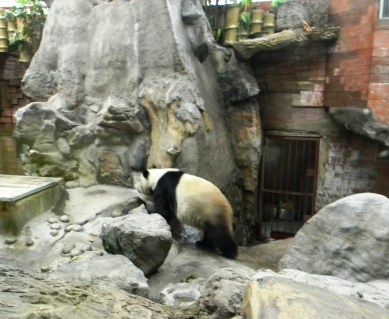
The zoo suffered from the same neglect and wear as the Forbidden City. Clearly it had been well planned and nicely located at one time. But it was not up to the traffic of a population of 20 million people in Beijing. The grass had long since been trampled bare; cages were rusty, enclosures dirty. The pandas were lovely to see, but encased in a glass enclosure (for their protection?), and packed with crowds seven or eight rows deep, it made viewing seem rather more a chore than a pleasure.
As we had arranged with Pam and Shelley to meet at the Bell and Drum Towers, and the crowed outside the closed subway station packed densely from the sidewalk to the first lane of traffic for the entire block, we caught a waiting taxi and paid the 50 Yuan he insisted on to get us out of there. The ladies were not there and through a text message (thank you Maxis!) we found out they had gone back to the hotel. After walking fruitlessly to find someplace affordable to eat in the trendy hutong district, Moochi and I caught a subway and bus back to the hotel in time to join the others for a bite to eat and plan out the next day’s activities.
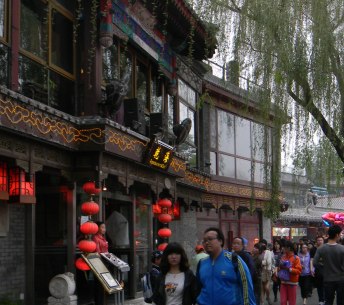 We decided that given the difficulty of getting around town by either cab or subway, we would hire a driver for the day. Pam and Shelley had been given a card by someone on the street who seemed nice. We called and she was happy to arrange a van for us for 400 Yuan to go out to the Summer Palace and “whatever else we wanted to do,” provided that it did not exceed 8 hours. I agreed to her terms, and set a pick up time for 8 o’clock.
May 6, 2012
Posted by Steve and Pam Wise under
Current News
[9] Comments

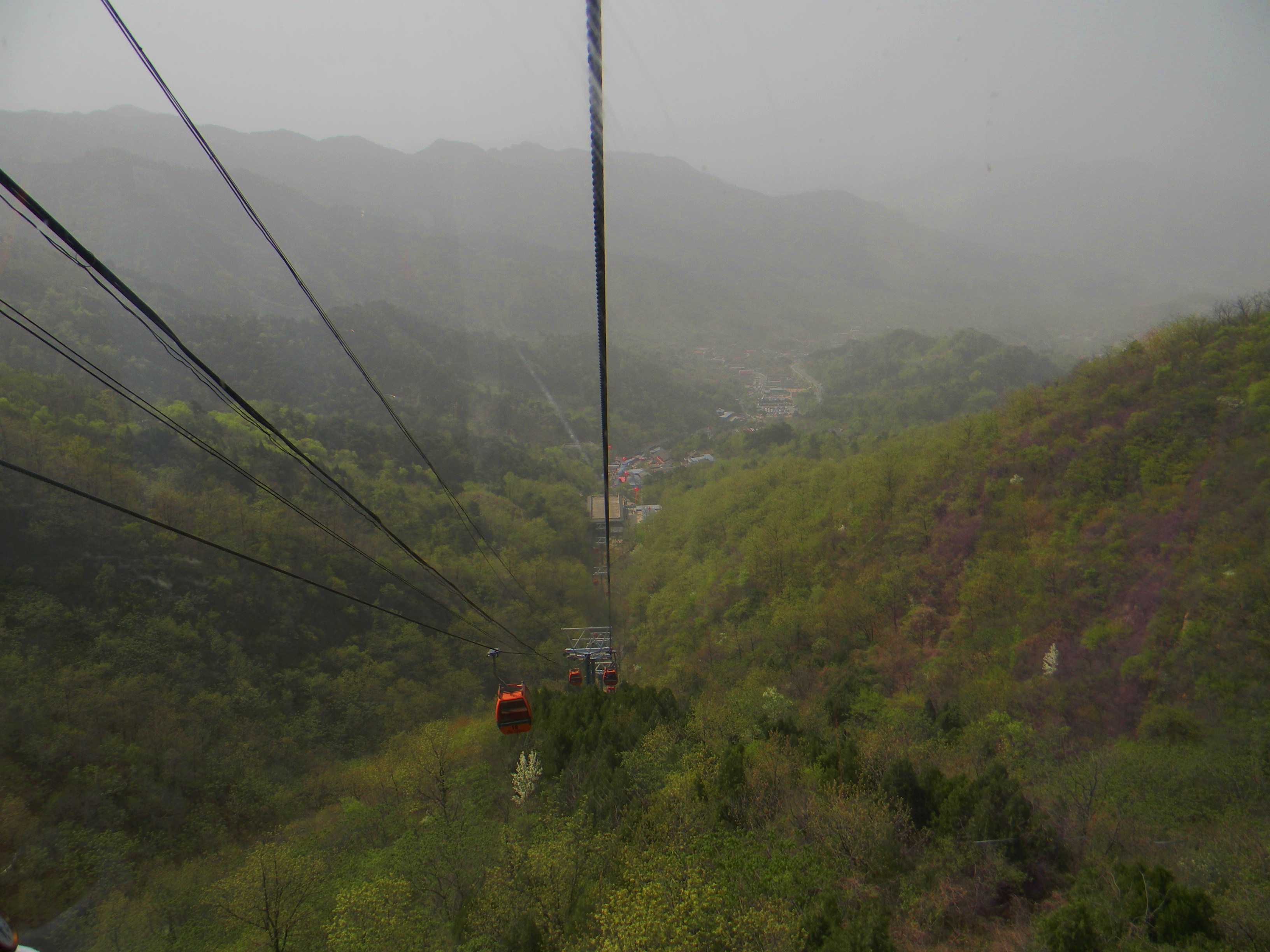
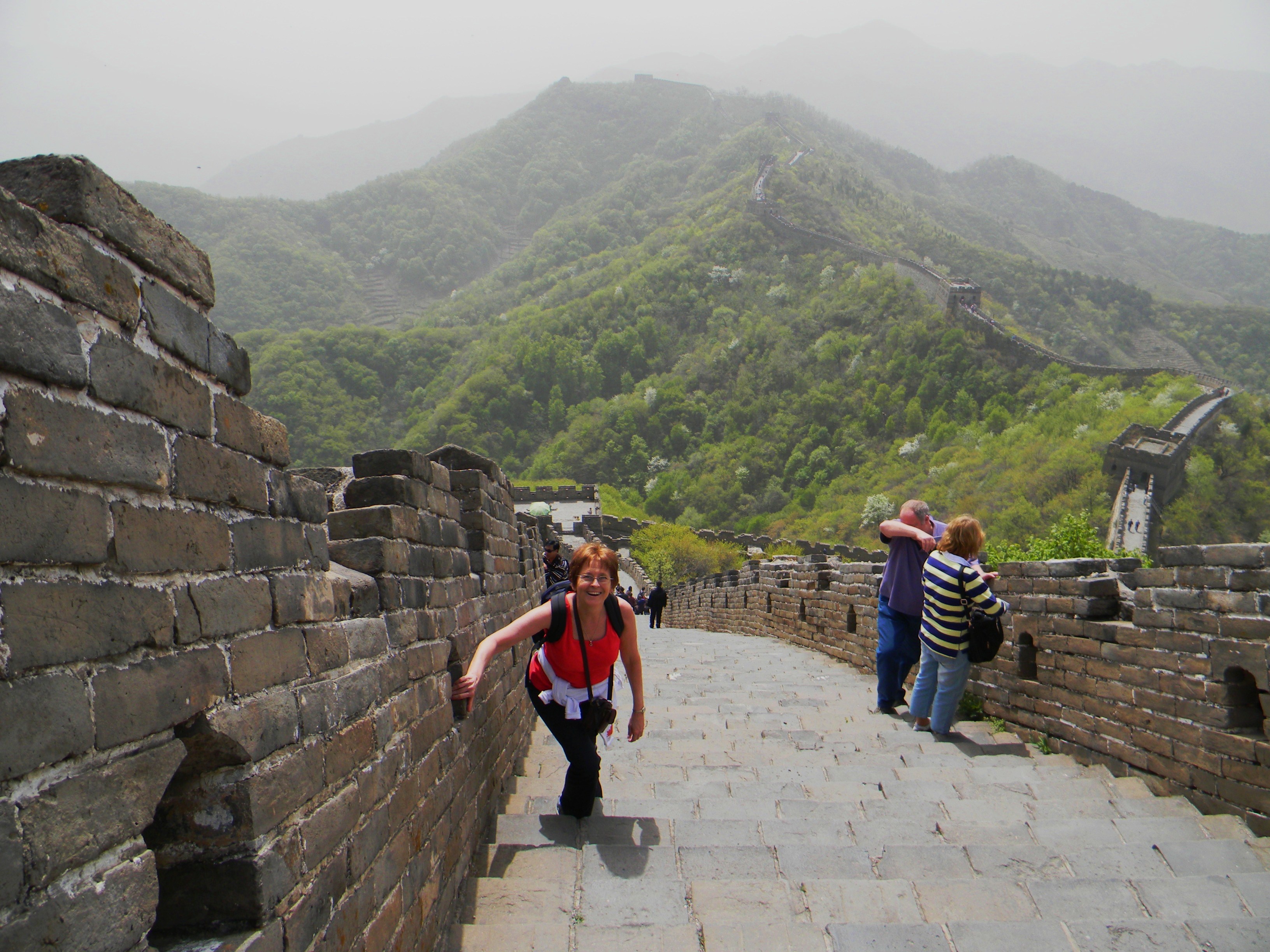
The Holiday Inn Express may be a modest hotel ($70 a night in a pricey city), but the beds are terrific and we had a great night’s sleep. Breakfast was a minimal affair; some watermelon chunks and a couple of hardboiled eggs. But the driver was right on time and we were away in a very nice vehicle driven by an excellent driver who knew the backroads and could avoid a lot of the traffic headache. He also knew the outside dimensions of his vehicle as if it were a second skin and we made the trip to Mutianyu in under two hours. We figured were going to do plenty of walking that day so we took the gondola ride to the top of the wall to begin our hike.

The wall is built along the top of a ridge; several hundred ridges in fact, as the wall winds its way across 7,000 kilometers of China’s northern and western borders. Originally built around 200 B.C. of stamped mud, it was expanded during the Han Dynasty and again under the Jin in the 12th century A.D. However it was unequal to the task of keeping Genghis Khan and his Mongol troops from conquering China begining in 1206 and continuing until the death of his grandson Kublai Khan in 1294. After the restoration of imperial China in the Ming Dynasty, 1367 to 1644, the wall underwent an extensive repair and rebuild, this time with more substantial building materials of rock, brick and mortar. It is this wall, some sections of which are nearly 650 years old, that has survived to the present age. Although nowhere near as artistic or inspiring as St Paul’s in Rome, which was finished at around the same time, it is impressive not only for its massive size but also for the beauty of its natural surroundings.
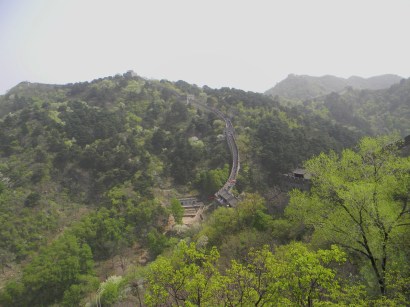
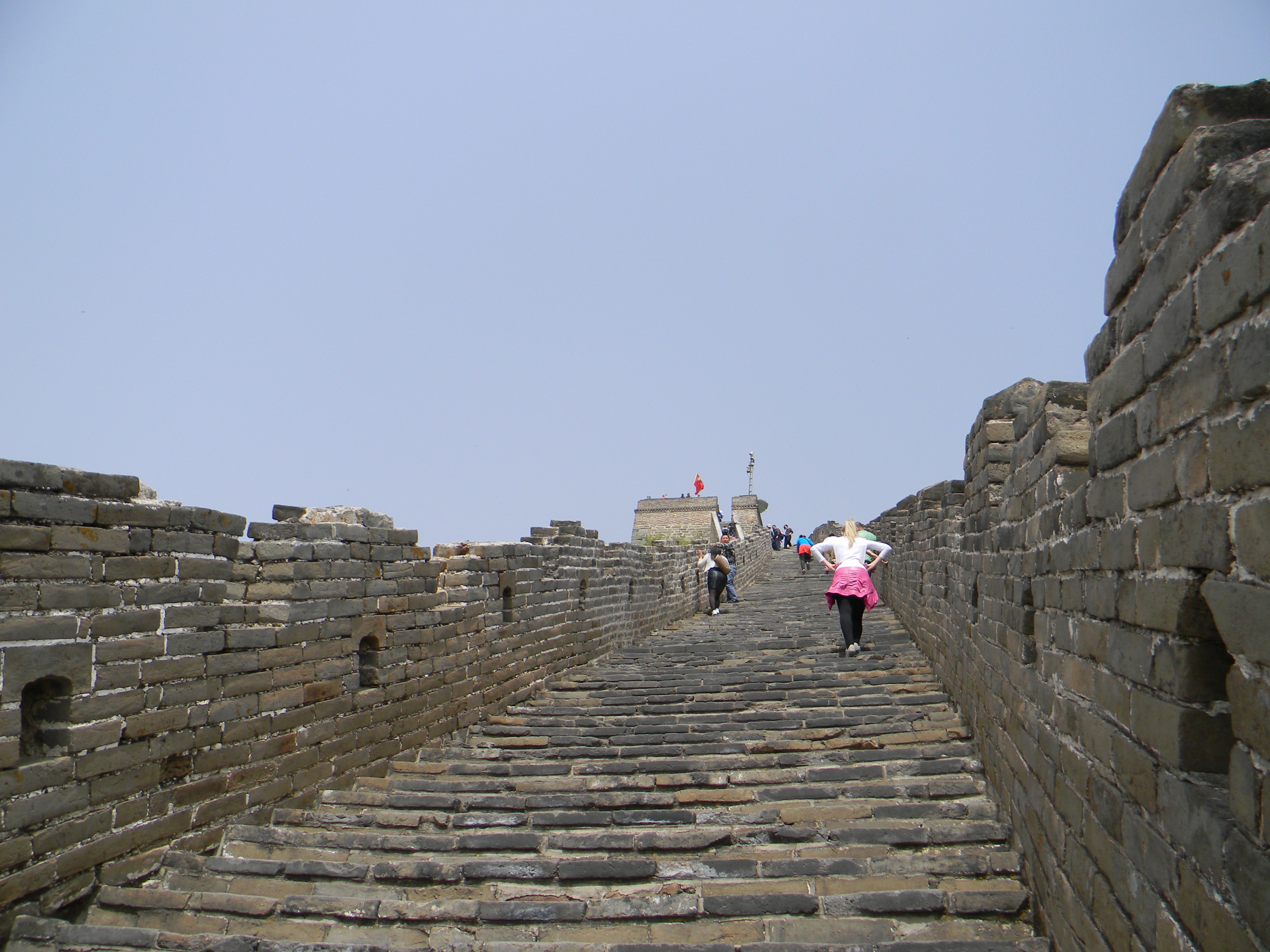
The gondola let us out at tower 14, and faced with the decision of either going uphill to the left/west, or downhill to the right/east, we chose uphill, figuring that once tired it would be better to go downhill. The rebuilt sections are wide enough for six to walk abreast, and the crowds were minimal at this hour, so we strolled easily, without jostling, admiring the view from each watchtower and the audacity and perseverance it must have taken to build such an enormous fortification. In addition to the watchtower, there were cannon placements and gun/arrow slots all along the wall.
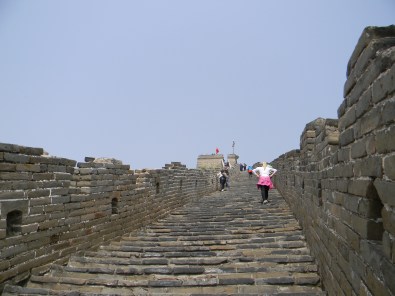
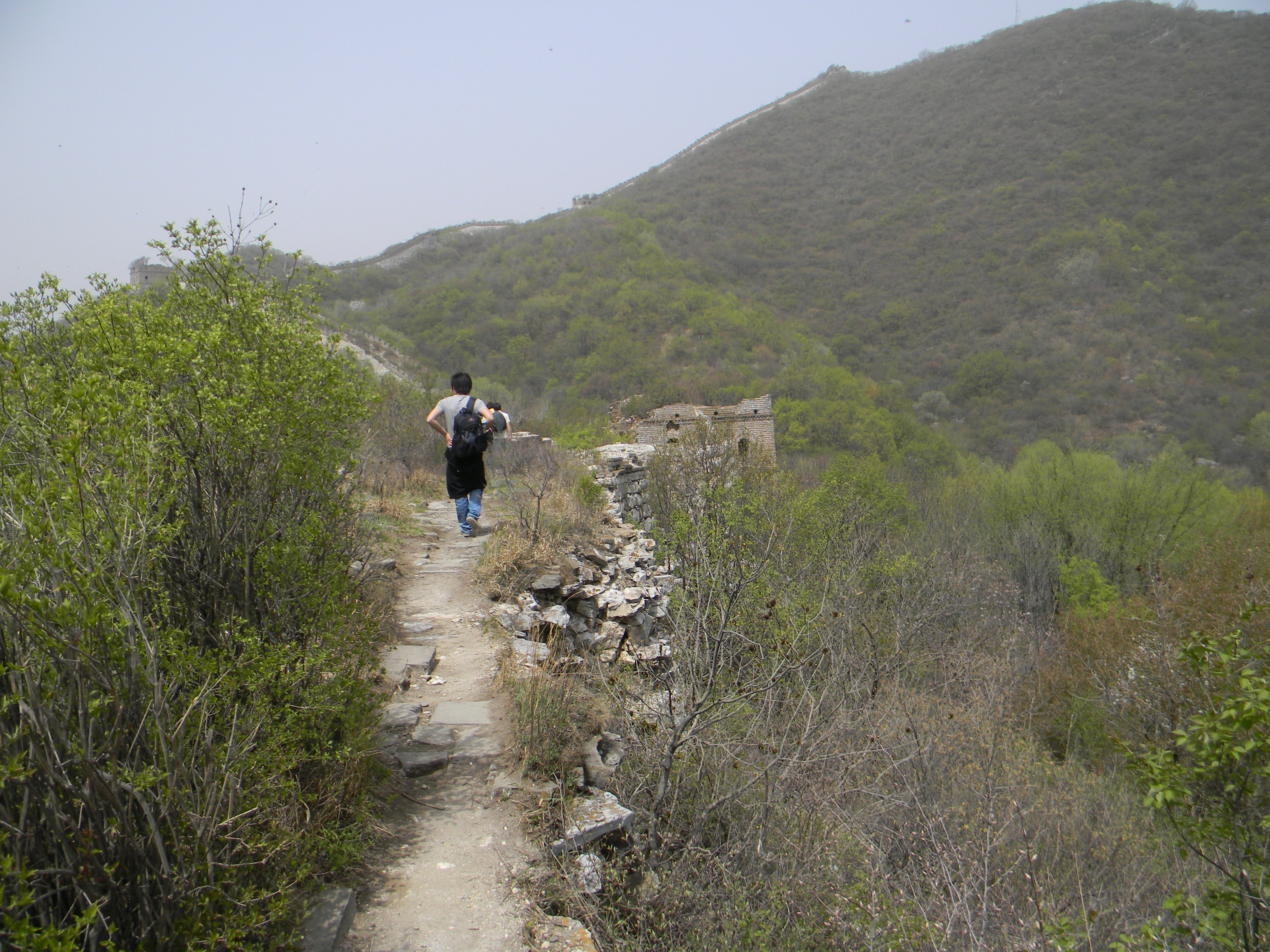
Pam and Moochi had run out of steam by tower 18, the last row of very steep steps proving too much. Shelley went on to tower 19 and took some videotape of me doing Tai Chi on the wall before she went back. I struggled on past tower 20, onto a stretch of unrestored wall. This is where it gets a little tricky, with no restraining wall and the ground dropping steeply away beneath a crumbling trail. I contented myself with one more kilometer before I too allowed discretion to overrule my enthusiasm for exploration. With a week of walking through Beijing and Shanghai before me, I did not want to risk twisting an ankle for the sake of amateurish bravado and bragging rights.

Back at tower 14 we considered our options. We could return the way we came, or we could go on by exploring the wall to the east. Moochi was pooched, and went back down the hill, but Shelley, Pam and I went on downhill, which given the wear on our quads and calf muscles, was a lot harder than it sounds. We soldiered on, treasuring the rare flat sections of the wall and enduring both up and down sections as they afforded the better views. It really is a spectacular setting and we enjoyed every vista to the max, pinching ourselves as we went that this was in fact us who were walking along the Great Wall of China!
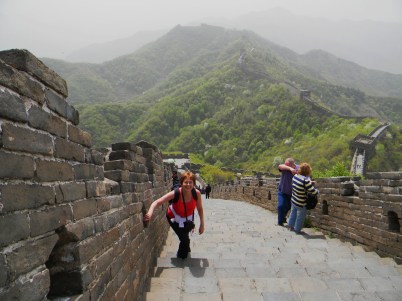
At Tower 4 we caught the slide to the bottom. That’s right, a tacky metal slide like you would find at Wonderland, with a tacky plastic toboggan that had a joystick handbrake and nothing else. It was wild and it was fun and I don’t care if it was comically out of place; we all enjoyed it! Our driver was waiting for us at the bottom, eager to be on the way to beat the Beijing traffic. But we were in no hurry to leave and bought a few souvenirs for the grandkids before we bundled back into the car for the trip back to Beijing.

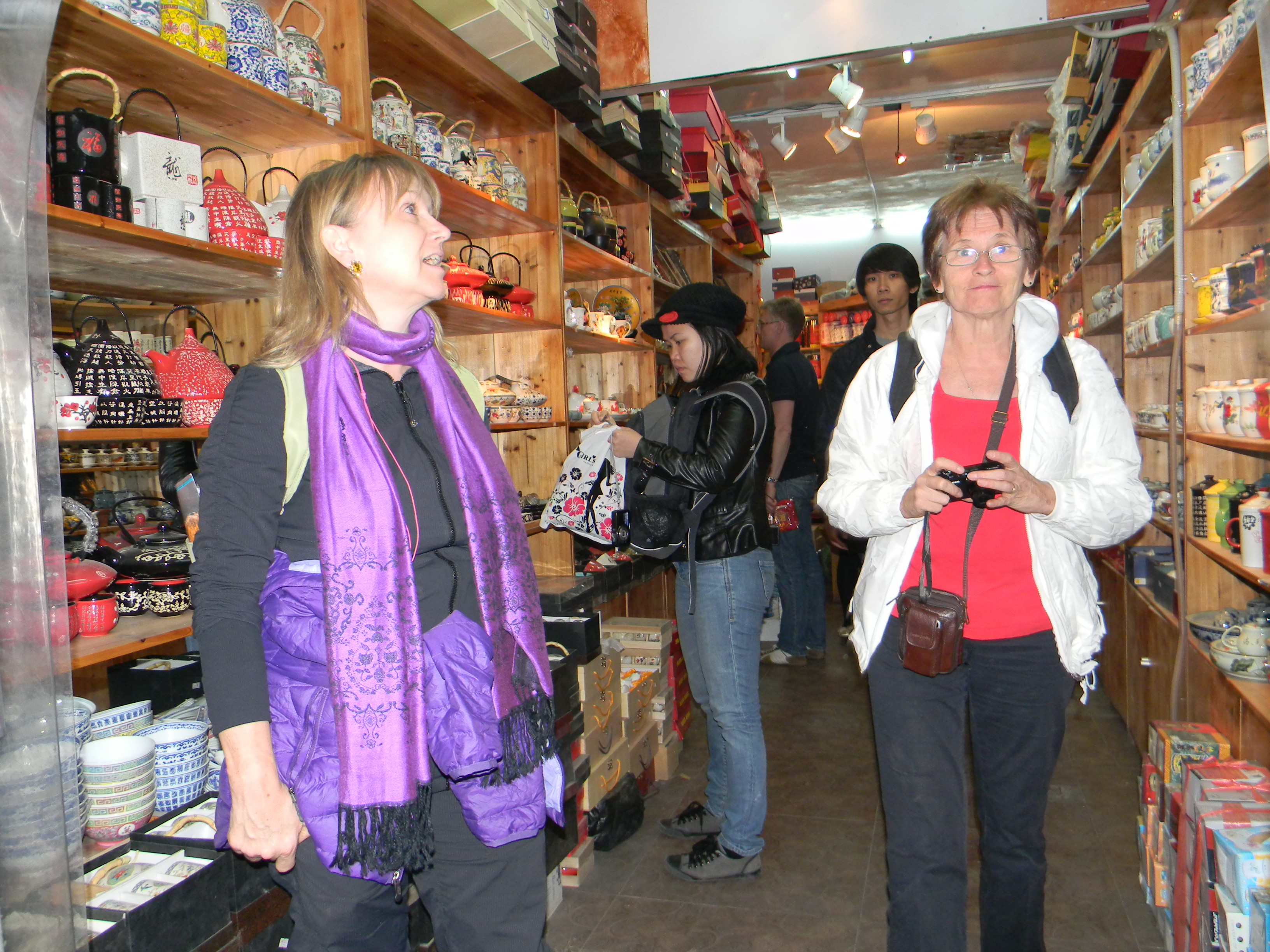
Rather than go back to the hotel, we had our driver drop us at the Bell and Drum Towers just north of the Forbidden City where we got a bite to eat on a rooftop restaurant overlooking the square. Suitably refreshed, we explored the little shops around the square where Pam and I found a wall hanging for that bare space above the television at a Chinese art shop. Then we headed into the hutongs, the little alleyways that line this side of town, bordering one of the many ponds and little lakes that dot the city. The ladies bought some scarves and we wandered until we could walk no more and then grabbed a taxi for the ride back to our hotel. It had been an amazing day!

May 5, 2012
Posted by Steve and Pam Wise under
Current News
[2] Comments

We got up at 4 am for the morning cab ride to the airport. It helps if you go to bed early. It also helps if you sit in the front with the cabbie, who at this hour is always a little sleepy. Can’t say that I blame them; these guys work awfully hard to scratch a dollar in this economy. All the same, they do love to drive fast in this country, and 140 clicks down the highway in the backseat of a cab driven by a guy who is nodding off can be a little unsettling.
Check in was a breeze, as it always is with Air Asia, and we were settled in the airport’s Coffee Bean with our lattes long before Shelley and Moochi, our companions for this trip arrived. The flight to Tianjin was uneventful. We had this Chinese lummox crammed in beside us who clearly needed a much larger seat than is available in economy class. But he got himself moved to somewhere else and Pam had room to stretch out and sleep for a good part of the journey.
Tianjin airport was clean and efficient and we easily found the ticket booth for the train to Beijing. The bus at 40 yuan was cheaper, but the train at 60 yuan ($10) is a better option. There was a connecting bus, which was not pleasant, but not terrible. The train however, was marvelous. We hummed along at nearly 300 kilometers an hour and the ride was a smooth as your grandma’s rocking chair. Outside the rice paddies and vegetable plots eased peaceably by. There seems to be some kind of reforestation program going on, as there were acres of newly planted poplars everywhere along the train tracks.
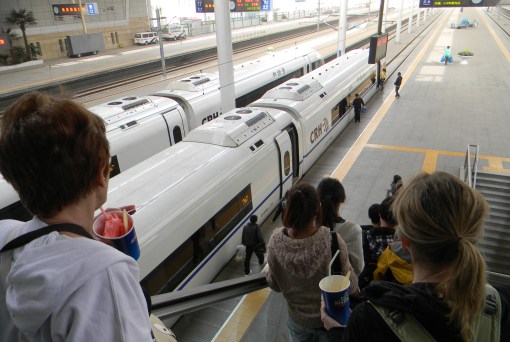
Reforestation sound like a good plan for China as there was not much on the way of natural forest left that we could see. The result is air that looks a lot like grey soup. You will see it in all the pictures that we took, although the photographic lens does lie to excess in that the diffused smog distorts the camera’s light sensors. The reality is better, but not by much. The smog is not localized, like it is over Toronto or New York, but seems to be pretty much regional. It was if anything thicker on the ride to Shanghai. But I am getting ahead of myself.
The train station in Beijing was impressive; very modern and efficient, much more like an airport than anything else. The line up for a cab was at least a hundred people long, but it was moving pretty quickly and we opted not to take up the offer a ride in a private car for 200 yuan ($35) as we had deliberately chosen our hotel for its proximity to this particular terminal. The meter on our cab was 20 yuan. I paid the cabbie 30 and we unloaded at the Holiday Inn Express Temple of Heaven. I assure you there was nothing heavenly about our surroundings but only a rather dreary commercial landscape with grey streets and grey buildings joining the grey air in a dismal harmony. I scouted the area for a suitable restaurant while the ladies unpacked, then we went out to a local eatery for a sampling of Beijing fare, which was tasty, but heavily salted and loaded with MSG.
After dinner we tried the hotel’s internet only to find that this was going to be severely limited during our time here. We could view our website, but as soon as we tried to enter the site to upload a post, it went offline. Facebook was similarly blocked. Google was fine and we did gain access to our email long enough to email a message to our kids, but that was about as far as we could get. Blocked from access to the outside, we turned our attention to the task at hand: plotting out our trip to the Great Wall.
We had obtained a couple of leads from colleagues back in KL, so I gave them a call. With the May 1 holiday around the corner, people were reluctant to brave the traffic for the drive to the Great Wall, our destination for Day 2. But we did find one guy who was willing to drive and who knew the way to Mutianyu, our preferred section of the wall. The catch was that he didn’t know English, but here is where Moochi came to our rescue. She is fluent in Mandarin and Cantonese and handled all of our translations for the week. We booked the driver for 7:30 and called it quits for the evening. We were going to need our strength for the following day.
« Previous Page


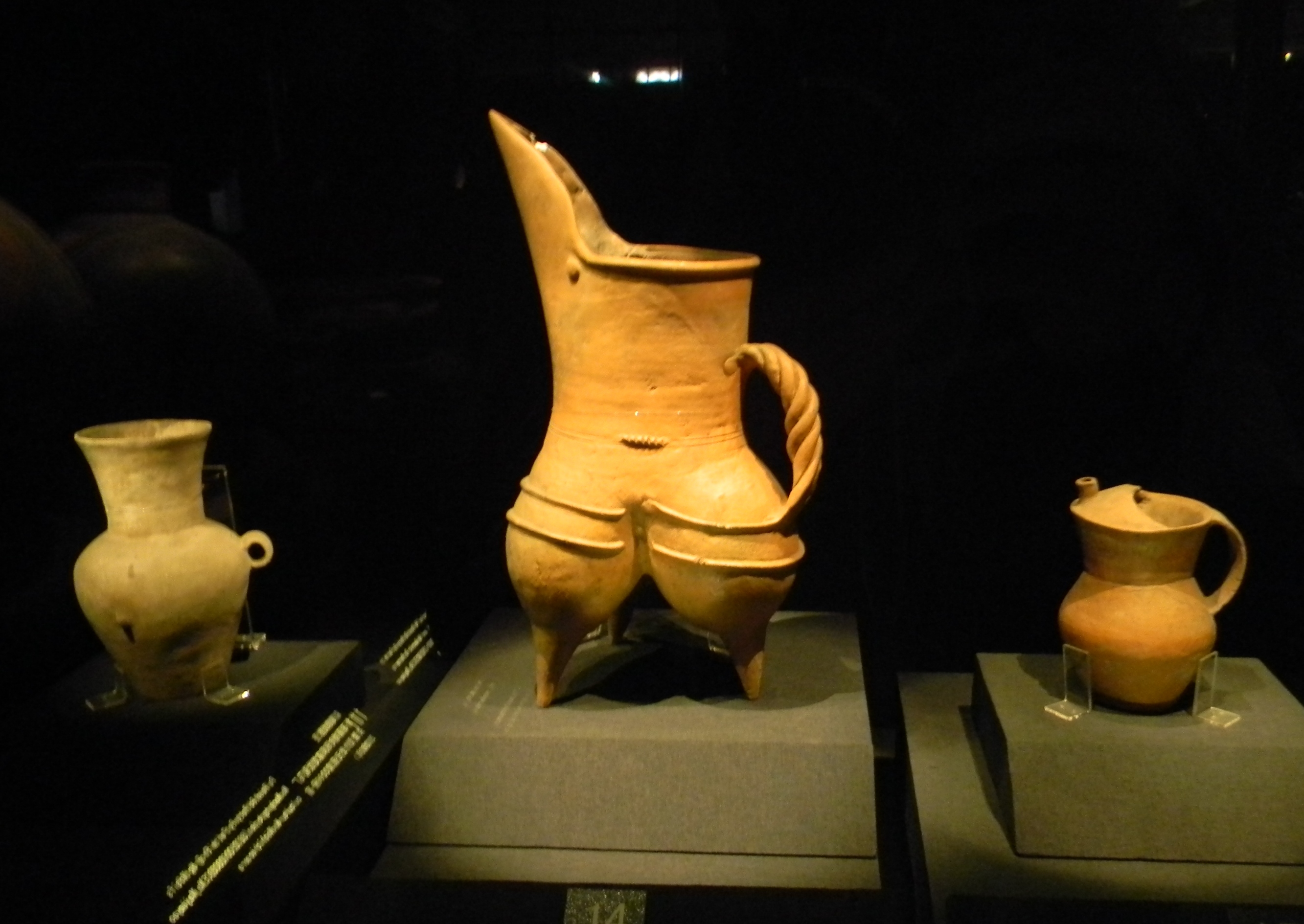 The one housing pottery was especially interesting, displaying vases of exquisite design, some of which were an astonishing 7,000 years old. As we were in Beijing during the May 1 holiday break, the site was packed with people, and to be honest, the Forbidden City was not particularly noteworthy. It was impossible to see into the larger buildings, and what we did see was threadbare and careworn, as were the grounds and the buildings themselves. The garden at the north end of the property was nice, but small, and far too crowded to be restful in any sense of the word.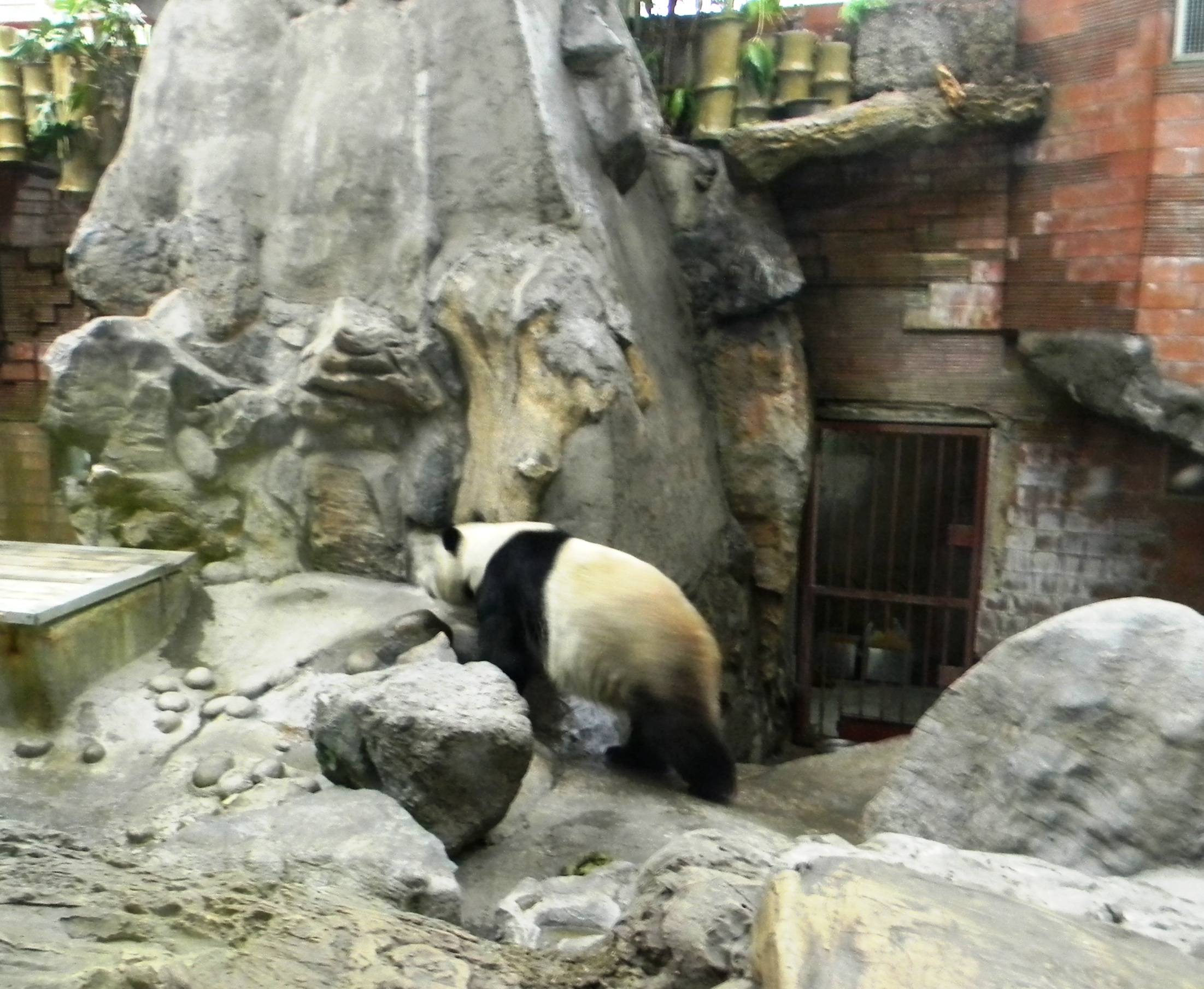
 We decided that given the difficulty of getting around town by either cab or subway, we would hire a driver for the day. Pam and Shelley had been given a card by someone on the street who seemed nice. We called and she was happy to arrange a van for us for 400 Yuan to go out to the Summer Palace and “whatever else we wanted to do,” provided that it did not exceed 8 hours. I agreed to her terms, and set a pick up time for 8 o’clock.




 Home Thoughts From Abroad